

Table of Contents
- Film Details
- Music Credits
- Essential Discography
- In Williams’ Words
- Videos
- Bibliography and References
Film Details
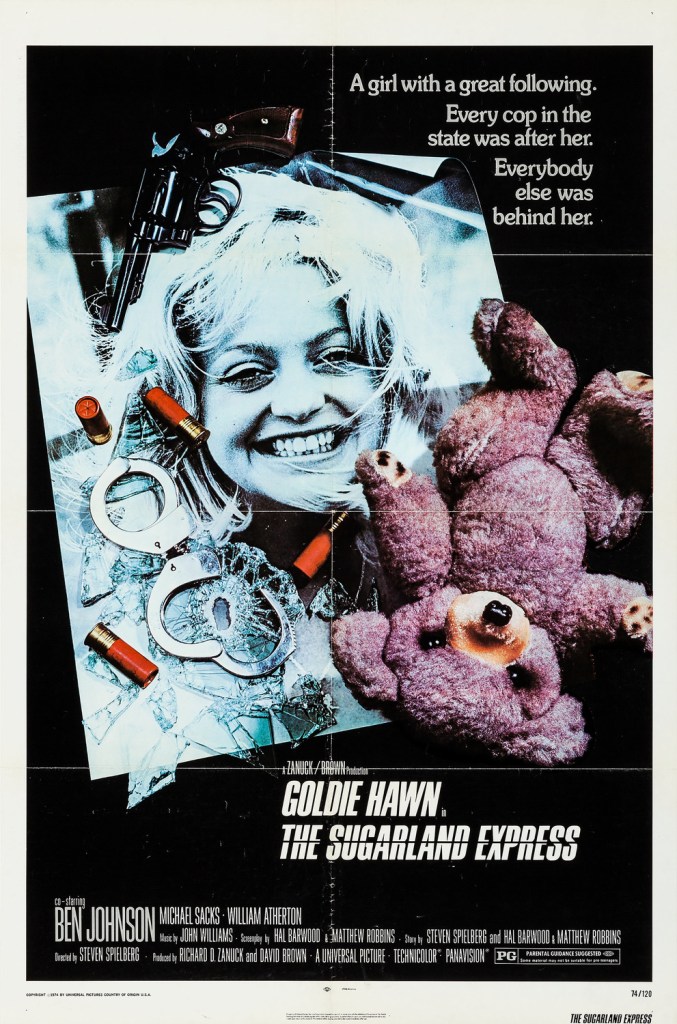
Year: 1974
Studio: Universal Pictures
Director: Steven Spielberg
Producers: Richard D. Zanuck, David Brown
Writers: Steven Spielberg and Hal Barwood & Matthew Robbins
Main Cast: Goldie Hawn, Ben Johnson, Michael Sacks, William Atherton
Genre: Crime – Drama
For synopsis and the full cast and crew credits, visit the IMDb page
Music Credits
Music Composed and Conducted by John Williams
Harmonica Solos by Jean ‘Toots’ Thielemans
Orchestra Contractor: Sandy DeCrescent
Orchestrator: John Williams
Music Librarian: Irwin Coster
Recording Studio: Universal Studios, Stage 10 Scoring, Universal City, California
Recording Dates: July 10, 24 and 25, 1973
Essential Discography
Orginal Soundtrack Album
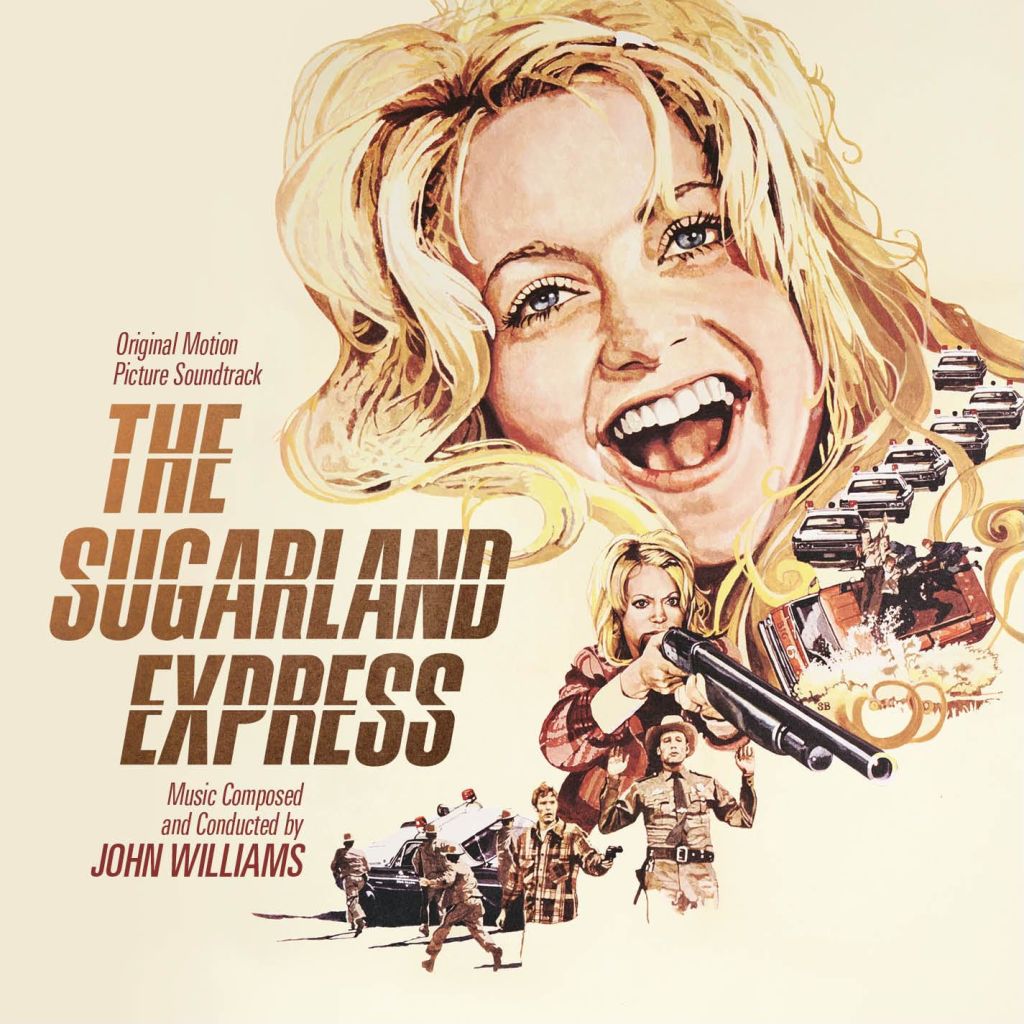
Original Motion Picture Soundtrack – 50th Anniversary Limited Edition (2024)
La-La Land Records LLCD 1650
Album Produced by John Williams
Edited, Mixed and Mastered by Mike Matessino
World premiere release of the original soundtrack
Selected Re-recordings

“The Sugarland Express: Theme”
Boston Pops Orchestra conducted by John Williams
Toots Thielemans, harmonica
The Spielberg/Williams Collaboration (1991)
Sony Classical SK 45997
Produced by Thomas Shepard; Engineered by Bud Graham
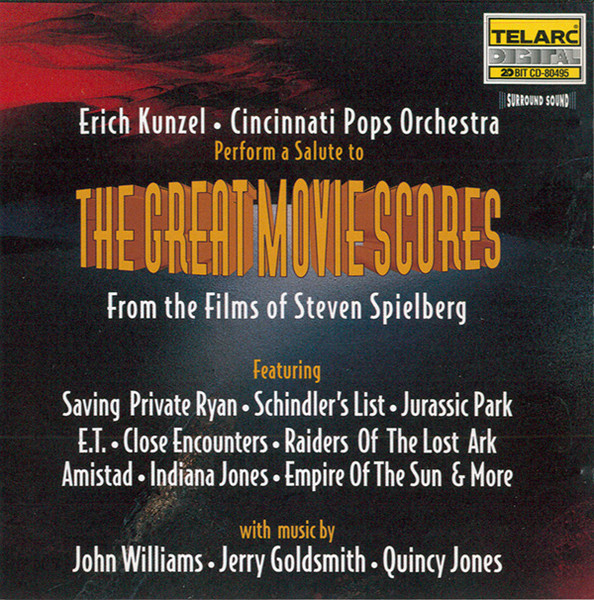
“The Sugarland Express: Main Theme” (arranged by Joseph D. Price)
Cincinnati Pops Orchestra conducted by Erich Kunzel
Guitar: Timothy Berens
Harmonica: Michael Turk Richards
Erich Kunzel and Cincinnati Pops Perform a Salute to the Great Movie Scores from the Films of Steven Spielberg (1999)
Telarc CD-80495
In Williams’ Words
“The first feature film that Steven Spielberg directed […] was called The Sugarland Express and it starred Goldie Hawn. It was not successful, but it showed such directorial gift, the kinetic energy that it had. The action sequences were beautifully photographed and wonderfully edited, and I think it was clear to everyone at Universal Studios that this just 23 year old boy could, in fact, do as he said, he could be a great director. And he became one, as we all know. The Sugarland Express had bluesy, jazzy music. The piece was set in a poor area of southwest Texas, and featured on the soundtrack was the great jazz harmonica soloist Toots Thielemans, for whom I wrote the solo.” 1
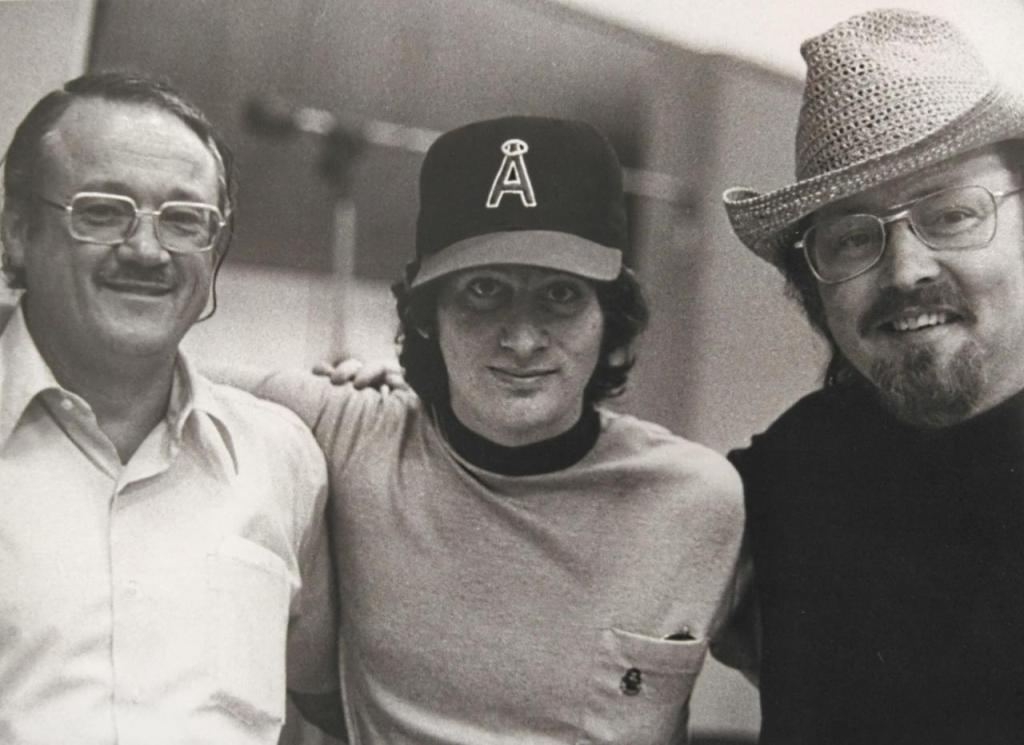
“I spoke to him for a few minutes and immediately realized, first of all, this kid was extremely bright, and he seemed to know more about film music than I did… and was almost a scholar in his level of information about it… I looked at Sugarland Express and it was so magnificently edited, particularly the action sequences, like nothing I’d seen at that level for a long time, that I quickly agreed to join Mr. – I mean Master — Spielberg.” 2

Quotes and Commentary
“I had seen two recent movies where the music especially impressed me, The Reivers and The Cowboys, and both of those scores were by John Williams. I wrote a screenplay listening to my LP of the soundtrack of The Reivers – in a way it was based on the music, which I heard so often I wore the record out and had to buy another one. The script never got made. Back then nobody was interested in my big inspirations. I thought, ‘If I ever get a shot at directing a movie, I really want to see if this guy will write the score.’ And when I was assigned to Sugarland Express, the first thing I did was get in touch with John.” 3
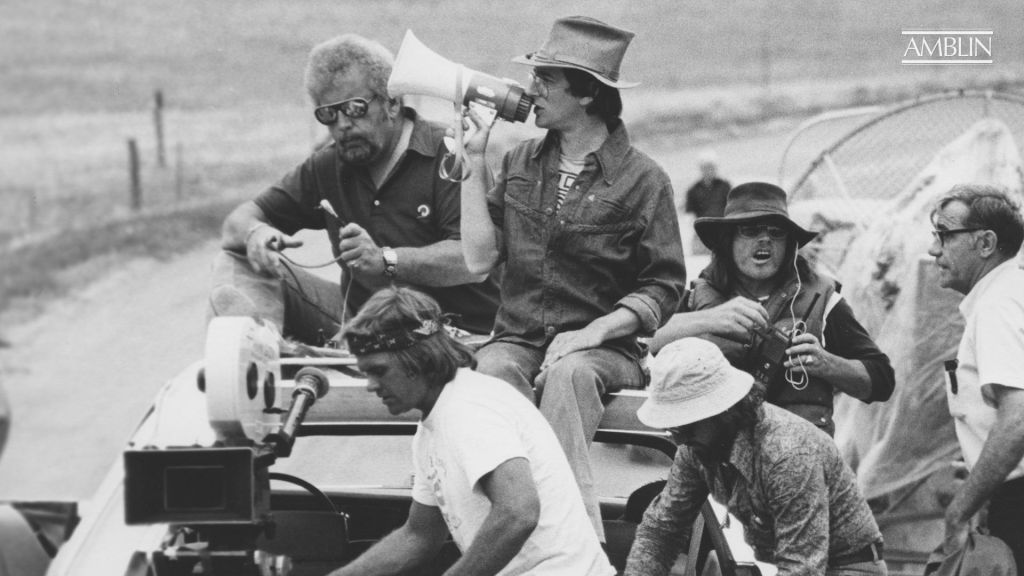
“I called him up and told him I finished The Sugarland Express and wanted him to take a look. I expected John to compose a real symphony. John said, ‘You’re going to hurt the movie if you want me to do [Aaron Copland’s] The Red Pony or Appalachian Spring. It’s a very simple story. The music should be soft. Just a few violins. A small orchestra. Maybe… a harmonica.’ I’d really wanted eighty instruments. And Stravinsky conducting! Johnny talked me out of that concept and got me to believe the score should be gentle. Almost cradle-like. And so we began a very prosperous relationship, I think, for both of us. We’re major collaborators on all my films.” 4
– Steven Spielberg

Quotes and Commentary
The very first session of music by John Williams for a Steven Spielberg movie was, on the surface, a notably low-key one. Just nine players showed up for a 2:00 p.m. start on Universal Stage 10 that day: one pianist, four percussionists and four guitarists. On piano was Michael Lang, son of studio executive Jennings Lang, who would go on to play for hundreds of film scores, including 32 for Williams. Three of the guitarists had worked together for the better part of a decade: acoustic players Tommy “Arbuckle” Tedesco and Alton (Al) Hendrickson, along with Carol Kaye, the most sought-after performer of Fender Bass in the business. All were part of an unofficial collective of Los Angeles session musicians eventually dubbed “The Wrecking Crew,” a group who played, mostly uncredited, on more hit records and TV theme tunes than anyone could count from the mid-’60s through the ’80s, as well as several film scores. At the first Sugarland session they were joined by premier pedal steel guitarist Buddy Emmons, known
as “Big ‘E’,” and to that strumming quartet were added Wrecking Crew
percussionists Emil Richards and Joe Porcaro, along with Jerry Williams, brother of the composer. Joining them was veteran session drummer Kenny Watson.
The cues recorded on that first day all called for a traditional orchestral string section, but the jazz-trained Williams wanted to work with the nine players separately so that they could together discover and hone a foundational sound for the score. Strings and harmonica would be added
later. The composer encouraged the guitarists (and eventually Thielemans as well) to explore their lines with improvisation, and then later settled on which performances felt best. Recorded on that first afternoon were the percussive cues representing Tanner and the police authorities, “The Caravan Forms” and “To The Roadblock,” along with jam-session style “wild” (not to picture) variations “Police Cars Move” and “Pursuit.” The day closed with the group coming together for a genuine Wrecking Crew showcase, “The First Chase.”
The second session took place a full week later, thus allowing Williams to listen to what the ensemble had achieved and tweak the other instrumental lines accordingly. On the morning of July 24, the full complement of 34 players, now including Thielemans, acclaimed jazz percussionist Larry Bunker, and two more top Wrecking Crew guitarists: Red Rhodes and Dennis Budimir gathered for the day. The string section, numbering 23 (half of whom had played with the Wrecking Crew guitarists and percussionists on pop recordings) performed their parts for the previously recorded cues, and everything else in the score was accomplished in that same session.5
– Mike Matessino

Videos
Steven Spielberg Talks The Sugarland Express at NYC Tribeca Festival (June 15, 2024)
Steven Spielberg and John Williams discuss their collaboration, from The Late Show with Stephen Colbert (January 2023)
Bibliography and References
. Crawley, Tony – The Steven Spielberg Story, Zomba Books, 1983
. Dyer, Richard – “Spielberg and Williams on Saving Private Ryan – At work again, he and John Williams exult in their admiring duet of 24 years,” The Boston Globe, February 24 1998
. Hammond, Pete – “Steven Spielberg & John Williams Talk 50 Years Of Music And Movies From ‘Sugarland Express’ To ‘Fabelmans’ – Exclusive Video,” Deadline.com, February 16 2023
. Matessino, Mike – “Road to Carte Blanche,” The Sugarland Express – Original Motion Picture Soundtrack liner notes, La-La Land Records, 2024
. Merluzeau, Yann – “An Interview with John Williams,” Soundtrack!, September 1993
. Thomas, David – “Point Blank: John Williams,” Total Film, September 1997
Legacy of John Williams Additional References
. Soundtrack Spotlight: The Sugarland Express – 50th Anniversary Soundtrack Release – Interview with Mike Matessino
Footnotes
- Speech excerpt from live concert with the London Symphony Orchestra, 1996 ↩︎
- Quoted in Steven Spielberg & John Williams Talk 50 Years Of Music And Movies From ‘Sugarland Express’ To ‘Fabelmans’, Deadline.com, 2023 ↩︎
- Quoted in Dyer, “Spielberg and Williams on Saving Private Ryan – At work again, he and John Williams exult in their admiring duet of 24 years,” The Boston Globe, 1998 ↩︎
- Quoted in Crawley, The Steven Spielberg Story, 1983 ↩︎
- Matessino, excerpt from The Sugarland Express – Original Motion Picture Soundtrack liner notes, 2024 ↩︎
 The Legacy of John Williams