
Table of Contents
- Work Details
- Program Notes by John Williams
- Recordings
- In Williams’ Words
- Quotes & Commentary
- Bibliography and References

Work Details
Year(s) of Composition: 2022-2023
Duration: 22′ ca.
Structure: Three movements – I. Introduction — Colloquy – II. Listening – III. Finale.presto (Oscar Peterson)
Instrumentation: 3 flutes (3rd doubling alto flute), 2 oboes, cor anglais, 3 Bflat clarinets (3rd doubling bass clarinet), 3 bassoons (3rd doubling on contrabassoon), 4 horns, 3 trumpets, 3 trombones, tuba, timpani, percussion (2 vibraphone, 2 glockenspiel, xylophone, marimba, suspended cymbals, tam-tam, triangle, tuned drums, snare drum, bass drum), harp, piano, celesta, strings
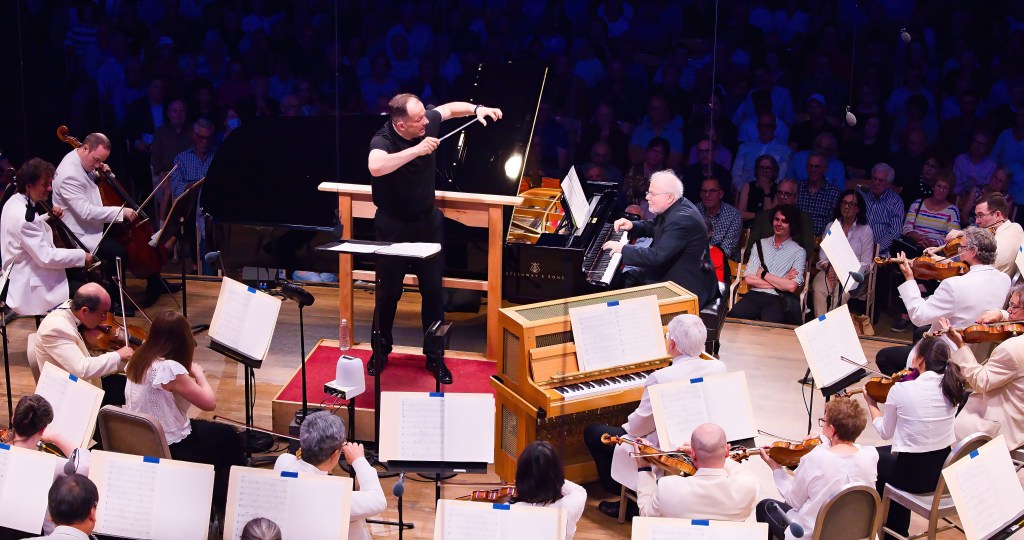
First Performance: July 26, 2025, at the Koussevitzky Music Shed, Tanglewood, Lenox, Massachusetts, USA
Soloist/Orchestra: Emanuel Ax, piano; Boston Symphony Orchestra conducted by Andris Nelsons
Program Notes by John Williams
Composing a piano concerto was, for me, particularly challenging given the enormous canon of rich and diverse piano and orchestral masterworks created over the past centuries. Although my effort here is not a jazz piece per se, much of the impetus to write it down has been my memory of the particular “sound” produced by three legendary jazz pianists. Past this simple concept, the music is in no way an attempt to serve as a portrait of each of these artists, but merely to suggest and remember the unique artistic personalities of three men who greatly inspired me along with so many other lovers of the piano around the world.
Firstly, Art Tatum. When I was fifteen or sixteen years old, I remember a scene in a Los Angeles jazz club which welcomed underaged patrons providing they didn’t drink. I saw a large man who was clearly not sighted being carefully guided to his place at the piano. The lights were turned down so as not to offend his eyes. He seemed to be huge. His piano also seemed enormous…not with the usual 88 keys, but seemingly with twelve additional keys at either end of the keyboard, accommodating his massive reach. The size of his sound was awesome and reminded one of Rachmaninoff. He played three chords, listened, and played them again with an added note or two. He seemed satisfied and then began with a brief cadenza which served as his warm-up. The avalanche of gems that followed could hardly be imagined.
Secondly, Bill Evans. The second movement begins with a viola solo. Why? This may be because Bill was a quiet and very ethereal man who, when he approached the piano, always seemed to be less interested in playing than listening to what the piano may have to tell us. His piano eventually joins the viola, supporting Bill’s ethereal mood while further investigations ensue.
Thirdly, tall, handsome Oscar Peterson emerges, looking like an NFL wide receiver on his day off. After a brief salutation from the timpani, he begins with a bristling and famous “bebop” passage composed by whom we do not know but often attributed to Oscar and to the late Phineas Newborn, who also possessed a similar technical prowess. It serves as a reminder of Oscar’s athletic affinity, which he always displayed with taste and the most graceful control.
I’ve always so greatly admired pianist Emanuel Ax, who is universally celebrated for his technical brilliance, refined elegance and great artistic sensibilities. He is also one of the most gracious gentlemen I’ve had the privilege to know. When I first met Manny years ago, I asked him if in his travels he ever encountered a bad piano. He replied simply, “all pianos are my friends.” I had only mentioned to a few friends and associates that I might be interested in writing a work for piano and orchestra. You can imagine my surprise and delight when Manny called me to say, “if you write it, I will play it!” I could not have been more grateful and honored. 1
John Williams, June 2025
Recordings
No recordings available at this time. Deutsche Grammophon plans to release a recording sometime in 2026.
In Williams’ Words
“So much history of piano music… So much in the history of music, piano, keyboard, digital, fingers — that anyone would be daunted, I think.
“Someone very aptly made the observation that Bach is the foundation of all piano music, and Liszt is the crowning mountain of piano repertoire and the technical idea of how to write for it, and together they make Beethoven possible.
“It’s the hardest thing I’ve ever done… I hope it makes its case.” 2

Quotes & Commentary
First of all, I was aware that his concert music was very different from his movie music. And we met a couple of times before he actually finished the piece. And he said that, you know, these are the people [pianists-ED] that affected me when I was young. But it doesn’t sound like any of them. It’s just, I think he was inspired by certain aspects of their playing, their invention, and so forth. And I think that’s really what it is. So I think it sounds like a John piece, and I’ve been practicing it for a long time, so when you practice something for a long time you start to love it, and I love it. And I’m very, very happy to say that most of the people that have heard the rehearsals and my friends in the orchestra also seem to like it enormously. So that makes me very happy.
I can’t say I was surprised by anything in particular, but the whole thing was a discovery, you know, and it was wonderful. And it was wonderful to be able to spend time with this incredible man. He’s, aside from his genius, one could say, he’s also the warmest, kindest, most generous person one can imagine, and it’s a privilege to spend time with someone like that. 3
– Emanuel Ax, pianist
As Boston Symphony Orchestra, Boston Pops, and Tanglewood audiences know well, throughout his career John Williams has composed concert music alongside his Hollywood activity. His early works in the concert sphere include a symphony in 1966 for André Previn (another musical polymath) and the Houston Symphony, and concertos for flute and for violin. He began writing concert music with much greater frequency after he was named Conductor of the Boston Pops in 1980 and came to know and work with principal players of that orchestra. He has written concertos for several members of the BSO/Pops, including former BSO tubist Chester Schmitz, oboist Keisuke Wakao, violist Cathy Basrak, and former principal harp Ann Hobson Pilot, as well as for members of other notable orchestras, such as Chicago Symphony former principal horn Dale Clevenger, New York Philharmonic principal bassoonist Judith LeClair, and Cleveland Orchestra principal trumpet Michael Sachs. He has also written works for soloist and orchestra for some of the most admired virtuosos in the world, including Yo-Yo Ma, Gil Shaham, and Anne-Sophie Mutter.
Like his new Concerto for Piano, many of Williams’s concert works have deep Tanglewood connections. Yo-Yo Ma premiered his Concerto for Cello with the BSO and Seiji Ozawa for the inaugural concert of Tanglewood’s Seiji Ozawa Hall in 1994 and his Highwood’s Ghost with Andris Nelsons, BSO Principal Harp Jessica Zhou, and the Tanglewood Music Center Orchestra in 2018. Anne-Sophie Mutter premiered his Markings with the BSO and Andris Nelsons in 2017 and his Violin Concerto No. 2 under the composer’s direction in 2021. There have been other premieres here, as well, among them his song cycle Seven for Luck, on poems by Rita Dove; Just Down West Street—on the left, written for the Tanglewood Music Center’s 75th anniversary, and his solo piano work Phineas and Mumbett, premiered by Gloria Cheng during the 2012 Festival of Contemporary Music. Emanuel Ax, who made his Boston Symphony Orchestra debut at Tanglewood in August 1978, is a true Tanglewood denizen, having performed in more than 100 concerts here as orchestral soloist, chamber musician, or recitalist.
That John Williams is the most famous composer in the world, his film music familiar to billions, eclipses a bit the fact that he is a complete musician—a four-tool player, as it were, with skills as composer, arranger, conductor, and pianist. That last item was, in fact, first: Williams has been a pianist nearly all his life. Born in New York City, it was there he had his first piano lessons. After moving to Los Angeles with his family as a teenager and a stint in the Air Force, he returned to New York for his advanced musical training, studying with Rosina Lhévinne at Juilliard by day and playing in nightclubs by night. When he returned to Los Angeles, he established his career initially as a pianist in film studios, within a couple of years also taking on arranging and composing jobs. The stylistic variety mastered during those years laid the foundation for his celebrated ability to capture the musical essence of a film scene with a few evocative brushstrokes.
Williams refined that ability over the course of a decade with scores for television (Wagon Train, Land of the Giants) and film. He won his first Academy Award for his adaptation of the Fiddler on the Roof music for the big screen in 1972. His extraordinary 50-year partnership with Steven Spielberg began with The Sugarland Express (1974) and Williams won his first Oscar for Best Original Score for their second film together, Jaws, in 1976. His third and fourth Academy Awards for Best Original Score were also for Spielberg collaborations, E.T. the Extra-Terrestrial and Schindler’s List. (He also won the Oscar for his score to George Lucas’s Star Wars.) Jazz, identifiable as such, has been relatively rare in his own film scores, the most notable exception being 2002’s Catch Me if You Can, in which Williams’s music mirrors the stylish 1960s depicted by Spielberg in the film. As a core part of his musical accent, jazz filters in and out of his film scores in variably explicit ways, but also appears more boldly in cameos—the most famous such instance being the cantina scene in Star Wars.
As Conductor of the Boston Pops from 1980 to 1993, Williams’s repertoire exhibited the sweep of his musical enthusiasms. Characteristic programs included his own and others’ film music, classical composers including Hector Berlioz, Camille Saint-Saëns, and Igor Stravinsky, “light” classical fare by Suppé and Johann Strauss, Jr., musical-theater composers including Leonard Bernstein, Kurt Weill, and Richard Rodgers, and performances by pop stars Johnny Mathis, Dionne Warwick, and Johnny Cash. And there was jazz: W.C. Handy, Fats Waller, Chuck Mangione, and collaborations with some of the genre’s greats: Tony Bennett, Mel Tormé with George Shearing, Oscar Peterson.
All this is to say that Williams is the sum of all these parts, and more: he continues to be inspired by the music and musicians he encounters, rechanneling those experiences into music that could be by no one else. His new concerto with its fourfold (including Emanuel Ax!) inspiration is a clear case in point. This is actually Williams’s second relatively recent work for piano and orchestra: he wrote a substantial Scherzo for Piano and Orchestra for Lang Lang in 2014, expanding it in 2021 by adding a prelude movement composed for Gloria Cheng. But this new piece is, as Maurice Ravel might have put it, a “proper concerto”—a work in the classical form of three movements, fast-slow-fast, familiar from the concertos of Mozart and Beethoven but also invoking the pianistic personalities, respectively, of Art Tatum, Bill Evans, and Oscar Peterson. Although there are no improvised passages, the solo part often provides space for flexibility of performance, for example in the cadenza-like opening of the first movement and markings of “dreamily” and “take time” to encourage the soloist toward a ruminating approach in the second. In this truly virtuoso concerto in which each movement has its challenges, the finale ratchets up the energy to another level, both for the soloist and the band. 4
– Robert Kirzinger, BSO Director of Program Publications
This is a work of extreme virtuosity, dispatched with cool ease by its soloist, Emanuel Ax, but also of restraint. Despite its traditional appearance, it’s more like a triptych than a work of broadly conceived architecture, episodic and hauntingly atmospheric; passages emerge from silence, run their course and gently depart before new ideas take their place. […]
There’s a freedom, too, in the concerto’s opening. On Saturday, Ax played three chiming chords that quickly returned with a wave of extra notes, followed by a rush of virtuosity. The piece wasted no time, like a pop song that starts with the chorus. Ax had a lot of wiggle room, encouraged by the
score’s directions like “a piacere” (“at your pleasure”) and “take time” to approach the precise notation with looseness. When other instruments join in, they mainly serve as support; this is a concerto that spotlights its soloist more than it integrates it with the ensemble.
Another soloist opens the second movement, though: the Boston Symphony’s principal viola, Steven Ansell, with discursive, almost improvisatory lyricism. The piano joins for a dreamy duet, and entire pages go by with almost the whole orchestra at rest. That is, until the finale, which storms in with the angular boogie-woogie of Stravinsky’s Capriccio for Piano and Orchestra.
As is often the case with Williams’s concert works, musical ideas tend to be strung together withouta flowing sense of purpose. Passages have neat divisions rather than transitions, like with the cues of a soundtrack; they fascinate in the moment, but not in the aggregate.
Still, this concerto wins over its audience by the end. The strings let out runs and punchy bursts, and a muted trombone melts with glissandos, all while the pianist races to the big chords of the finish line. That may be the most traditional thing about this piece, a satisfying signal to start clapping.
– Joshua Barone, The New York Times

Mr. Williams’s new 21-minute concerto—which will enjoy a run of four performances in Boston with the same forces in January—does not have a catchy title like “TreeSong,” the violin concerto in all but name he wrote for Mr. Shaham in 2000. But the program indicates that the work’s three discrete movements are nods to the great jazz pianists Art Tatum, Bill Evans and Oscar Peterson. The composer, whose father was a jazz drummer, is
a pianist himself, so he comes by such connections honestly. Yet the jazz aspects of the piece are not especially obvious.
Instead, I felt the concerto, scored for a large and colorful orchestra and featuring novel couplings, had a strong universal narrative that moved from near desolation to triumph, with several diverting episodes in between. It opens boldly, for the piano alone, with no time signatures, so Mr. Ax, now age 76, played freely. That changed once the orchestra entered and the perennial struggle of group versus individual unfolded—though in later
passages some members of the orchestra were briefly afforded similar liberties.
The work has many appealing aspects, not least that it doesn’t wear out its welcome. Understandably for a man well into his tenth decade, Mr. Williams wishes to get straight to the point. Modernists like Charles Ives and Alban Berg are clearly invoked but never oppressively, while some rhythms in the finale struck me as straight from Dvořák’s playbook.
But the concerto’s high point must be the opening of the second movement, in which a solo viola (BSO principal Steven Ansell on this occasion) spins a lachrymose melody that is soon joined by the questing solo piano. Once entwined, the music quickly becomes a love duet, which then gradually expands as other instruments enter. The end of the third movement will also have its fans, especially those who cherish Mr. Williams’s film work, for it is a hell-for-leather orchestral coda in the mode of Beethoven that rises in intensity until a thwack from the bass drum tells us we’re done—as if we didn’t know!
– David Mermelstein, Wall Street Journal
In context of the Williams œuvre – concertante works and film scores alike – the Piano Concerto seems to pick up where the Violin Concerto No. 2 left, presenting us with a score imbued with jazz idioms and sonorities; albeit one not imitating their sounding raiment. Instead, the concerto adopts highly chromatic musical language, calling for extensive virtuosity and thorough grasp of its underlying sensibilities. In the solo writing and orchestral setting alike, the ear picks multiple – fleeting – allusions to the composer’s film works, constituting a substantial synthesis of various threads of Williams’s style, while gazing ahead to hitherto unseen musical horizons.
A world premiere to remember, Ax mastered the enormously challenging – and profoundly rewarding – solo part with full-on commitment and seemingly boundless craft, endorsing Williams’s utmost intricate rhythmic mazes and marvelously contemplative passages in equal measure, crowning his achievement with rejuvenating joie-de-vivre of the third movement. Joining the concerto’s dedicatee, the BSO and Nelsons transcribed the orchestral score into ravishing symphonic textures and colors, delivering exquisite solos and compelling tuttis, all beautifully aligned with the keyboard part.
– Jari Kallio, Adventures in Music
References
- John Williams – Program Notes for Concerto for Piano and Orchestra, BSO.org, 2025 ↩︎
- Tim Greiving – “John Williams Hasn’t Stopped Composing. His Latest? A Piano Concerto,” The New York Times, July 25, 2025 ↩︎
- Interview with Emanuel Ax, CRB Classical, July 26, 2025 ↩︎
- Robert Kirzinger – Program Notes for Concerto for Piano and Orchestra, BSO.org, 2025 ↩︎
 The Legacy of John Williams