
Table of Contents
Work Details
“Scherzo” commissioned by “Music In The Summer Air” Festival for soloist Lang Lang
“Prelude” commissioned by Albany Symphony Orchestra for soloist Gloria Cheng
Year of Composition: 2014 (Scherzo); 2021 (Prelude)
Duration: 15 min ca.
Instrumentation: 3 flutes (all doubling on piccolo), 2 oboes, 1 Cor Anglais, 2 Bflat clarinets, 1 Eflat clarinet, 1 bass clarinet, 3 bassoons (3rd doubling on contrabassoon), 4 horns, 3 trumpets, 3 trombones, tuba, timpani, percussion (glockenspiel, vibraphone, marimba, piatti, cymbal, sus cymbal, high cymbal, medium cymbal, low cymbal, small cymbal, high sizzle cymbal, high bright sizzle cymbal, small triangle, 3 pitched drums, tuned drums, large tam-tam, high blocks, woodblocks, small woodblocks, high small woodblocks, small claves, small timbales, bass drum, large bass drum, slapsticks, small slapticks), harp, strings, piano
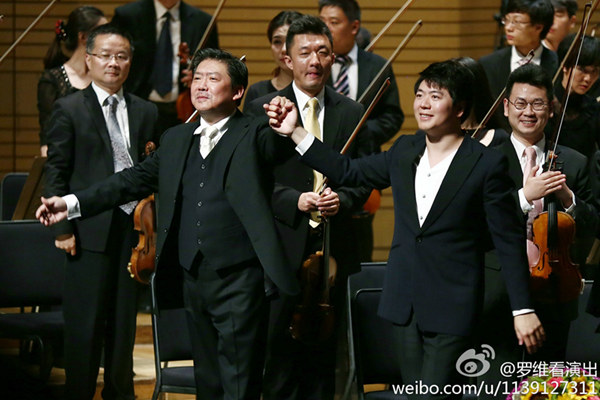
First Performance: “Scherzo” premiered in July 1, 2014, at Poly Theatre, Beijing, China
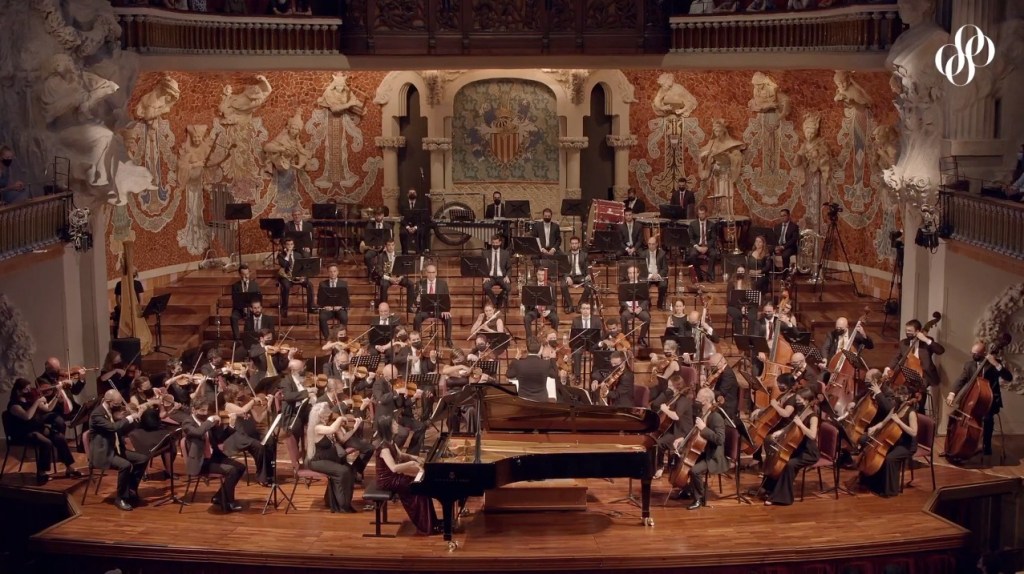
“Prelude” (followed by revised “Scherzo”) premiered in June 21, 2021, at Palau de la Mùsica, Barcelona, Spain
Soloist/Orchestra: Lang Lang/China Philharmonic conducted by Long Yu (Scherzo); Gloria Cheng/Orquestra Simfònica del Vallès conducted by Marc Timòn (Prelude)
Two-movement piece for piano and orchestra to be performed “attacca” with each other. The Scherzo was composed first, originally meant as a “birthday piece” for conductor Long Yu, while the Prelude was specifically written for soloist Gloria Cheng to be merged with a revised version of the Scherzo.

Selected Recordings
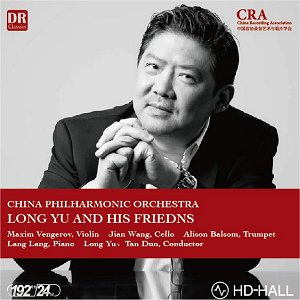
Long Yu And His Friends (2017)
China Recording Association CP54-462 (digital release)
contains “Scherzo for Piano and Orchestra”
Lang Lang, piano
China Philharmonic Orchestra conducted by Long Yu
Live recording of the concert from July 1st, 2014 held at Poly Theatre in Beijing
Published Scores
There are no published scores or reductions for this work. The section will be updated in case anything will be made officially available.
Quotes & Commentary
“The Prelude (2021) was added 7 years after the Scherzo (2014) at the request of David Alan Miller and the Albany Symphony, so John needed make it segue organically to the preexisting piece, which is not easy. There’s a dark moment at the end of the Prelude before going into the Scherzo, but the timpani turns puckish and takes us off into a brand new world.
The Prelude is […] nocturnal, very pensive, internal, reflective, poetic… I love that because in some ways, while Conversations was John tapping things that were interesting to him, it felt like the Prelude was meant for me. I trend more poetic than super-virtuoso. For instance, when I received the Conversations hair-raising fourth movement (“Strays, Duke… and Blind Tom,”), I thought, “What made him he write that for me?” John knew I always wanted to be a jazz pianist, but I had to really come to meet that piece on its own terms. In the case of the Prelude, I’m at home right away. The Scherzo truly channels Lang Lang, especially the original ending, and it highlights Lang Lang’s sensibilities; I feel like John wrote the Prelude in a way that highlights mine.” 1
– Gloria Cheng
A Talk With Marc Timón, by Maurizio Caschetto
How did you become involved in conducting the World Premiere of the Prelude and the European Premiere of the Scherzo in Barcelona in 2021?
I had the opportunity to meet pianist Gloria Cheng in Santa Monica (Los Angeles), at a concert within the framework of Jacaranda. My good friend Tomàs Peire introduced us. We had a brief but very pleasant conversation, during which I mentioned that I was the Resident Composer of the Season at the Palau de la Música in Barcelona. When I also told her that I had conducted several concerts in that hall as an orchestra conductor, she asked if I would be interested in premiering John Williams’s Prelude and Scherzo for Piano and Orchestra. I told her I was a great admirer of Williams’s music and that it would be a true honour. In the following days, when Gloria mentioned the possibility to John Williams, he was very pleased with the idea of me conducting the premiere in Barcelona. In the days that followed, I spoke with the Palau to find a date for the premiere, and they responded with great enthusiasm. That’s how life gave me the immense gift of conducting a world premiere by Maestro Williams. I will always be grateful to Gloria Cheng for the opportunity, to John Williams for entrusting me with his music, and to Tomàs Peire for introducing us that day at this concert in Los Angeles.
You are a professed fan of John Williams. What were your feelings when you received the score for this concert work by the Maestro? Did it look challenging already by just looking at the score on the page?
My feelings when I received the score were exactly like those of a child receiving their very first brand-new bicycle from Santa Claus at Christmas. I felt extremely happy, grateful, and deeply aware of the responsibility. I couldn’t wait to examine the score and begin studying every single measure carefully. At first glance, the piece already looked very challenging for several reasons. As a conductor, one of the main difficulties in a work like this is maintaining a tight coordination between the piano and orchestra. Another challenge lies in the contemporary musical language found in certain sections, which makes some tempi and rhythmic passages particularly demanding. Achieving the right atmosphere for the Prelude (so magical!) was also a significant challenge.
Did you have a chance to talk with Maestro Williams before conducting the piece?
Yes, I had a long conversation with Maestro Williams. As both a conductor and a composer, whenever I premiere a new work, I always seek the composer’s insights, which is essential for approaching the score with authenticity. John had a very clear vision of how he wanted the piece to be performed. A score is ultimately a code; even when it’s meticulously written and full of markings, hearing the composer’s own voice and explanations brings it to life in a completely different way. We spoke about everything, from the overall intention and essence of the piece to specific aspects such as tempi, phrasing, expression, and other distinctive musical elements. I truly wanted to conduct the piece as John imagined it. At one point, he even sat at the piano and played through sections of the score to show me the character and tempo he envisioned. It was an unforgettable moment.
We also spoke about my own piece, The Beacon. Tribute to John Williams, which I had dedicated to him and which would be premiered at the same concert. Beyond music, we had a wonderful conversation about life and music more broadly. He was extraordinarily kind and warm to me, and expressed his gratitude for my conducting his piece in Barcelona.
How did you and soloist Gloria Cheng work together in preparing the piece? Did you meet just at the orchestral rehearsals or did you work also before?
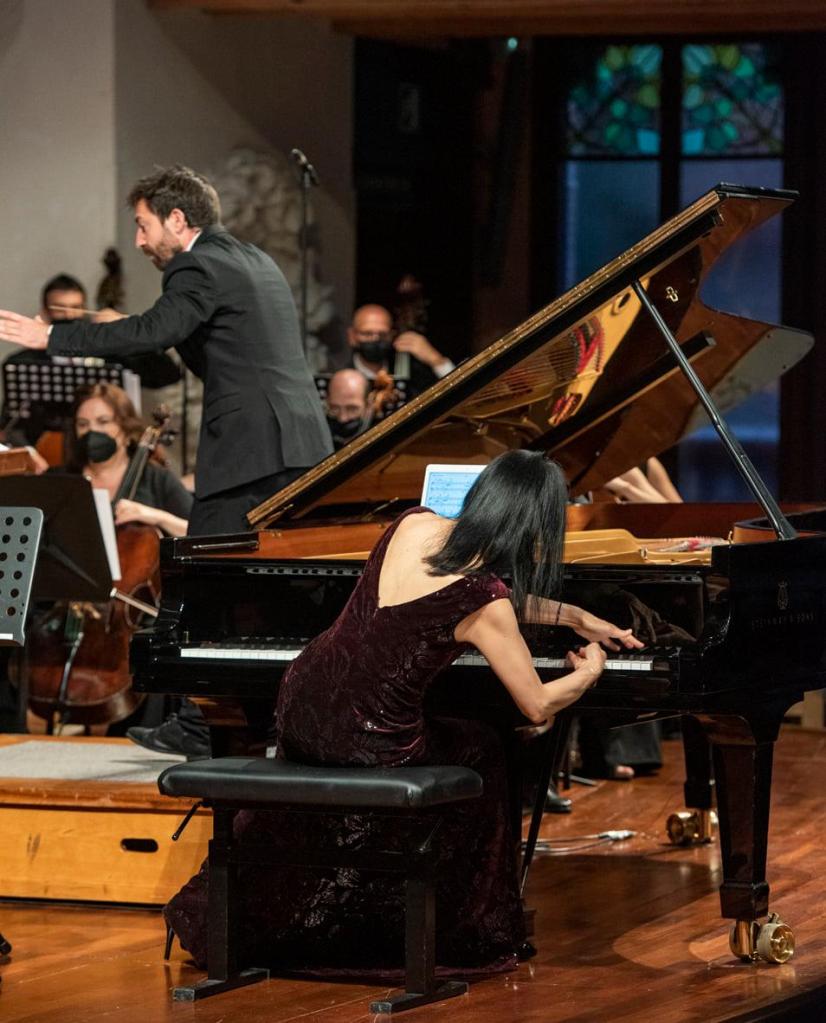
Working with Gloria was wonderful from the very beginning. She’s an exceptionally talented pianist and, at the same time, incredibly humble (a truly inspiring combination). I would say we had a special connection from the first moment, and from there, everything felt easy and natural. Before rehearsing with the orchestra, we spent time working together alone. Gloria already had a very clear vision of how she wanted to approach the piece, and my goal was to shape the orchestral part in a way that would feel like a new skin for the music — one that fit naturally and comfortably around her interpretation. In the weeks leading up to the rehearsals, once I had received the score, Gloria and I spoke often about the piece. Those conversations were essential in preparing for the premiere.
The orchestra sounds really big, especially during the Scherzo segment.
The sound of the piece is expansive not only because of the size of the orchestra but also thanks to Williams’s orchestration. He has this remarkable ability to create a truly grand sound when he wants to, regardless of the specific instrumentation. The orchestra also sounds large and full thanks to the dedicated work we did in rehearsal with the Orquestra Simfònica del Vallès. From the very beginning, they were deeply committed to the premiere. Together, we crafted the dynamics with great care from magical, almost impressionistic pianissimi in certain parts of the Prelude to a rich and noble sound in the more epic moments of the Scherzo.
When John Williams writes music for the concert hall, he goes in a very different direction compared to when he writes music for films. What are the main differences according to your experience? And in what aspects instead his voice remains very much the same?
The voice of a composer, especially one with as long career as Williams, remains essentially the same throughout. What changes is the way that voice is expressed when telling different stories or working within different formats. In the realm of concert music, we find a bolder Williams, one who embraces harmonic clashes, dissonances, and rhythmic playfulness, among other elements, while still preserving his love for melody and thematic development, albeit through a more extreme musical language. At the same time, that does not mean he is any less daring in his film music; on the contrary, he has opened many new paths at key moments in that field. We have countless examples, such as the space battle sequences in Star Wars, the rich contrapuntal textures that always accompany his memorable main themes, or his frequent use of augmented and modal harmonies in contexts, registers, and genres where such language is uncommon. In the main theme of the Scherzo, for instance, we can clearly hear the voice we associate with the essence of Williams. Then, very skillfully, he weaves this deliberate thematic preference with more exploratory passages, always in service of the work’s overall intention.
What does the music of John Williams mean to you personally, both as a composer and as a conductor?
For me, John Williams’s music is home. We share the same style of film composition, with a deep love for the symphonic genre and the use of leitmotifs on screen, which is why I’ve always felt Williams’s music very close to me. His music means a return to my roots. Not in a naïve way, simply recalling how E.T. amazed me as a child, but rather it connects me to an entire musical and orchestral universe that helped me grow and planted a seed within me that would later blossom. And not only Williams’s music, but also the music of all those classical composers to whom his work is deeply connected, and who have shaped my development as a composer.
On a more emotional level, Williams’s music is adventure, dream, magic, wonder, and a return to childhood — five of the things I cherish most and that fill my life. As a composer, his work is a beacon, a safe place to find rest and learning, a mirror to reflect on myself, a source of familiar paths or new directions. As a conductor, performing Williams’s music has been a gift of a lifetime, especially in conducting his world premiere in Barcelona. Approaching his score and bringing them to life only deepens my admiration for him and his art, revealing the immense attention to detail behind his melodies, which are instantly recognizable, familiar, and unforgettable — even when dealing with his more intricate and sophisticated concert music.
In short, the music of Maestro Williams represents for me an immense universe where I find happiness, learning, self-reflection, and a reminder of who I am and who I want to be. 2

After dawn, came a prelude—literally—with John Williams’ Prelude and Scherzo, orchestral music with a concertante piano part played by Gloria Cheng. As Miller explained, this originally was slated for the Albany Symphony to premiere, but pandemic cancellations meant the piece was first played in Spain.
The Prelude had an intriguing antiphony between a psychologically and harmonically complex solo part, and Williams’ classic sound—rich orchestral harmonies with the shine and simple eloquence of mid-20th century American tonal modernism. Despite the expressiveness of her part, Cheng’s playing was unsentimental, which was an effective setup for the Scherzo. More than just playful, the music established an intense feeling, then proceeded to pick itself apart and reassemble. Rhythmically and structurally tricky, this was an impressive performance from the orchestra and Cheng, who seemed to relish the extreme angularity of much of the writing. 3
– George Grella (New York Classical Review)
Video
“Prelude and Scherzo for Piano and Orchestra”
Gloria Cheng, piano
Orquesta Simfònica del Vallès
Marc Timón, conductor
World Premiere of the Prelude and European premiere of the Scherzo at the Palau de la Música (Barcelona. June 21, 2021).
Bibliography and References
. Grella, George “Albany Symphony wraps season with an American celebration,” New York Classical Review, 5 June 2022
. Freedman, Geraldine – “Music review: Albany Symphony, Cheng and McAllister in top form,” The Daily Gazette, 5 June 2022
 The Legacy of John Williams