

Table Of Contents
- Film Details
- Music Credits
- Essential Discography
- In Williams’ Words
- Videos
- Bibliography and References

Film Details
Year: 1966
Studio: 20th Century Fox
Director: William Wyler
Producer: Fred Kohlmar
Writers: Harry Kurnitz, George Bradshaw
Main Cast: Audrey Hepburn, Peter O’Toole, Eli Wallach, Hugh Griffith, Charles Boyer
Genre: Comedy – Crime – Romance
For synopsis and full cast and crew credits, visit the IMDb page
Music Credits
Music Composed and Conducted by John Williams (credited as “Johnny Williams”)
“Two Lovers”
Music by Johnny Williams
Lyrics by Leslie Bricusse
Orchestrator: James Harbert
Music Supervisor for 20th Century Fox: Lionel Newman
Recorded at 20th Century Fox Studio Scoring Stage, Los Angeles, California
Recording Dates: April 25, 26, 27, May 17 and 27, 1966
Original Soundtrack Album sessions recorded in June 1966

Essential Discography

Original Motion Picture Score Album (1966) – LP
20th Century Fox Records S-4183
Re-recorded selections from the original score, arranged and expanded by the composer for album presentation
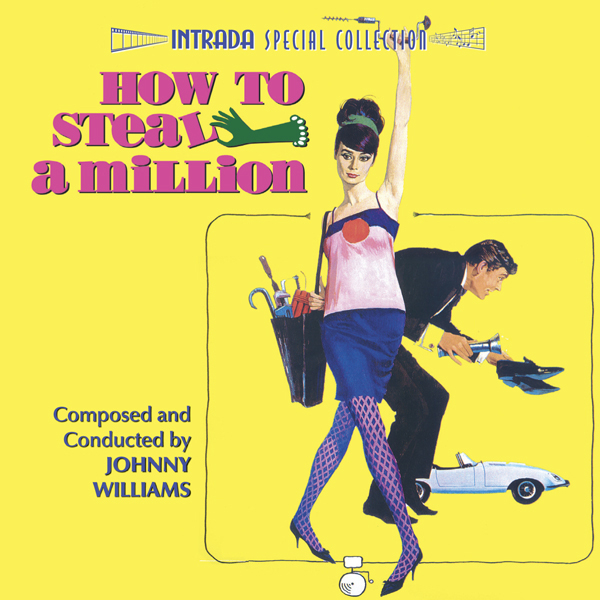
Expanded Reissue (2008)
Intrada Special Collection Vol. 83
2-CD Limited Edition
Restored and Assembled by Mike Matessino
Mastered by Dan Hersch
Produced by Nick Redman, Mike Matessino, Douglass Fake
Remastered 1966 OST album re-recording on Disc 1; premiere release of the original film recording on Disc 2 (also contains tracks from “Bachelor Flat”)
In Williams’ Words
“[How to Steal a Million] meant a lot to me because it was my first really major picture. [It is] a romantic score, with a Gallic flavour in the overture. I got on well with [William] Wyler. There’s a little chase scene at the end of the picture where Peter O’Toole and Audrey Hepburn come out of the closet and the French comedian Moustache has the statue. There’s a chase in the museum and I treated it in a very burlesque way-sort of slipping on banana skins followed by a crash from the orchestra, and running semiquavers all over the place… I thought I’d gone too far but Wyler loved it. There were also some claustrophobic kissing scenes between Hepburn and O’Toole: I scored them in a fairly broad way and was afraid it was too musically extrovert, but again he loved that. He liked the opening, too, that little French boulevard piece… We didn’t really have any discussions over the music for the picture. I remember there was one sequence he didn’t like but that wasn’t because he’d given me any other instructions–he just didn’t like it when he heard it. I can’t remember the exact details, but there was some sort of presentation scene and I was underscoring some knowing looks between people in it. At the end of the recording Wyler came up to me and very politely said, ‘Mr. Williams, would you mind re-writing that sequence?’ And I said, ‘Of course not. What is it you don’t like?’ And he said, ‘Do something like Elgar. Forget the two characters and play the ceremony of the thing. You know, trumpets and cymbals, so that they can make a regal entry.’ So in the interim before the next recording session I wrote a short march, and he loved that. That’s the only scene where we had any sort of disagreement. He was very nice.”1

Quotes and Commentary
John Williams was winding down his contract with Revue Studios (MCA’S television division) when he was invited to return to 20th Century Fox for the first time since Bachelor Flat (1962). His first assignment in summer 1964 was the feature John Goldfarb, Please Come Home, after which he began his collaboration with Irwin Allen, composing themes and scores for Lost in Space, The Time Tunnel and Land of the Giants. By the time he finished the last of these he would also score A Guide for the Married Man and adapt and conduct André Previn’s songs for Valley of the Dolls, both released in 1967, the latter a huge hit that earned Williams his first Oscar nomination. In the midst of this came a major career stepping-stone: How to Steal a Million. […]
Williams composed How to Steal a Million in March 1966, working with orchestrator James Harbert, an accomplished trumpet player and pianist who had written hit songs recorded by Frank Sinatra and Doris Day. […]
As with many soundtrack albums of the day, the original 1966 LP for How to Steal a Million was a re-recording, initially released by 20th Century-Fox Records). It is noteworthy for being the first album of feature film music entirely composed by Williams. […]
The model for light-comedy scoring in the 1960s was the work of Henry Mancini, who skillfully applied conventions of light jazz and pop to a traditional orchestral ensemble. Williams began with this template, utilizing saxophone, amplified guitars, harpsichord and electric keyboard in his scoring, and infusing it with his distinctive ostinati and compelling harmonies.2
– Mike Matessino
Videos
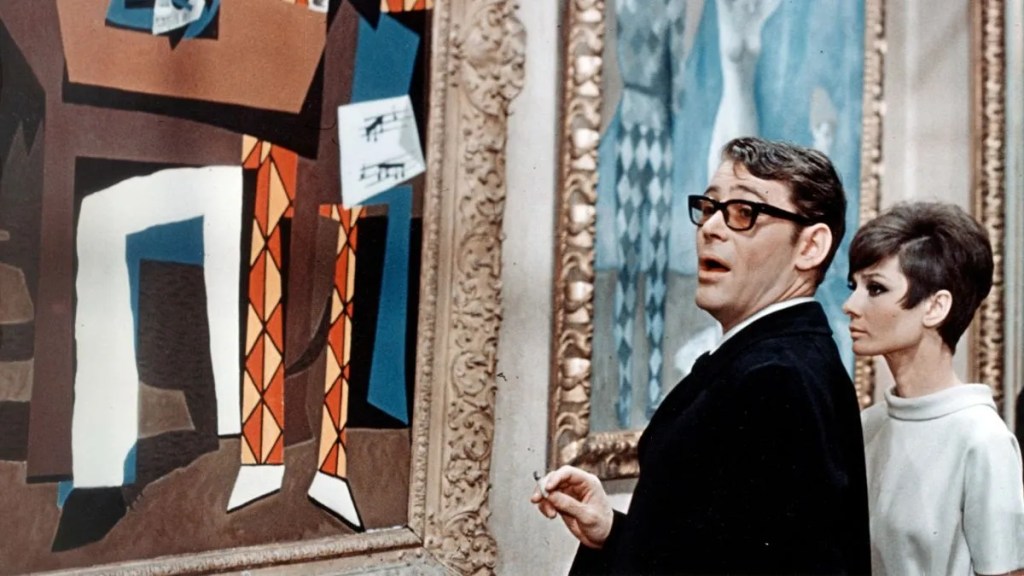
Title sequence from How to Steal a Million | 20th Century Fox | 1966
Simon and Nicole in the closet from How to Steal a Million | 20th Century Fox | 1966
How To Steal A Million Original Trailer (featuring music by John Williams)
Bibliography and References
. Audissino, Emilio – “Williams’ Early Years: Spotting the First Traces of Neoclassicism,” The Film Music of John Williams, University of Wisconsin Press, 2021
. Audissino, Emilio / Huvet, Chloé – “Irony, Comic, and Humor: The Comedic Side of John Williams,” The Palgrave Handbook of Music in Comedy Cinema, Palgrave-Macmillan, 2023
. Dyer, Richard – “Where Does John Williams Come From?,” The Boston Globe, June 1980
. Elley, Derek – “The Film Composer: John Williams – Pt. 1 and Pt. 2,” Films and Filming, July/August 1978
. Matessino, Mike – Liner notes for How to Steal a Million/Bachelor Flat, Intrada Special Collection Vol. 83, 2008
Footnotes
 The Legacy of John Williams