

Table Of Contents
- Film Details
- Music Credits
- Essential Discography
- In Williams’ Words
- Quotes and Commentary
- Videos
- Bibliography and References

Film Details
Year: 1989
Studios: Universal Pictures/United Artists
Director: Steven Spielberg
Producers: Steven Spielberg, Frank Marshall, Kathleen Kennedy
Co-Producer: Richard Vane
Writer: Jerry Belson, based on the 1943 motion picture A Guy Named Joe directed by Victor Fleming and written by Dalton Trumbo
Main Cast: Richard Dreyfuss, Holly Hunter, John Goodman, Brad Johnson, Audrey Hepburn, Roberts Blossom
Genre: Drama – Fantasy – Romance
For synopsis and full cast and crew credits, visit the IMDb page
Music Credits
Music Composed and Conducted by John Williams
French Horn Soloist: Jim Thatcher
Music Editor: Kenneth Wannberg
Scoring Mixer: Shawn Murphy
Music Preparation: JoAnn Kane Music Service
Orchestra Contractor: Sandy DeCrescent
Concertmaster: Stuart Canin
Orchestrators: Alexander Courage, John Neufeld, Herbert Spencer
Recorded at Lorimar Music Scoring Stage, Culver City, California
Recording Dates: October 30 and 31, November 1, 2, 10, and December 4, 1989
Essential Discography
Original Soundtrack Album and Expanded Reissues

Motion Picture Soundtrack Album – LP/CD (1989)
MCA Records – MCAD-8036
Original Score Produced by John Williams
Also includes selected songs featured the film
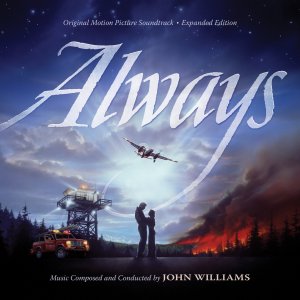
Original Motion Picture Soundtrack – Expanded Edition (2021)
Limited Edition CD
La-La Land Records LLCD 1527
Produced and Mastered by Mike Matessino
Liner Notes: Mike Matessino
Expanded film score presentation plus additional music
Selected Re-recordings

The Spielberg/Williams Collaboration (1991)
Sony Classical SK 45997
contains “Theme” from Always
Boston Pops Orchestra conducted by John Williams
Richard Sebring, French horn
Bob Winter, piano
Produced by Thomas Shepard
Engineered by Bud Graham
In Williams’ Words
“Some of the sequences of Always are in heaven. We didn’t want exactly rhetorical music, thematic music that has as an actual expression of a phrase, but another atmosphere and world that sometimes electronics can create better than an orchestra—these kind of decisions, really artistic decisions I guess, driven, dictated by the moment and by the scenes.” 1

Quotes and Commentary
John and I have a bit of an operatic relationship, our scores are rather operatic and we haven’t had a chance to be understated and subtle. And with this story, the last thing that John and I wanted was a sort of Spielberg/John Williams score. We weren’t looking for a memorable soundtrack to sell in stores. We were just looking to gently give a kind of carpet of stars, musically, for the performers to pretty much act on—just feeling music. It’s almost cerebral that we’ll somehow get into your feelings, but we’ll bypass your ears.2
– Steven Spielberg
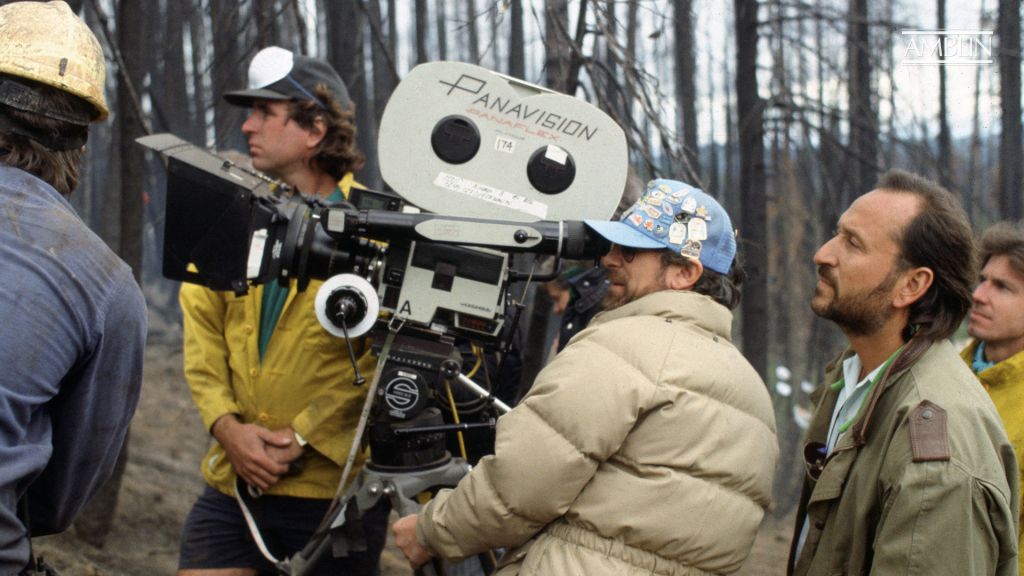
Composer John Williams screened the film with Spielberg in late September 1989. Discussions about the music resulted in a change of pace for the composer-director collaboration. For the first time, underscoring would be withheld for the first 20 minutes of the movie, and they settled on a sound that would be ethereal, dreamy, flowing as if carried by the wind in a realm with no time restraints, music that contemplated relationships in all their tenuousness and occasional bliss. While the score is subtle in its uses of melodic material, Williams did compose a central motif for Pete and Dorinda, romantic yet uncertain, its intervals rising toward an unattainable goal. A secondary motif represents the firefighting component of the story, while a third, related to the second and uniting the two, is associated with Dorinda and Ted. Many of the cues, particularly those related to Pete’s time spent with the angel Hap and the moments where, as his ghostly self, he speaks to Dorinda, are “New Age” in character, an idiom the composer had explored for the “Fortress of Solitude” sequence in Superman and, obscurely, an early scene in the futuristic comedy Heartbeeps. It would also become a component in Williams’ music for Far and Away. Synthesizer, harp, piano and celesta are principal elements creating this atmosphere, often ornamenting passages that otherwise consist only of string instruments.
A plaintive, high-register French horn solo characterizing the resolution of Pete’s relationship with Dorinda is featured in “Among The Clouds,” played by Jim Thatcher in his first performance on a Williams score.
Scoring took place at what is now the Sony Pictures scoring stage (Lorimar at the time) beginning on October 30, 1989, with Ralph Grierson and Randy Kerber recording electronic keyboard lines. The full orchestra performed over the next three days, with an additional day on November 10 and one last session on December 4 to record final revisions. 3
– Mike Matessino

Videos
The “Follow Me” scene from Always, featuring the isolated music as heard in the final film and the original version of the cue
The “Among the Clouds” scene from Always | 1989
Steven Spielberg talk about the music of Always | 1990
Bibliography and References
. Maslin, Janet – “Film Review: ‘Always,’ Love and Death in a Wilderness,” The New York Times, December 22, 1989
. Matessino, Mike – “Music for Always” – Always – Original Soundtrack Expanded Edition, La-La Land Records, 2021
. Merluzeau, Yann – “A Conversation with John Williams,” Cantina Band – The John Williams Appreciation Society, Vol. 4 No. 16, 1993
. Moorman, Peter – Spielberg-Variationen: Die Filmmusik von John Williams, Nomos Verlagsgesellschaft, 2010
Legacy of John Williams Additional References
Soundtrack Spotlight with Mike Matessino
Footnotes
 The Legacy of John Williams