
Table Of Contents
- Film Details
- Music Credits
- Essential Discography
- Quotes and Commentary
- Videos
- Bibliography and References
Film Details
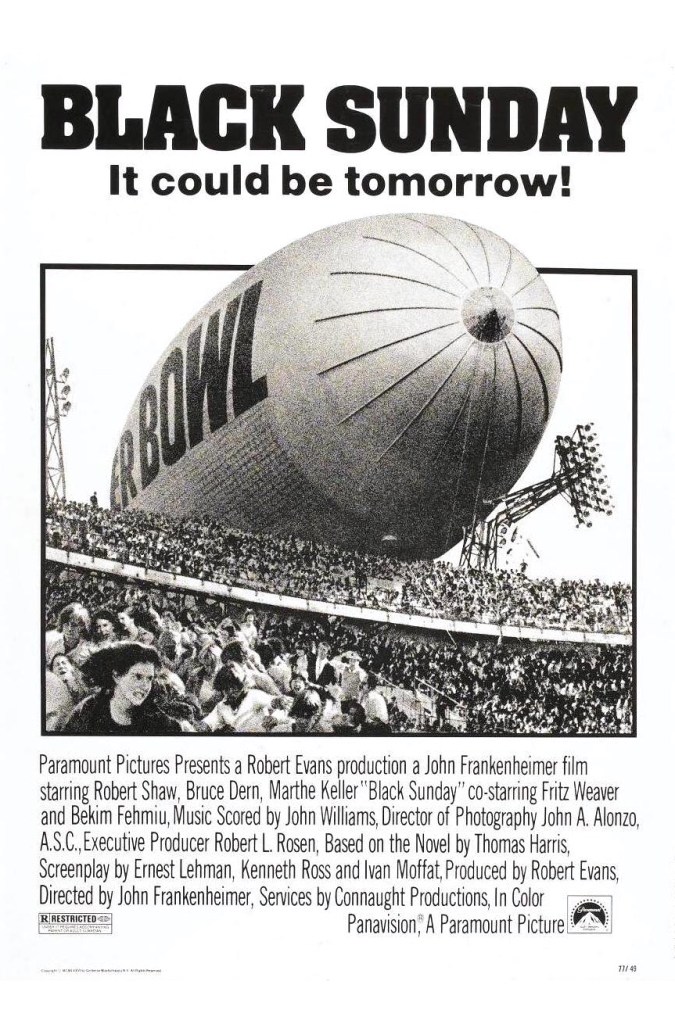
Year: 1977
Studio: Paramount Pictures
Director: John Frankenheimer
Producer: Robert Evans
Writers: Ernest Lehman, Kenneth Ross, Ivan Moffat, based on the novel by Thomas Harris
Main Cast: Robert Shaw, Bruce Dern, Marthe Keller, Fritz Weaver, Bekim Fehmiu. Steven Keats, Michael V. Gazzo, William Daniels
Genre: Drama – Thriller
For synopsis and full cast and crew credits, visit the IMDb page
Music Credits
Music Composed and Conducted by John Williams
Music Editor: June Edgerton
Scoring Mixer: John Norman
Orchestra Contractor: Philip Kahgan
Orchestrator: Herbert W. Spencer
Recorded at Paramount Scoring Stage M, Hollywood, California
Recording Dates: August 17, 18, 19 and September 1, 1976
Essential Discography

Music from the Motion Picture – Limited Edition CD (2010)
Film Score Monthly Vol.12, No.19
Produced by Lukas Kendall and Mike Matessino
Mix and Assembly by Mike Matessino
Mastered by Erick Labson
Premiere release of the original motion picture score
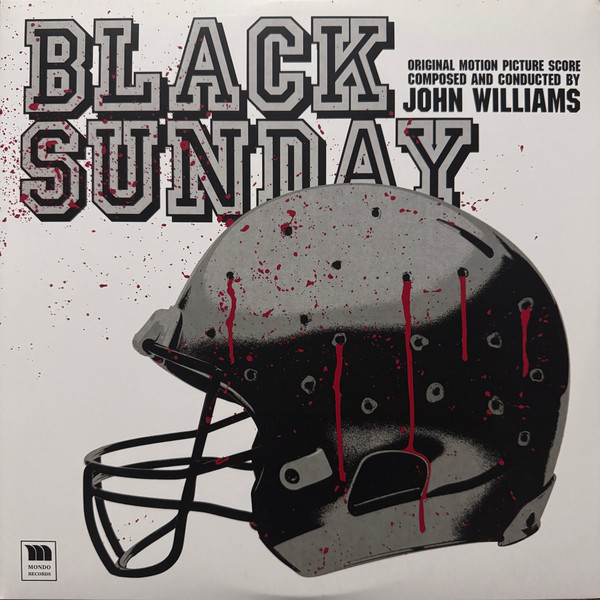
Original Motion Picture Score – Limited Edition 2-LP Vinyl (2015)
Mondo – MOND-054
Produced by Lukas Kendall and Mike Matessino
Mastered by James Plotkin
2-LP release of the 2010 Film Score Monthly assembly newly mastered for vinyl

Music from the Motion Picture – Remastered Limited Edition CD (2025)
La-La Land Records LLCD 1664
Remixed, Remastered and Produced Mike Matessino
Liner Notes: Jeff Bond
Newly remastered edition of the complete film score

Quotes and Commentary
John Williams was an obvious choice to provide the music for Black Sunday, given his high-profile scores for three of the biggest “disaster” films of the early ’70s (The Poseidon Adventure, The Towering Inferno and Earthquake) as well as his work on the political thriller The Eiger Sanction (1975) and his landmark achievement on Steven Spielberg’s Jaws (1975).
Given that Paramount viewed Black Sunday as their own Jaws-style blockbuster, hiring the composer who had added so much to that earlier film came as no surprise.
Jaws had elevated Williams’s profile considerably, winning him his first Oscar for Original Score. Following Jaws, Williams scored three films released during the first half of 1976: Family Plot, which would be Alfred Hitchcock’s last picture; the high-profile (but critically lambasted and financially unsuccessful) Marion Brando-Jack Nicholson western The Missouri Breaks; and the World War Il docudrama Midway. By late July 1976, at which time Williams was already at work on Black Sunday, the Los Angeles Times announced that the composer would score both The Deep (like Jaws, based on a Peter Benchley novel) and The Sentinel (a horror film directed by Michael Winner). But Williams’s next project after Black Sunday would end up being Star Wars, launching him into another realm altogether (John Barry and Michael Small, respectively, would score The Deep and The Sentinel).
It is fascinating to consider the arrival of a Williams score in a world that had never heard Star Wars, and Black Sunday represented the last such opportunity. While the irrepressible John Simon carped in New York magazine that “it does rather repeat his shark theme from Jaws,” Charles Champlin of the Los Angeles Times deemed Black Sundays score “invaluable” and “worth 50 pages of exposition.” Frankenheimer would also praise Williams’s contribution in interviews about the film, but close analysis reveals that the score as composed underwent many editorial changes, with several unused music cues and a climax that bears little resemblance to the composer’s original intentions. Williams even returned after the original sessions to score a revised (and more upbeat) ending that–in retrospect–might mark the precise moment the gloom and negativity of the early ’70s transitioned to the optimism of the Star Wars era. […]
Despite the revisions, Williams’s effort is a key component of Black Sunday‘s effectiveness. At the forefront is an obsessive motive for the terrorist plot: its first phrase consists of four repeated notes (the tonic), while the pitches of the second phrase are (perhaps coincidentally) the first four notes of the Dies Irae in retrograde; the third phrase repeats the first, and a final two-note phrase simply descends from the tonic to the pitch a half-step lower. (Williams would use these same four pitches-in a different iteration-for an important motive in Spielberg’s Close Encounters of the Third Kind.)
The second major theme, associated with Kabakov (Robert Shaw) and his attempts to foil the terrorist plot, is bleak in character rather than heroic, somewhat anticipating Williams’s theme for Obi-Wan Kenobi in Star Wars the following year, while serving as an antecedent for some of the material in Spielberg’s Munich, made nearly three decades later. Kabakov’s theme is never stated in full in the finished film (a complete statement would have been heard in the end title, but even this was replaced by music tracked from earlier cues).
Williams’s score for Black Sunday is unusual in that it features such limited melodic content. Yet this approach perfectly matches the single-mindedness of the film’s principal characters–all of whom are either committed to carrying out the terrorist plot or equally committed to stopping it.1
– Scott Bettencourt, Jeff Eldridge, Mike Matessino, Al Kaplan
Videos
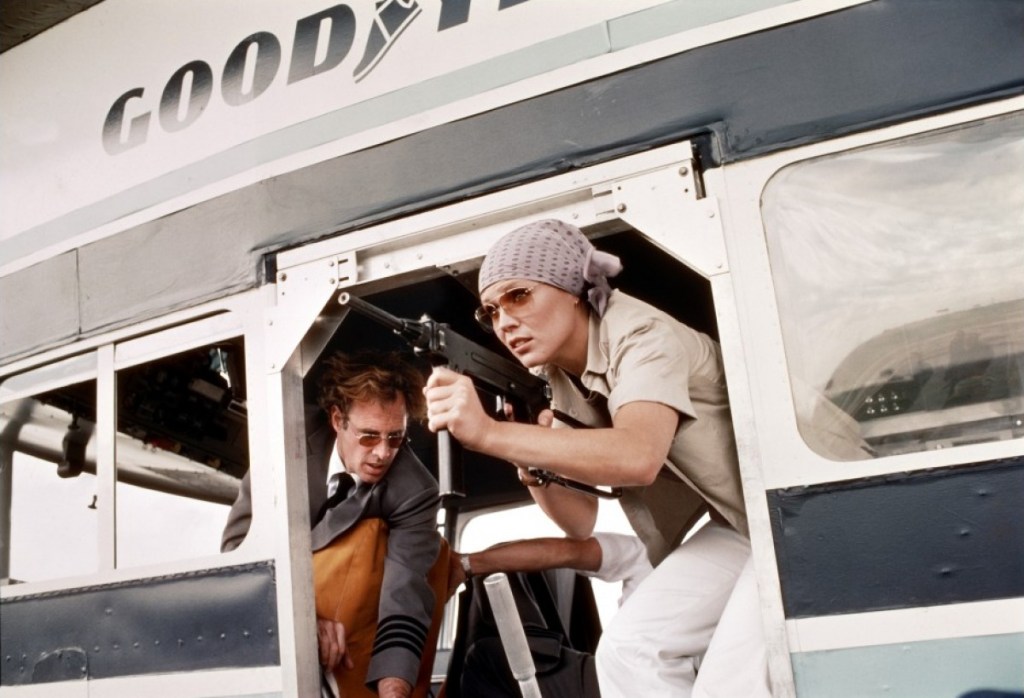
“Nurse Dahlia” scene in Black Sunday, Paramount Pictures, 1977
“Preparations” scene in Black Sunday, Paramount Pictures, 1977
“Air Chase” scene in Black Sunday, Paramount Pictures, 1977
Black Sunday Original Theatrical Trailer (featuring John Williams’ music)
Bibliography and References
. Bettencourt, Scott / Eldridge, Jeff / Kaplan, Al / Matessino, Mike – “The Day of the Dirigible,” Black Sunday – Music from the Motion Picture liner notes, Film Score Monthly, 2010
. Satterwhite, Brian – “The Super Bowl of Terrorism Films: A History of Black Sunday,” Black Sunday – Original Motion Picture Score, Mondo Records, 2015
Footnotes
- Bettencourt / Eldridge / Kaplan / Matessino, Black Sunday – Music from the Motion Picture liner notes, Film Score Monthly, 2010 ↩︎
 The Legacy of John Williams