
Table Of Contents
- Film Details
- Music Credits
- Essential Discography
- Awards and Nominations
- In Williams’ Words
- Quotes and Commentary
- Videos
- Bibliography and References
Film Details
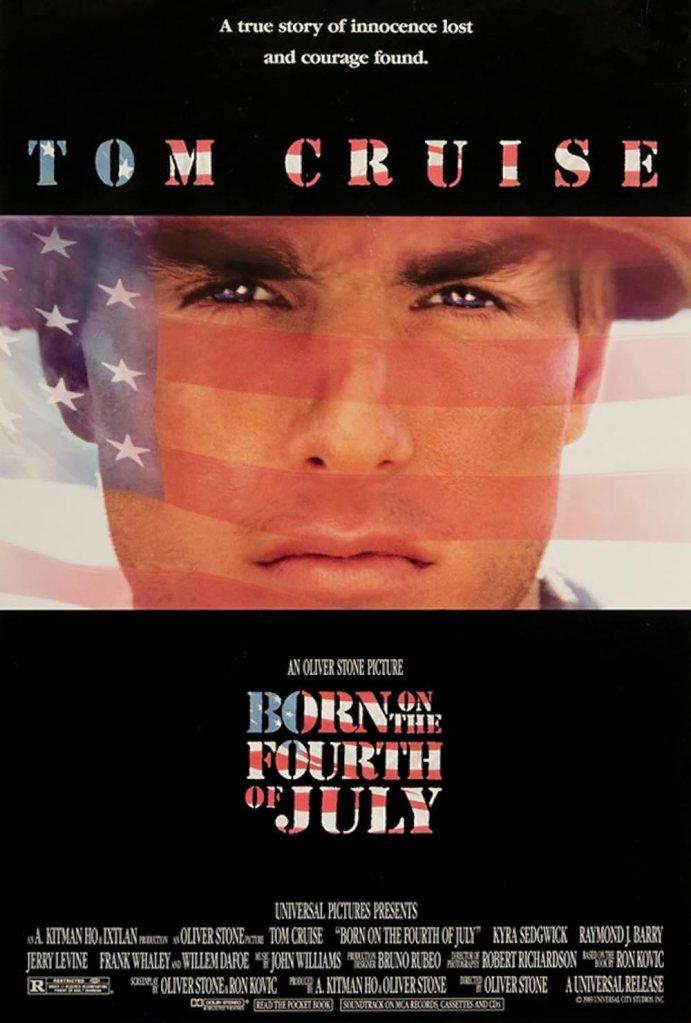
Year: 1989
Studio: Universal Pictures
Director: Oliver Stone
Producers: A. Kitman Ho, Oliver Stone
Writers: Oliver Stone & Ron Kovic, based on the book by Ron Kovic
Main Cast: Tom Cruise, Kyra Sedgwick, Raymond J. Barry, Jerry Levine, Frank Whaley, Willem Dafoe, Caroline Kava
Genre: Drama – War
For synopsis and full cast and crew credits, visit the IMDb page
Music Credits
Music Composed and Conducted by John Williams
Trumpet Solos: Tim Morrison
Music Editor: Kenneth Wannberg
Scoring Mixer: Armin Steiner
Music Preparation: JoAnn Kane
Orchestra Contractor: Meyer Rubin
Orchestrators: Herbert Spencer, John Neufeld
Recorded at 20th Century Fox Scoring Stage, Hollywood, California
Recording Dates: August 14, 15 and 16, 1989

Essential Discography
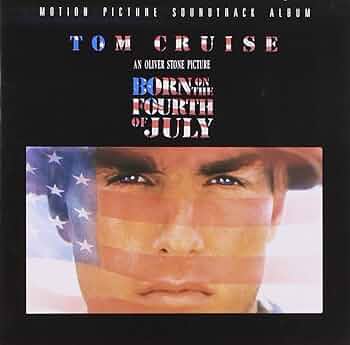
Motion Picture Soundtrack Album (1989)
MCA Records – MCA-6340
Executive Producer: Budd Carr
Contains 25 minutes of score selections plus period songs from the 1960s
Selected Re-recordings
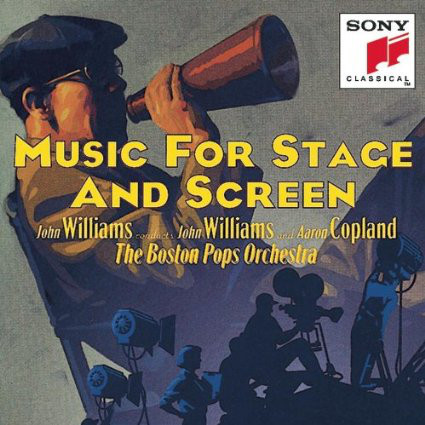
Music For Stage And Screen (1994)
Sony Classical SK 64147
contains “Suite from Born on the Fourth of July in three movements”
Boston Pops Orchestra conducted by John Williams
Tim Morrison, trumpet soloist
Produced by Thomas Z. Shepard

Hooten Plays Williams (2019)
THCD-002
contains “Theme from Born on the Fourth of July“
Recording Arts Orchestra of Los Angeles conducted by John Williams
Thomas Hooten, trumpet
Awards and Nominations
Academy Awards
Nomination: Best Original Score
Golden Globes
Nomination: Best Original Score
Grammy Awards
Nomination: Best Arrangement on an Instrumental (“Born on the Fourth of July”)
In Williams’ Words
“In his films, Platoon and Born on the Fourth of July, director Oliver Stone brought great force to the screen.
His own service in the Vietnam War clearly infused in him the powerful inspiration that gave these films their extraordinary impact and strength.
I feel privileged to have been invited to compose the musical score for the second of these landmark works, and to acknowledge the exceptional artistry of trumpeter Tim Morrison who performed the solo part so brilliantly on the soundtrack of the film.” 1

“It is an important, painful, serious and vivid film. I knew immediately I would want a string orchestra to sing in opposition to all the realism on the screen, and then the idea came to have a solo trumpet — not a military trumpet, but an American trumpet, to recall the happy youth of this boy. And I knew I wanted Tim [Morrison] — he has an American sound and his playing is very touching, very beautiful. There is real serenity in his playing; Tim’s a thoughtful guy.”
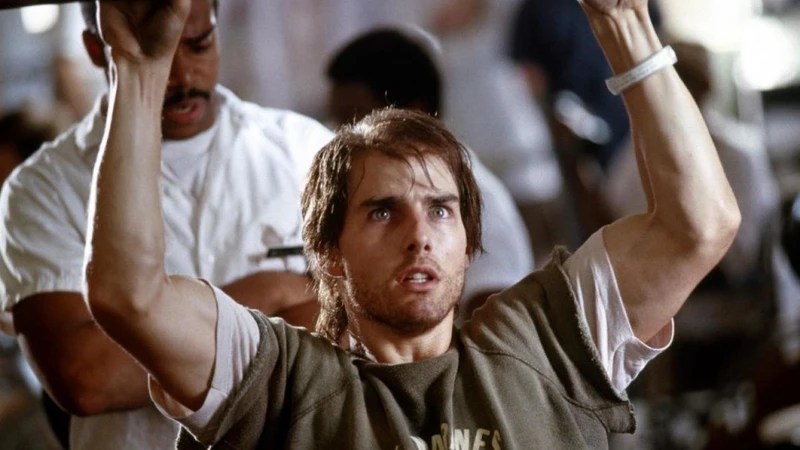
“I think some sequences in the film are as good as anything I have ever seen. Tom Cruise has matured remarkably and he is brilliant in it. But I know people are going to find it difficult to watch some of this film, and whether the American public is ready to embrace something so strong, I don’t know. But it is an important film and to my mind the best of the Vietnam films. And Tim Morrison soars in it from the beginning right through. His playing has that special glow.” 2
Quotes and Commentary
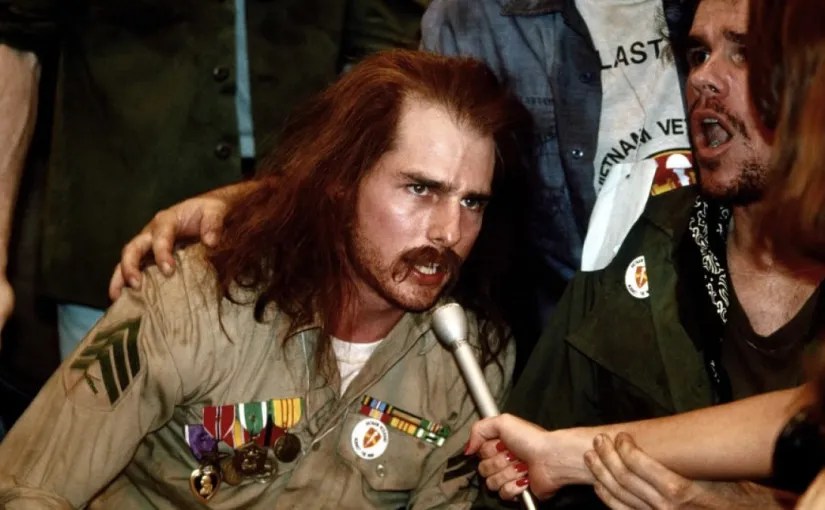
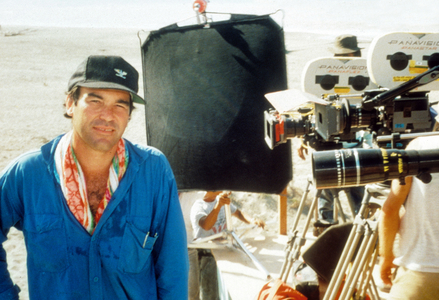
Born on the Fourth of July came into my life in 1978, when producer Martin Bregman introduced me to the autobiographical story of Ron Kovic, who volunteered for the Marines at age twenty, served two tours in Vietnam and came back paralyzed. After much conflict and self-punishment, Kovic found a reason to live in becoming a peace activist. Bregman asked me to adapt the book, with the idea of a film to be directed by William Friedkin and starring Al Pacino. When the German co-producers pulled out, causing the project to fold, I made a firm commitment to Kovic, “If I ever manage to make it in this business, I promise I’ll come back and make the film with you.” By 1988, ten years later, the success of Platoon and Wall Street allowed me to keep my word. Born on the Fourth of July was made with funding from Universal Pictures, starring Tom Cruise. When the issue of the music came up, I hesitated: after Salvador and Platoon, should I go back to Georges Delerue? Or could Stewart Copeland, the composer on my last two films, be the man for the job? It was my music supervisor Budd Carr who asked me. “And why not John Williams?” I was skeptical. “Williams works with the gods of Mount Olympus, way up there. If he took it on, his music would take us to another level.”
As I recall, John Williams didn’t agree on the spot, his agent, Michael Gorfaine, replied that he might be interested, but without committing further. Did John know my films? Not necessarily… As a filmmaker, I was still a newcomer.
Things opened up when he read the script: those ten years had allowed me to refine it. It certainly had strong material to fire both an actor’s and a composers imagination: the story of a broken destiny, chaptered in three acts, of a human journey… So we met, and he immediately admitted having felt real connections with the topic of Born on the Fourth of July. Because John knew the army: in the early fifties, he had served three years in the US Air Force. Straightaway, he told me he was hearing a noble, heroic theme, with great musical clarity… for solo trumpet. While talking about the idea of elevation, of lyricism and pain intertwined, the name Aaron Copland came up. It was the right direction, the perfect pointer.
When we were editing, the images seemed to grow inside John and already resonate in his notes. During this, he played themes to me on the piano.
Then, at the recording session, it paid off when I realized the firepower of his inspiration for Born on the Fourth of July. It was all there: the pastoral dimension of the youth years in Massapequa, the violence of the central act, in Vietnam, with an aggressive and barbaric composition… then this grand theme led by Boston Pops soloist Tim Morrison’s trumpet. This trumpet is a lament to the patriotic values Kovic clung to… It’s also his awareness, even the expression of his guilt, at having accidentally killed a soldier named Wilson in his platoon, which he was leading as a sergeant. When I mixed the music with the image, the film took off, went up two levels. Especially in the parade sequence, during the opening credits, when young Ron’s eyes (ten) meet those of a veteran of World War II. With John’s music, you understand that his destiny is being played out in that very moment. One day, Kovic will in turn become a veteran, in a war yet to come. What else is there to say about the soundtrack of Born on the Fourth of July? It’s music you can listen to outside the film, like a sort of Americana, an elegy to those sacrificed for Vietnam, to all those souls that have flown. Five years after the film was released, for a Boston Pops album, John re-recorded music from the score, pairing it with that of The Red Pony by… Aaron Copland. In a way, things had come full circle.3
– Oliver Stone
The music from Born on the Fourth of July awesomely reflects the somber yet human nature of the movie and can be immensely moving. […] Most of the movie’s score was reserved for the string section, so almost all of the first track is strings, except for an oboe solo after the main theme. During the scenes of Kovic’s childhood, Williams’ paints a wonderful picture of innocence and family, which later grows into another theme. This theme is more happy and upbeat than the others, and on track 14 it even creates a triumphant atmosphere. But soon the happiness of the early days melts back down to the main theme. The track dies down on a major note, depicting hope in the somber film. […]
Track 11, “The Shooting of Wilson”, is absolutely terrifying. The track accompanies the wartime scene when Kovic’s company accidentally massacres a house full of innocent Vietnamese. As the troops walk in, the strings slide up and down uncomfortably and almost drunkenly to depict a sense of confusion. A lone baby sits in his dead mother’s lap, crying in the movie. In this piece, you can hear that baby crying. You can see the corpses and smell the stench of blood. After the massacre, the troops emerge under fire. […] The music has no destination, no sense of direction. The confusion of battle is captured in this piece. But the climax of the piece occurs after a pause from the strings. Suddenly, unexpectedly, a sharp dissonant jab on a piano. Kovic realizes that he has shot one of his own men. After the shock, Williams gives us the Prologue elegy, and beautifully adds the family theme, showing us that Kovic is still human.4
– Frank Lehman

The score for Born on the Fourth of July was by John Williams, and was the first of three films he and Stone did together, the others being JFK in 1991 and Nixon in 1995. Williams agreed to work on the film after viewing a rough cut version, and immediately knew that he wanted to have a score which used a beautiful string orchestra to juxtapose the horror and carnage of the war, and which featured a solo trumpet to illustrate the happy, innocent, idyllic youth that Kovic lost in the jungles so far from home. The ironic use of intentionally beautiful music to make the devastation of war seem more emotionally powerful is not a new idea (Georges Delerue did it in Stone’s previous film, Platoon, by mimicking Samuel Barber’s famous Adagio for Strings), but Williams’s class and taste and unmatched talent makes the score for this film feel especially poignant. 5
– Jonathan Broxton
Videos
Opening scene Born on the Fourth of July (1989) | Universal Pictures
The “Cua Viet River” scene from Born on the Fourth of July (1989) | Universal Pictures
Theme from Born on the Fourth of July Music Video | MCA Records | 1990
John Williams conducts Born on the Fourth of July concert suite | Boston Pops Orchestra Japan Tour | 1993
References
- Introductory note to Born on the Fourth of July concert suite, Hal Leonard HL 04490833 ↩︎
- Richard Dyer, “You’ll Be Hearing from Him,” The Boston Globe, August 31st 1989 ↩︎
- Stéphane Lerouge,The Legend of John Williams liner notes, Universal Music France, 2023 ↩︎
- Frank Lehman, Born on the Fourth of July soundtrack album review, JWFan.com, 2003 ↩︎
- Jonathan Broxton, Born on the Fourth of July soundtrack review, Movie Music UK, 2019 ↩︎
Legacy of John Williams Additional References
John Williams and the American Sound, essay by Maurizio Caschetto
Legacy Conversations: Tim Morrison, podcast interview
 The Legacy of John Williams