

Table Of Contents
- Film Details
- Music Credits
- Essential Discography
- Awards and Nominations
- In Williams’ Words
- Quotes and Commentary
- Videos
- Bibliography and References
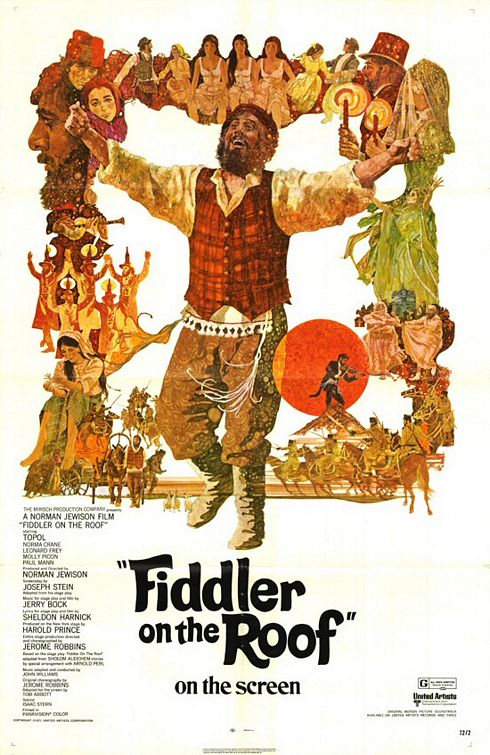
Film Details
Year: 1971
Studio: United Artists/The Mirisch Production Company
Director/Producer: Norman Jewison
Based on the 1964 musical produced on the New York stage by Harold Prince directed and choreographed by Jerome Robbins
Screenwriter: Joseph Stein, based on his stageplay “Fiddler On The Roof,” adapted from stories by Sholem Aleichem by special arrangement with Arnold Perl
Executive Producer: Walter Mirisch
Main Cast: Topol, Norma Crane, Leonard Frey, Molly Picon, Paul Mann, Rosalind Harris, Michele Marsh, Neva Small, Paul Michael Glaser, Ray Lovelock
Genre: Drama – Musical
For synopsis and full cast and crew credits, visit the IMDb page
Music Credits
Music by Jerry Bock · Lyrics by Sheldon Harnick
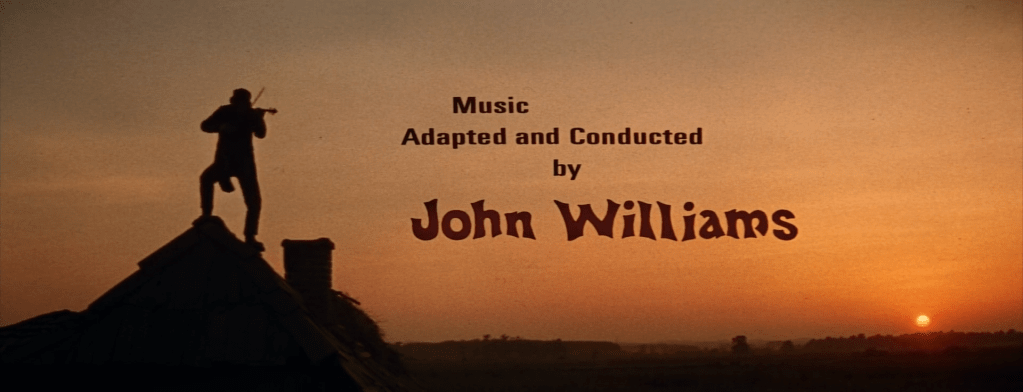
Music Adapted and Conducted by John Williams
Soloist: Isaac Stern
Music Editor: Bob Hathaway
Scoring Mixer: Eric Tomlinson
Orchestra Contractor: Sidney Sax
Choral Contractor: John McCarthy
Concertmaster (leader): Patrick Halling
Orchestrators: John Williams, Alexander Courage
Recorded at Anvil Film Recording Group, Denham, Middlesex, United Kingdom
Recording Dates: June 1, 8, 18, 24, 26, July 2, 8, 10, 11, 14, 16, August 1–2, 1970, and January 2, June 8, 10, 14, 16, 17, July 2, August 6 & 13, 1971
Essential Discography
Original Soundtrack Album and Expanded Reissues
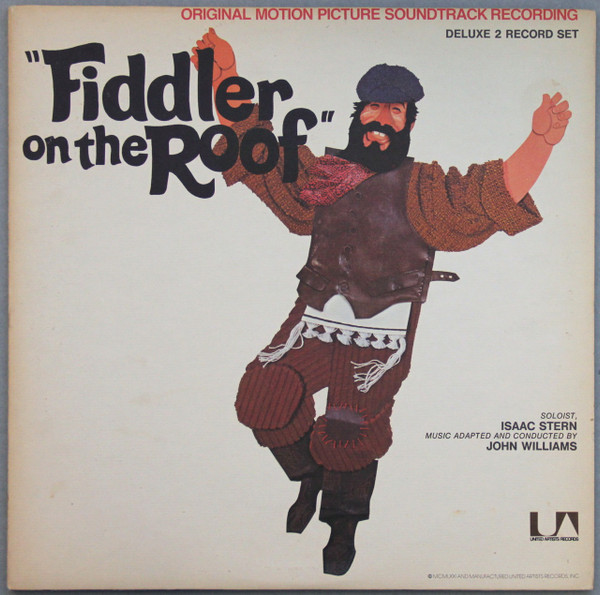
Original Motion Picture Soundtrack Recording – Deluxe 2-LP set (1971)
United Artists Records – UAS-10900

Original Motion Picture Soundtrack – CD Reissue (1986)
EMI America – CDP 7 46091 2
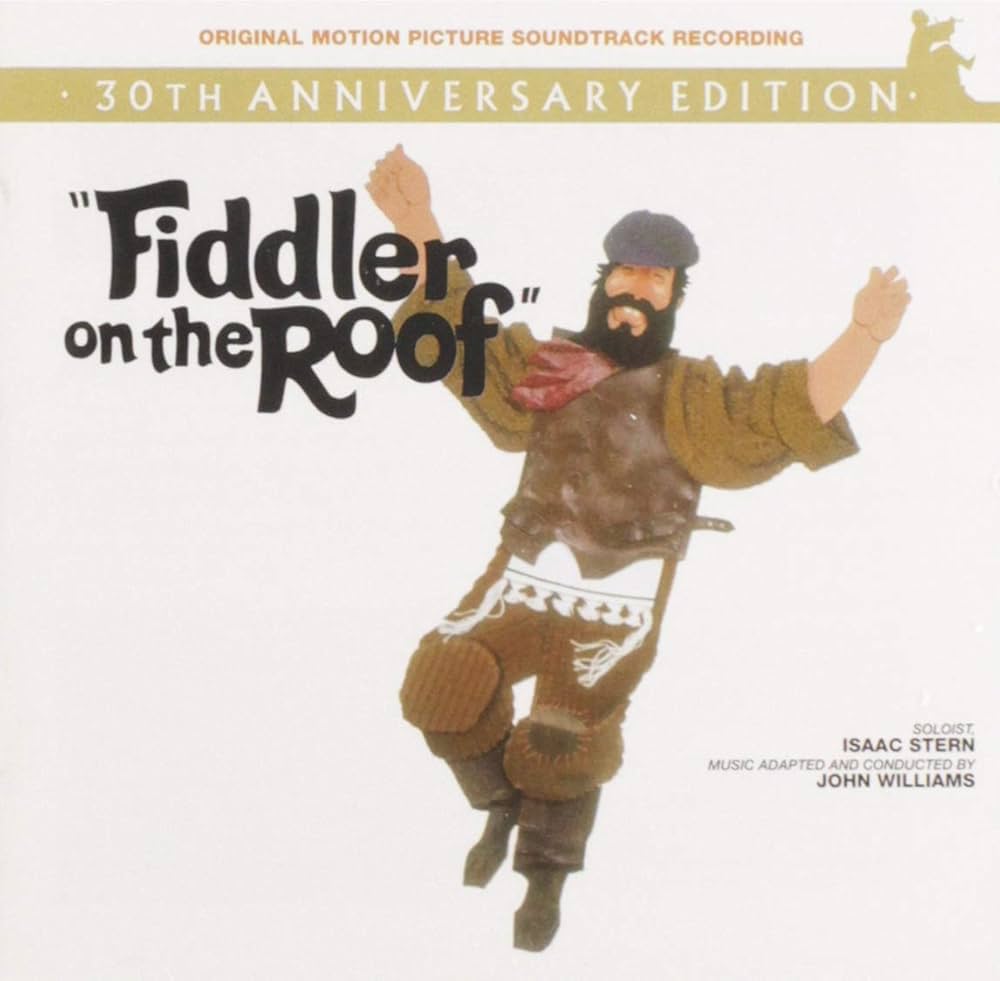
Original Motion Picture Soundtrack Recording – 30th Anniversary Edition – CD (2001)
EMI/Capitol – 72435-35266-2-7
Produced and Compiled by Gregg Ogorzelce and Cheryl Pawelski
Remixed by John Hendrickson
Mastered by Ron McMaster
Liner notes: Didier C. Deutsch
Remastered reissue of the original 1971 soundtrack album with three unreleased bonus tracks
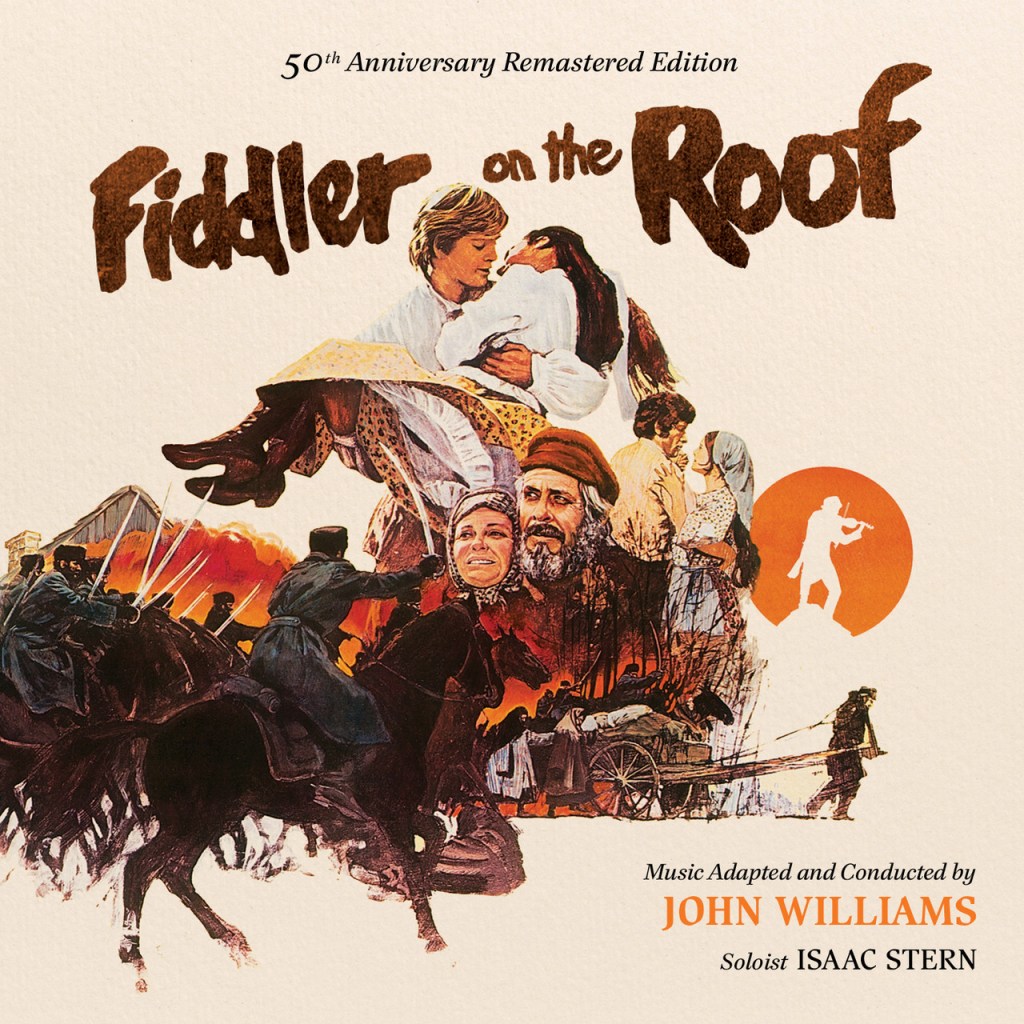
50th Anniversary Remastered Edition – 3-CD set (2021)
La-La Land Records LLCD 1576
Produced by Mike Matessino
Executive Producers: MV Gerhard, Matt Verboys
Music Restored, Mixed and Mastered by Mike Matessino
Liner notes: Mike Matessino
Remastered reissue of the original 1971 soundtrack album on Disc 1; alternate takes and unreleased score tracks on Disc 2; pre-recorded takes and additional score tracks on Disc 3
Selected Re-recordings

That’s Entertainment (1981)
Philips – 6302 124 (LP) – Philips Digital Classics – 416 499-2 (CD Reissue)
includes “Excerpts” from Fiddler On The Roof, adapted and arranged by John Williams
Emanuel Borok, violin
Boston Pops Orchestra conducted by John Williams
Produced by George Korngold

A John Williams Celebration: Opening Gala Concert (2015)
C Major – 730404 (Blu-ray)
contains “Variations and Cadenza” from Fiddler On The Roof, adapted and arranged by John Williams
Itzhak Perlman, violin
Los Angeles Philharmonic conducted by Gustavo Dudamel
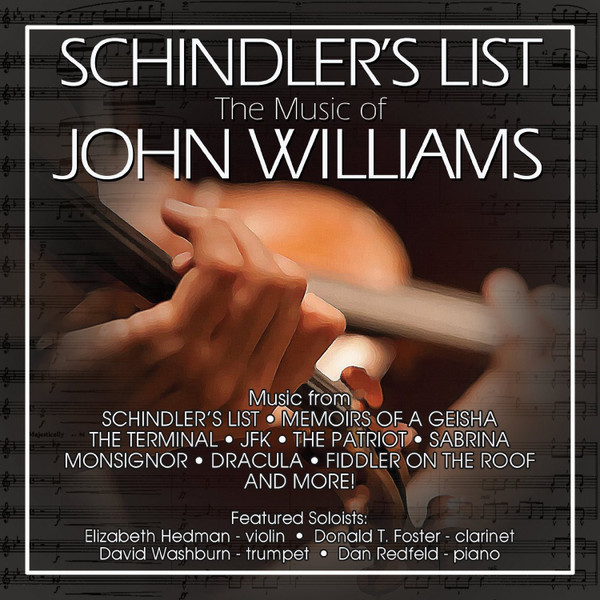
Schindler’s List: The Music of John Williams (2015)
BSX Records – BSXCD 9103
includes “Variations and Cadenza” from Fiddler On The Roof (for violin and piano), adapted and arranged by John Williams
Elizabeth Hedman, violin
Dan Redfeld, piano

Fiddler On The Roof – 2016 Broadway Cast Recording (2016)
Broadway Records – B01BDM2ZDI
includes “Variations and Cadenza” from Fiddler On The Roof, adapted and arranged by John Williams
Itzhak Perlman, violin
Fiddler Broadway orchestra
Awards and Nominations
1972 Academy Awards
Winner: Best Scoring: Adaptation and Original Song Score
In Williams’ Words
“Most musicians with a literate music education will know well the idiom and modalities of Jewish music. It was familiar to me, particularly being an American and having had so many Jewish teachers. But this was a wonderful opportunity for me to go to the music department of the university [of Jerusalem] and spend a couple of days listening and taking notes. All of this put me in a frame-of-mind, or a mode of listening, that I needed.” 1
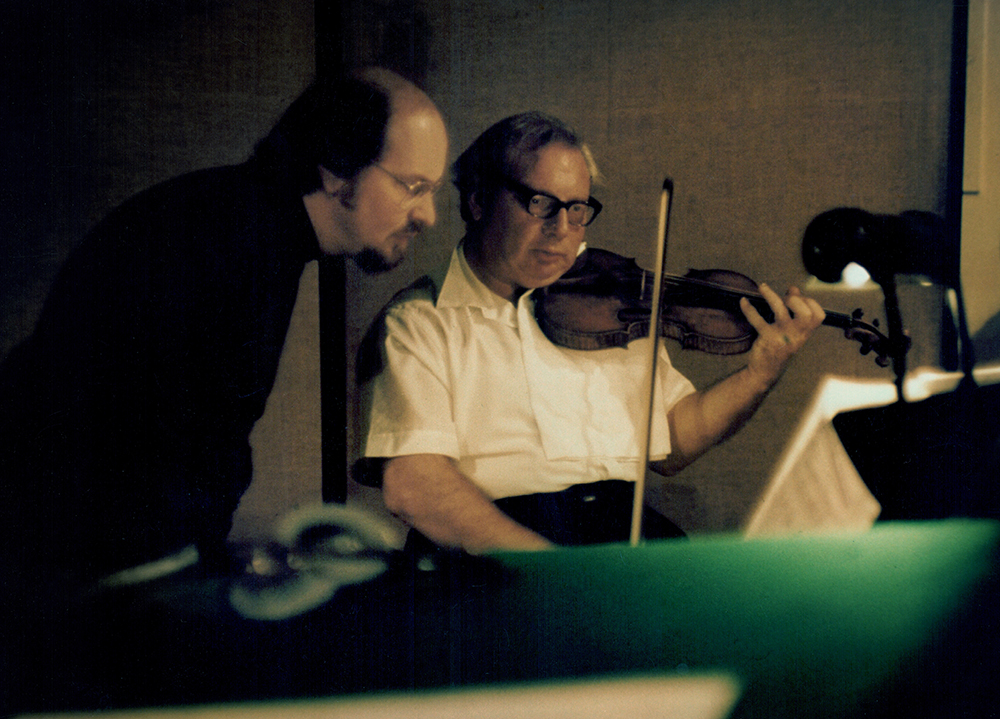
“I thought whoever made the choice of Norman Jewison for this film made a good one. I took the assignment extremely seriously, as I know Norman did also, because we had one of the most treasured and beloved pieces of American theatre being put in our hands to put onto the screen.” 2

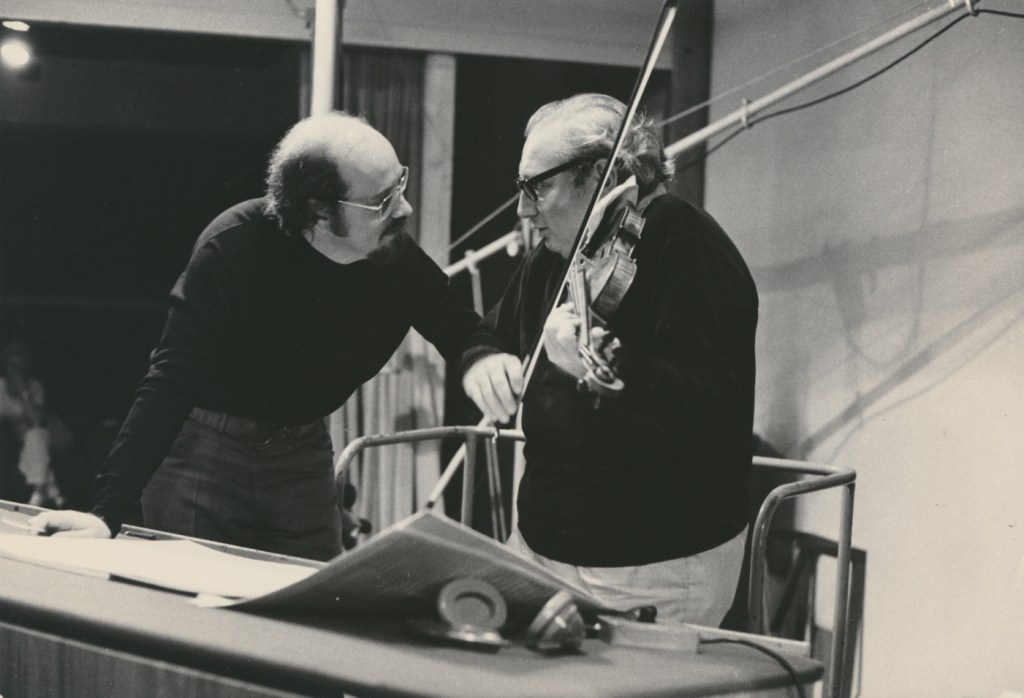
“We all felt that we were dealing with something almost sacrosanct, very tried-and-true and dear to people everywhere. So we didn’t want to change it all that much in bringing it to the screen, and I didn’t deviate any more from the original basic schemes of harmony and instrumental coloration than I felt to be absolutely necessary. Of course, I’d have been foolish to ignore the luxuries the film soundtrack offers, but I don’t think I ever blew up the scoring just for the sake of it. I used the full 90-piece symphony orchestra occasionally and special effects such as the zither and cimbalom-even a balalaika orchestra. (I had to go to the London Balalaika Club to learn how to write for them!) And it was fun having Isaac Stern to play the fiddler’s part (on the sound-track, I mean!). I forget how it came about, but I think the initial move must have come from Isaac. I wrote him a big cadenza in the prologue to give him a chance to come into his own, but you’ve only got to hear him play the Chava ballet sequence to realise how much the music is him and how much it means to him.” 3
Quotes and Commentary
“The adaptation was so right for the film. The arrangement never forfeited the honesty of the original score or the orchestration. It just embraced something that only John Williams could do, in just a wonderful, ideal way
for the film.” 4
– Jerry Bock

The music was obviously a subject of great importance. “I needed a brilliant composer/conductor,” Jewison succinctly told author Barbara Isenberg. Arrangers and conductors for the stage show had been considered, along with film musical veterans Walter Scharf and Roger Edens, but in September 1969, Mirisch was thrilled to receive a call from Marc Newman, agent for John Williams, conveying his client’s interest in Fiddler. He’d met Williams during the scoring of The Apartment, a 1960 Mirisch production on which Williams had served as session pianist. More recently, Williams had composed the score for the company’s 1967 production Fitzwilly. […]
At the time Mirisch received the momentous call, Williams had just completed adapting and conducting he score for Leslie Bricusse’s musical version of Goodbye, Mr. Chips. While the film joined a long list of late ’60s musical box office disappointments, buzz about the score was positive. Williams worked on it in London for much of 1968 and the entire first half of 1969, during which time he also won an Emmy for his television score to Heidi, and had his “Sinfonietta for Wind Ensemble” premiered at the Eastman School of Music in Rochester, New York. It was a key period of creative development for the composer. Williams wrapped up Chips with work on the soundtrack album after his return to California in mid-June 1969. At the end of August, director Mark Rydell asked him to compose a score for The Reivers. Written in an idiom best described as Americana, the project later became widely considered to be a line of demarcation in Willams’ composing style.
Just as The Reivers was about to begin scoring, Williams met with Jewison.
They discovered that they’d technically collaborated before: Williams had done some arrangements for the Jewison-directed 1962 TV special, The Judy Garland Show. Williams remembered that Jewison “was absolutely fabulous with singers and performers.” […]
Jewison’s first question was who they could get to do the actual fiddling. “He asked, ‘ Who’s the greatest violin player in the world?,’” Williams recalled. “I said, ‘Isaac Stern.’ And Norman, shocked, said, ‘How do we get him to do it?’ and I said, ‘ You ask him.’” Jewison flew to Chicago on October 1, where Stern was about to perform Beethoven’s Violin Concerto in D Major with the Symphony. Stern asked Jewison why he had come all this way, and the director replied, “Because I wanted to look in your eyes and tell you there’s only one fiddle player in the world who should play this, and it’s you.” After clarifying that a dancer would be hired to appear in the actual film, to be matched to recordings that Stern would make in a studio, the violinist said, “That would be fine. Send me the music.” Jewison reflected: “All the Mirisch brothers saw was money going out the window. I was going to spend a fortune on somebody to play background music. But I became totally committed to Isaac Stern. I even offered to pay for him myself, have the money taken out of my fee for the film. They said, ‘No, we couldn’t do that,’ but that’s how strongly I felt about it.” 5
-Mike Matessino
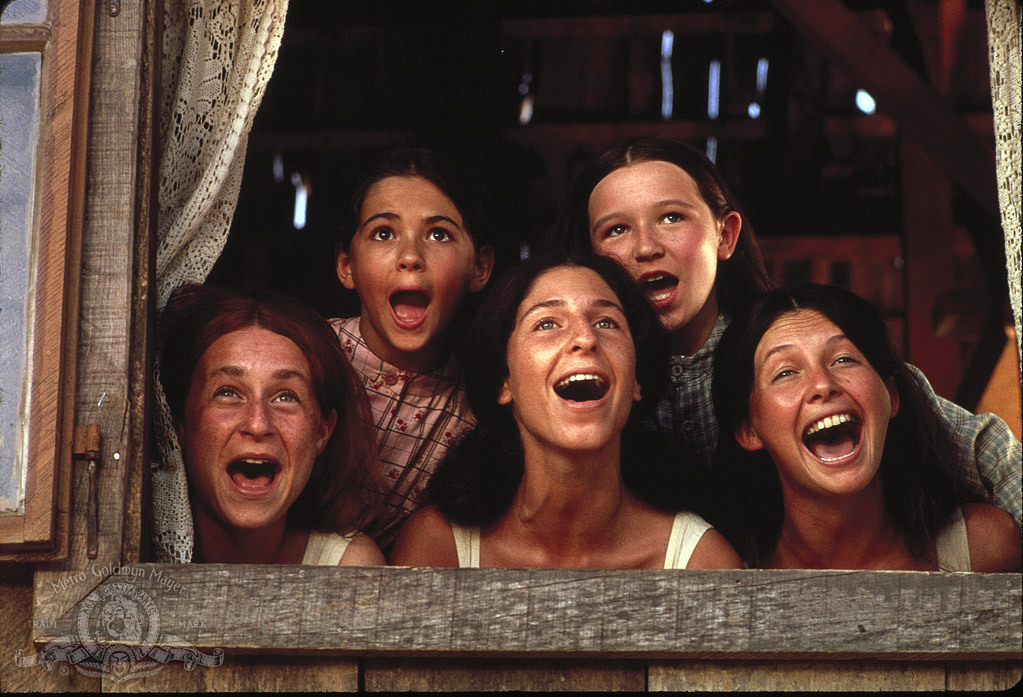
Videos
“John Williams: Creating a Musical Tradition” | DVD Featurette | M-G-M Home Entertainment | 2006
John Williams talks about the challenges of making Fiddler On The Roof before a screening in Hollywood Sunday with director Norman Jewison and casting director Lynn Stalmaster | Turner Classic Movies | 2011
John Williams reminisces on his first Oscar-winning score Fiddler On The Roof | 2022
“‘Tradition!’” from Fiddler On The Roof
“If I Were A Rich Man” scene from Fiddler On The Roof
“To Life” scene from Fiddler On The Roof
“Miracle of Miracles’” scene from Fiddler On The Roof
Itzhak Perlman performs John Williams’ “Variations and Cadenza” from Fiddler On The Roof | Los Angeles Philharmonic conducted by Gustavo Dudamel | C Major Entertainment | 2014
John Williams conducts “Excerpts” from Fiddler On The Roof with the Los Angeles Philharmonic Orchestra | Bing Wang, violin | Hollywood Bowl, Los Angeles | 2022
Bibliography and References
. Elley, Derek – “The Film Composer: John Williams, Pt.1,” Films And Filming, July 1978
. Isenberg, Barbara – Tradition!: The Highly Improbable, Ultimately Triumphant Broadway-to-Hollywood Story of Fiddler on the Roof, the World’s Most Beloved Musical, St. Martin’s Griffin, 2015
. Matessino, Mike – A Much Bigger Circle: Scoring ‘Fiddler On The Roof,’ essay contained in Fiddler On The Roof – 50th Anniversary Remastered Edition, La-La Land Records, 2021
. Palmer, Christopher – “Composer John Williams: A Profile,” Crescendo Music International Magazine, April 1972
Legacy of John Williams Additional References
. Tradition! John Williams and ‘Fiddler On The Roof,’ podcast episode on the 50th Anniversary Soundtrack Edition, with producer Mike Matessino
. Back To Anatevka: More Talk on ‘Fiddler On The Roof’ 50th Anniversary, podcast episode with producer Mike Matessino and Broadway music director Andy Einhorn
Footnotes
 The Legacy of John Williams