

Table Of Contents
- Film Details
- Music Credits
- Essential Discography
- Quotes and Commentary
- Videos
- Bibliography and References
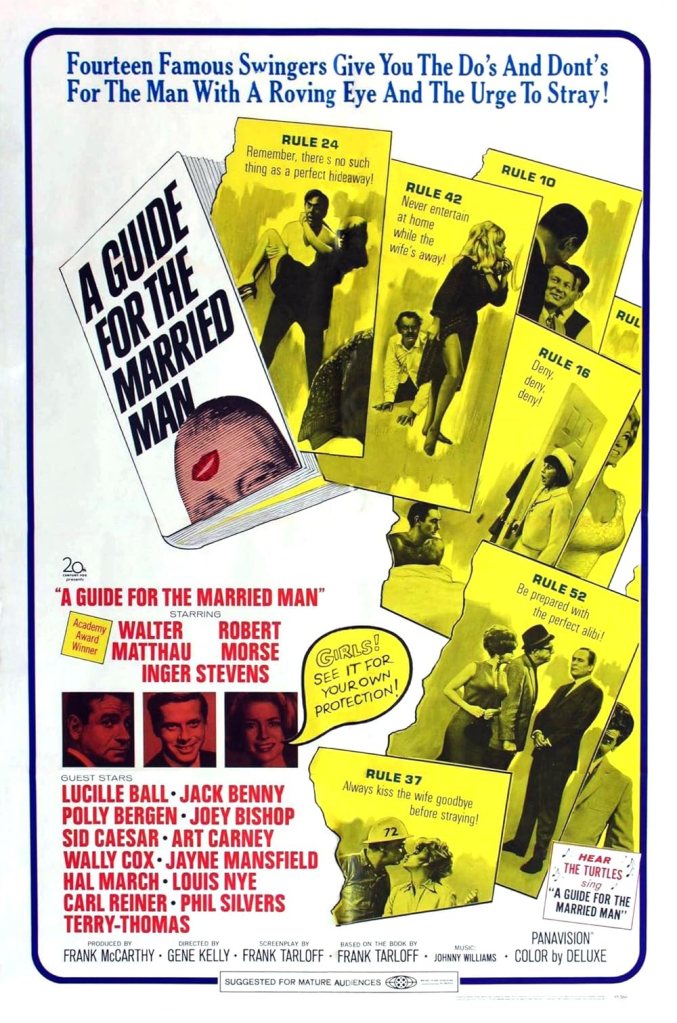
Film Details
Year: 1967
Studio: 20th Century Fox
Director: Gene Kelly
Producer: Frank McCarthy
Writer: Frank Tarloff, based on his book
Main Cast: Walter Matthau, Robert Morse, Inger Stevens, Sue Ane Langdon, Elaine Devry, Jackie Joseph; with cameo appeareances of Lucille Ball, Jack Benny, Polly Bergen, Joey Bishop, Sid Caesar, Art Carney, Wally Cox, Jayne Mansfield, Hal March, Louis Nye, Carl Reiner, Phil Silvers, Terry Thomas
Genre: Comedy
For synopsis and full cast and crew credits, visit the IMDb page
Music Credits
Music Composed and Conducted by John Williams (credited as “Johnny Williams”)
“A Guide for the Married Man”
Music by Johnny Williams
Lyrics by Leslie Bricusse
Performed by The Turtles
Orchestra Contractor: Urban Thielmann
Librarian: Fred Combattente
Orchestrator: Herbert Spencer
Recorded at 20th Century Fox Scoring Stage, Century City, California

Essential Discography

Single – 45rpm vinyl (1967)
White Whale – WW 251
Features the song “Guide for the Married Man” performed by The Turtles (also available in their 1967 album Happy Together)

Original Motion Picture Soundtrack – FSM Silver Age Classics – CD (2000)
Film Score Monthly – FSMCD Vol.3 No.5
Produced by Lukas Kendall and Nick Redman
Associate Producer: Jeff Eldridge
Restoration and Sequencing by Mike Matessino
Mastered by Dan Hersch
Liner notes: Jeff Eldridge
Premiere release of the original film soundtrack

Quotes and Commentary
During the first decade of his career in Hollywood, John Williams’ film scoring assignments spanned the gamut of familiar genres: juvenile delinquent and exploitation films (Daddy-O, Because They’re Young, I Passed for White), dramas (Diamond Head, The Killers), espionage and war films (The Secret Ways, None But the Brave), westerns (The Rare Breed, The Plainsman) and no fewer than eight comedies. With the exception of Gidget Goes to Rome, this last group of entries in Williams’ filmography can be divided into two distinct sub-genres: the caper comedy (How to Steal a Million, Penelope, Fitzwilly) and the sex farce (Bachelor Flat, John Goldfarb Please Come Home, Not With My Wife You Don’t, and A Guide for the Married Man). […]
A Guide for the Married Man posed additional challenges for John Williams: because the film skips quickly from one sequence to another, tied together by voiceovers, the score was required not only to support the comedic action, but to tie the disparate sequences into a seamless whole. While binding together the many scene changes and underlining the visual jokes with the musical equivalent of a wink and a nod, Williams’ music is also given a strong narrative voice in the storytelling.
Afforded many opportunities to pastiche and parody various film music conventions, Williams often uses as a model the ballet scores of Prokofiev and Shostakovich (by way of Carl Stalling) to underscore many sequences with the appropriate musical tongue in cheek. It is not surprising that the score would be balletic in nature, given Gene Kelly as the director and given that many sequences include finely choreographed slapstick. […]
Williams’ score for A Guide for the Married Man is a veritable catalog of the diverse styles in which he had become adept at writing over the previous decade: everything from goofy, faux-hip source music to bold orchestral scoring featuring brass fanfares and his trademark woodwind runs. Astute listeners will note many instances which foreshadow the music he would provide a decade later for space epics and adventure films; heard in retrospect, the score is a fascinating glimpse at musical ideas that would later become famous in everything from Close Encounters to The Phantom Menace.1
-Jeff Eldridge

Equally rich in Mickey-Mousing episodes is A Guide for the Married Man, where music has a foregrounded position and an extensive presence, partly because of the film’s farcical nature, and partly because of director Gene Kelly’s dance background. The pantomime-like nature of the score is evident from the outset. The title song starts on the shot of a buxom female neighbor wiggling her hips, the rhythm of the song synchronized with the woman’s enticing walking. The film showcases many instances of Mickey-Mousing:
the gestures of a worker who hooks up the phone and shrugs his shoulders –
after lying to his wife – is ironically accompanied by the xylophone; a stereotypical gong hit points out the presence of a Chinese man on the tarmac of an aiport; an upward violins and harp glissando replicates the night breeze coming through window; the Romanoff’s restaurant scene is practically a silent film piece accompanied by music,. which at one point renders a woman’s enraged cries with furious sforzando horns rips. The cartoonlike scene in which an unfaithful husband hastily flees, forgetting his shoes in his mistress’ home, also has, again, neither dialogue nor sound but only foregrounded music: explicit sync points stress his jumping off the wall, the surprise when he realizes tha he is barefoot, his pantomimic slapping his forehead in disappointment, and his taking off his hat to greet a shoe salesman when he enters the shop.2
– Emilio Audissino
Videos
“Prologue and Main Title” from A Guide for the Married Man | 20th Century Fox
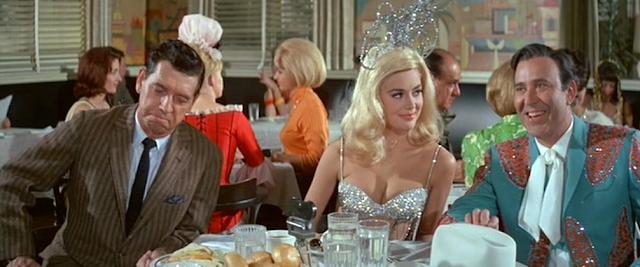
“Romanoff’s” scene from A Guide for the Married Man | 20th Century Fox
The Turtles perform “Guide for the Married Man” | 1967
Bibliography and References
Audissino, Emilio – “Williams’ Early Years: Spotting the First Traces of Neoclassicism,” The Film Music of John Williams, University of Wisconsin Press, 2021
. Audissino, Emilio / Huvet, Chloé – “Irony, Comic, and Humor: The Comedic Side of John Williams,” The Palgrave Handbook of Music in Comedy Cinema, Palgrave-Macmillan, 2023
. Eldridge, Jeff – A Guide for the Married Man – Original Motion Picture Soundtrack liner notes, Film Score Monthly, 2000
Footnotes
 The Legacy of John Williams