
Table Of Contents
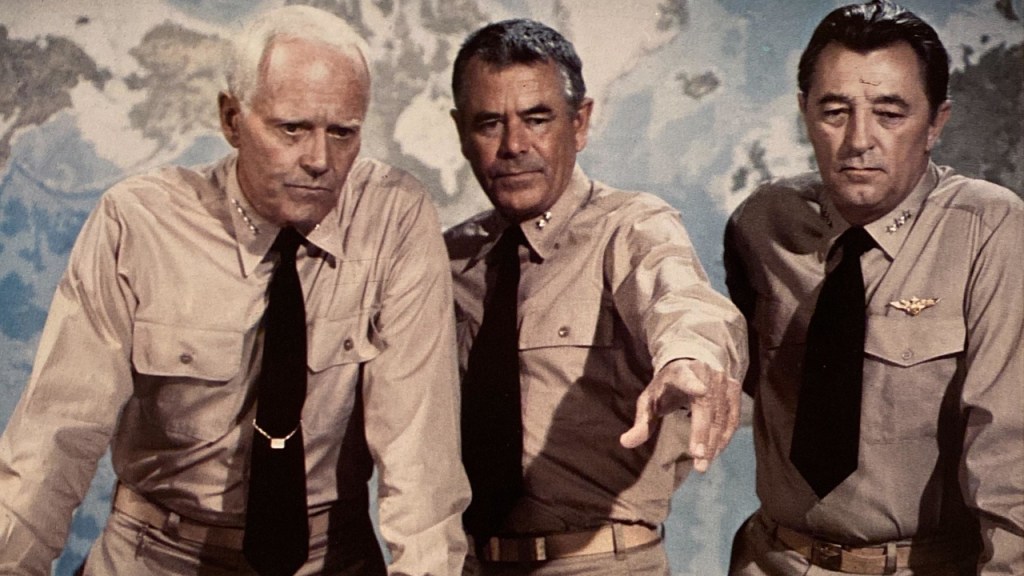
- Film Details
- Music Credits
- Essential Discography
- In Williams’ Words
- Quotes and Commentary
- Videos
- Bibliography and References

Film Details
Year: 1976
Studio: Universal Pictures
Director: Jack Smight
Producer: Walter Mirisch
Writer: Donald S. Sanford
Main Cast: Charlton Heston, Henry Fonda, James Coburn, Glenn Ford, Hal Holbrook, Toshiro Mifune, Robert Mitchum, Cliff Robertson, Robert Wagner, Robert Webber, Ed Nelson, James Shigeta, Christina Kokubo, Pat Morita
Genre: Drama – War
For synopsis and full cast and crew credits, visit the IMDb page
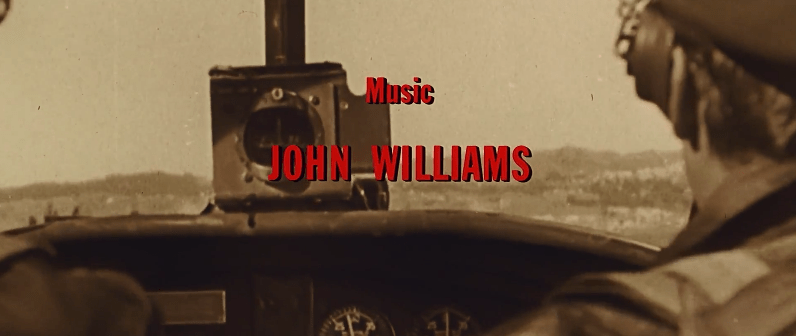
Music Credits
Music Composed and Conducted by John Williams
Orchestra Contractor: Sandy DeCrescent
Concertmaster: Israel Baker
Recorded at Universal Studios Stage 10, Studio City, California
Recording Dates: December 2 and 3, 1975
Essential Discography
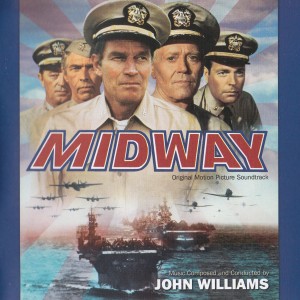
Original Motion Picture Soundtrack – Limited Edition CD (2011)
Varèse Sarabande – VCL 1011 1124
Produced by Robert Townson
Mixed and Edited by Mike Matessino
Mastered by Erick Labson
Liner Notes: Mike Matessino
Premiere release of the original film score recording

Single – 45rpm vinyl (1976)
MCA Records – MCA-40575
Produced by John Williams
Contains “Midway March” on Side A and “Men of the Yorktown March” on Side B
Selected Re-recordings
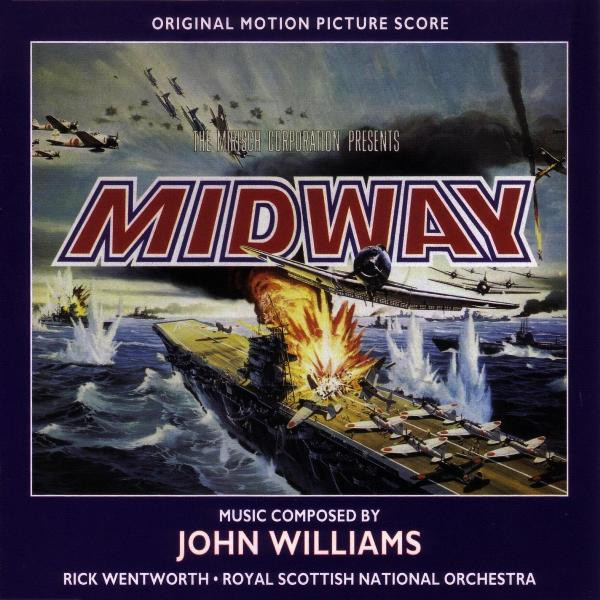
Original Motion Picture Score (1998)
Varèse Sarabande – VSD-5940
Royal Scottish National Orchestra conducted by Rick Wentworth
Produced by Robert Townson
Recording Engineer: Jonathan Allen
Re-recording of the full film score
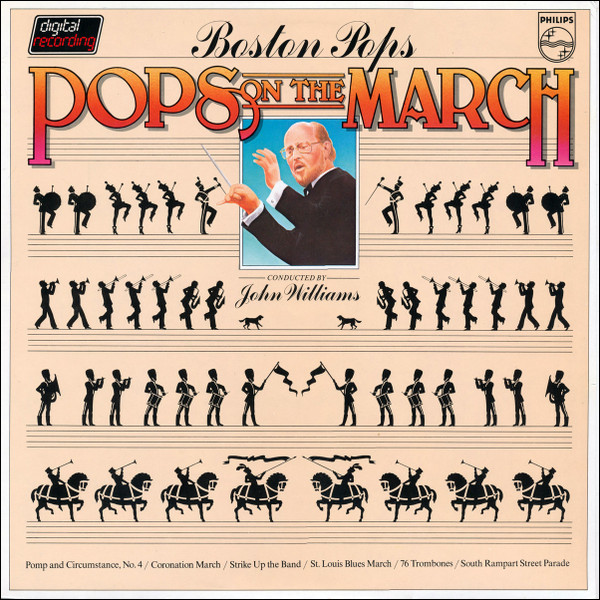

Lights, Camera… Music! Six Decades of John Williams (2017)
BSO Classics – 1704
Includes “Men of the Yorktown March” from Midway
Boston Pops Orchestra conducted by Keith Lockhart
In Williams’ Words
“The Battle of Midway was one of the great events in the history of the United States Navy. It was wonderful to see the recent reunion of American and Japanese veterans joining in peace and warm friendship, as they’ve searched to locate the site of the great struggle.
When I was young, I remember my father recounting to me that, during his childhood, he’d heard and seen John Philip Sousa conduct his famous band. And so, when the opportunity emerged to compose music for the film Midway, I tried to write an orchestral march that would be American in spirit, with a jazzy nautical swagger, and would fit squarely in the tradition of the great American marches that I’ve loved since my youth.”1

“I played military bands when I was a member of the Air Force briefly. I played in bands in school. I did band arrangements actually before I did orchestrations and all of the material for Midway is orchestral, it’s also band-like in a way, so I was happy about the opportunity to do this film for Walter Mirisch and happy to contribute what I could on the subject of the Battle of Midway.”2
Quotes and Commentary
As the theme for Midway, John Williams wrote what has become one of his most famous pieces — The Midway March. A soundtrack of Williams’ score was not issued at the time of the film’s release and, despite many performances of the march during both the composer’s numerous guest conducting appearances around the world, and during his Boston Pops tenure, nothing more than the march itself was ever commercially released. Until now, however, this constituted the entire recording history of what would end up being some of the final music John Williams would compose before the most impactful score of his life. As a glimpse of music composed during a turning point in the career of this composer, Midway is a fascinating example. Success on the scale of Star Wars (1977) tends to obscure everything that had come before. The general public is given the impression that, regardless of how many “dues-paying-years” may lie behind someone, they are now labeled an “overnight success.” However John Williams had been one of film music’s greats for a full decade before his galactic journeys began. He was already a two time Oscar winner, had, by this time, composed such scores as The Reivers, Jane Eyre, The Cowboys, The Paper Chase, his disaster triptych of The Poseidon Adventure, The Towering Inferno and Earthquake, and was already two films into his relationship with director Steven Spielberg (The Sugarland Express and Jaws).3
-Robert Townson
Midway‘s only antecedent in Williams’ canon is his score for None But The Brave, a 1965 Warner Bros. film that has the distinction of being the only feature directed by Frank Sinatra. This story of two groups of soldiers marooned on the same island — one Allied, one Japanese — gave Williams the opportunity to explore sonorities that evoked a Japanese flavor and an overall militaristic vibe. While the composer was then known more for jazzy comedies (he was then credited as “Johnny”), None But The Brave is an unexpectedly expansive work which, in conjunction with Midway a decade later and its one legitimate descendant, Spielberg’s Saving Private Ryan from 1998, create a decade-spanning troika of the composer’s scores for World War Il combat tales.
Surveying how each was approached musically illuminates the evolution of cinematic treatment of such stories. Musically, while Williams’ distinctive voice is clear, none is like the others, a tribute to the versatility that has kept the composer at the top of his field.
What immediately sets Midway apart from the other two scores is the inclusion of a straightforward patriotic march. Although in the film it is heard fleetingly, apart from the “End Credits,” its presence (appropriate to the project’s bicentennial vibe) prefigures Williams’ later association with patriotic music that came with his 1980 posting as principal conductor of the Boston Pops Orchestra. A concertized version of “The Midway March” was, in fact, among the first of Williams’ works recorded with the orchestra.
Eventually it became part of his performance repertoire, although it appeared less frequently than works such as “Olympic Fanfare,” “The Liberty Fanfare,” “Celebrate Discovery” and the composer’s popular marches from his blockbuster scores for Superman, Star Wars and Raiders Of The Lost Ark. Also remarkably resilient, and thus not to be overlooked, is his “March from 1941,” the main theme for Spielberg’s manic World War II comedy which, musically, melds Williams’ patriotic, militaristic and comedic modes in a score as epic as that for any Star Wars film. Despite the long shadows cast by these later works, “The Midway March” is a reverent tribute to the Armed Forces and stands equally among Williams’ other festive concert writing.
The actual main theme heard in the score to Midway is the more melancholy “Men Of The Yorktown March,” which characterizes the sacrifice of war and a yearning for home and family (this theme has also occasionally been performed in concert). The motif’s versatility is demonstrated with a short, sentimental statement over the film’s sepia-tinted prologue before serving as a martial countermelody over footage depicting B-25s launching on the April 1942 Doolittle Raid, America’s first strike on Japan following the Pearl Harbor attacks four months earlier. The theme only returns occasionally and briefly, the generally sparse surrounding cues largely devoted to the aforementioned strategy meetings, character moments and key bits of establishing action as fighters launch and carriers get underway. Where the scoring does extend into action sequences, it tends to quickly set up the jeopardy and then withdraw, allowing the film to do what it sets out to accomplish: present actual events realistically.
Compositionally Williams allows all sections of the traditional symphony orchestra equal footing, expectedly making use of martial percussion, staccato piano figures and open chords to evoke the Japanese, and long phrases of brass and strings to enhance the tension, anticipation or action as necessary.
Listeners familiar with the composer’s work of the period will clearly detect a tendency toward a broader presence and a general mood of optimism despite the drama of the proceedings. This move away from the doom-laden writing for the earlier disaster scores seemed to begin with the refreshingly upbeat sea chases in Jaws and carry forward into Star Wars, a transition reflective of the movies themselves which, in turn, reflected shifting cultural moods at the time they appeared. Midway clarifies this through-line perfectly, making Star Wars seem almost inevitable.4
– Mike Matessino
Videos
The Score of Midway | DVD bonus feature | Produced, Written and Directed by Laurent Bouzereau | Universal Home Entertainment | 2001
“Prologue and Main Title” from Midway, 1976
End Credits from Midway, 1976
“The Men of the Yorktown March” from Midway | Film Symphony Orchestra conducted by Constantino Martínez-Orts
Brett Mitchell performs his original piano arrangement of “The Men of The Yorktwon” from Midway
Bibliography and References
. Bouzereau, Laurent – The Score of Midway,’ DVD featurette, Universal Home Entertainment, 2001
. Dyer, Richard – “Where is John Williams coming from?,” The Boston Globe, June 29th, 1980
. Matessino, Mike – “The Battle of Midway,” Midway – Original Motion Picture Soundtrack liner notes, Varèse Sarabande, 2011
Footnotes
- Introductory note to “Midway March” – John Williams Signature Edition Orchestra, Hal Leonard 04490379 ↩︎
- From The Score of Midway DVD featurette, Universal Home Entertainment, 2001 ↩︎
- Townson, Robert – Midway – Original Motion Picture Score liner notes, Varèse Sarabande, 1998 ↩︎
- Matessino, Midway – Original Motion Picture Soundtrack liner notes, Varèse Sarabande, 2011 ↩︎
 The Legacy of John Williams