

Table Of Contents
- Film Details
- Music Credits
- Essential Discography
- In Williams’ Words
- Quotes and Commentary
- Videos
- Bibliography and References

Film Details
Year: 1979
Studios: Universal Pictures/Columbia Pictures
Director: Steven Spielberg
Producer: Buzz Feitshans
Executive Producer: John Milius
Writers: Robert Zemeckis & Bob Gale, John Milius
Main Cast: Dan Aykroyd, Ned Beatty, John Belushi, Lorraine Gary, Murray Hamilton, Christopher Lee, Tim Matheson, Toshiro Mifune, Warren Oates, Robert Stack, Treat Williams, Nancy Allen, Eddie Deezen, Bobby Di Cicco, Dianne Kay, Slim Pickens, Wendie Jo Sperber, Lionel Stander
Genre: Comedy – War
For synopsis and full cast and crew credits, visit the IMDb page
Music Credits
Music Composed and Conducted by John Williams
“Swing, Swing, Swing” featuring Abe Most (clarinet) and Louie Bellson (drums)
Music Editor: Kenneth Wannberg
Scoring Mixer: John Neal
Assistant Engineer/Stage Manager: Bobby Fernandez
Music Preparation: JoAnn Kane Music Service
Orchestra Contractor: Marion L. Kline
Concertmaster: Paul Shure
Orchestrator: Herbert W. Spencer
Recorded at Warner Bros. Scoring Stage, Burbank, California
Recording Dates: August 27, 28, 29, 30, September 12, 14, 17, 20, 27, and November 9, 1979

Essential Discography
Original Soundtrack Album and Expanded Reissues

Original Motion Picture Soundtrack – LP (1979)
Arista – AL 9510
Album Produced by John Williams

Original Motion Picture Soundtrack – CD (1989)
Bay Cities – BCD 3005
Reissue Produced by Nick Redman
Executive Producers: Bruce Kimmel, Alain Silver, Michael Rosen
Mastered by Dan Hersch
Premiere CD reissue of the 1979 original soundtrack album

Original Motion Picture Soundtrack – CD (1989)
Alhambra – A 8913
CD reissue of the 1979 original soundtrack album; released only in European countries

Original Motion Picture Soundtrack – CD (1997)
Varèse Sarabande – VSD-5832
Executive Producer: Bruce Kimmel, Michael Caprio
CD reissue of the 1979 original soundtrack album

Expanded Original Motion Picture Score (2011)
Limited Edition 2-CD set
La-La Land Records LLCD 1179
Produced by Mike Matessino (La-La Land); Didier C. Deutsch and Mark G. Wilder (Sony Music)
Remix and Assembly by Mike Matessino
Mastered by Mark G. Wilder
Liner Notes: Mike Matessino
Expanded film score presentation on Disc 1; remastered 1979 original soundtrack album plus additional music on Disc 2
Selected Re-recordings

By Request… The Best Of John Williams And The Boston Pops – CD (1987)
Philips Classics – 420 178-2
contains “March” from 1941
Boston Pops Orchestra conducted by John Williams
Produced by John McClure

The Spielberg/Williams Collaboration – CD (1990)
Sony Classical SK 45997
contains “March” from 1941
Boston Pops Orchestra conducted by John Williams
Produced by Thomas Z. Shepard
Engineered by Bud Graham

Williams on Williams: The Classic Spielberg Scores – CD (1995)
Sony Classical SK 68419
contains “The Battle For Hollywood” from 1941
Boston Pops Orchestra conducted by John Williams
Produced and Engineered by Shawn Murphy

In Williams’ Words
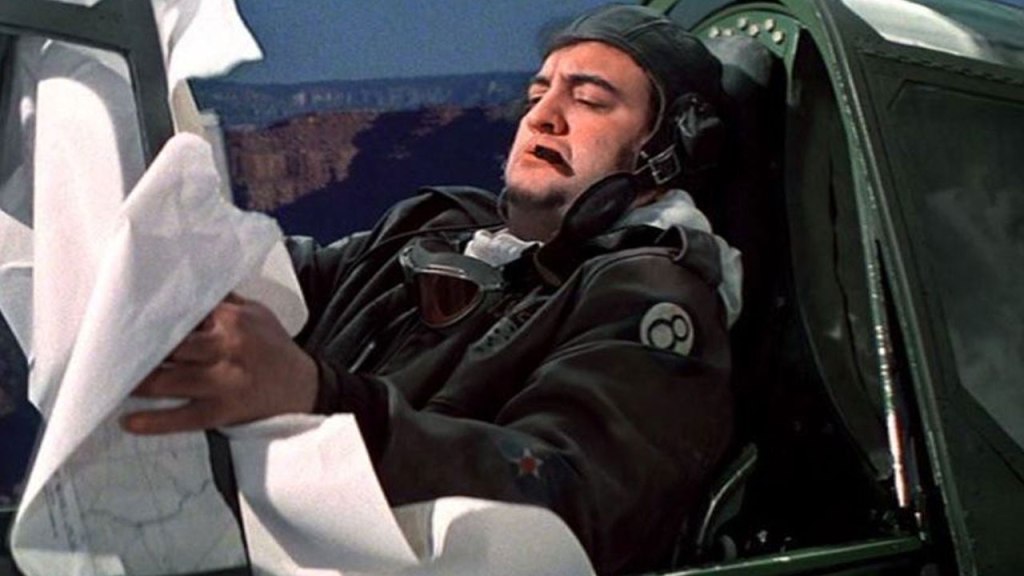
“Steven Spielberg’s hilarious comedy 1941 featured the late actor John Belushi brilliantly portraying a character known as Wild Bill Kelso.
Kelso was a crazy, impertinent but lovable Air Force pilot whose antics seemed to require a musical accompaniment that had humor and rhythmic vitality. As a result, I set myself the task of writing a zanily patriotic march that upon hearing, we might be moved to tap our feet to an imaginary parade going by, and have fun doing it.” 1

“I felt, and Steven did also, that certain characters, I think especially John Belushi, that he should be characterized by a typical World War II American march, of the kind that I grew up with as a child and played with even in school. And that march has a kind of jazzy, almost southern swagger to it… and the accents are tilted and the sync-ups are a little bit off, and it’s a little bit impertinent in its character.” 2
Quotes and Commentary
On his film score for Jaws, John Williams became half pirate, half shark. On Close Encounters of the Third Kind, he was part Star Child, part Super Nova. Finally, with “1941,” John went half crazy and all gung-ho attempting to fit a score to a movie that tries to make World War II a Comedy Spectacular. Film humor is sticky business. In order for it to succeed, it must always have one foot firmly on the ground, no matter what colour sock the other foot is wearing.
“1941” is about a mix of characters whose reaction to the “Invasion of Hollywood” is at times so extreme that we wonder what on earth is keeping them from blasting into orbit. John’s score is a major reason. It is so brazenly dramatic, so brimming with guts and glory, that if you hear the album before seeing the movie you’ll probably wonder just how much comedy “1941” really has. We hope it’s “Full of it”. If you agree, it is due in large part to ninenty minutes of incredible music that underscores the most liberate reinterpretation of American History since Butch Cassidy and Sundance Kid.3
– Steven Spielberg

“1941 is one of my two or three favorite Williams scores. I consider it perfect movie music. It captures the spirit and tone of the film perfectly, it enhances the scenes, evokes the period, and yet it’s thematic enough to listen to all by itself.” 4
– Bob Gale, screenwriter

In an unusual move, just days after preparing the Superman soundtrack album, Williams found himself conducting music for 1941. A specially filmed teaser trailer, directed by Milius and featuring Belushi as “Wild Wayne Kelso,” required an original score, which Williams recorded on December 6, 1978. While he made no effort to commit to actual themes for the film (which had only been shooting since late October), the composer still had to find the basic mood and approach for which the filmmakers were aiming.
One more component of 1941 required consultation with Williams prior to the actual scoring of the movie. Somewhere in Spielberg’s mind was a vision of 1941 as a full-blown old-fashioned Hollywood musical. He had discussed it with Williams, but in the end distilled the idea into what became the film’s musical centerpiece: the U.S.O. jitterbug contest.
The sequence in the original Zemeckis/ Gale script resulted from the writers discovering big band music in their research, which, Gale relates, “we had previously pretty much ignored as ‘that stuff our parents liked.’ What a revelation then to discover that we really liked it, too—and that our parents really didn’t have such bad taste! We were so taken with the Andrews Sisters that we wrote ‘The Anderson Sisters’ into our script as the entertainment at the U.S.O. dance. We also discovered the great Benny Goodman. And once we heard the ten-minute version of ‘Sing, Sing, Sing’ we knew that it was the perfect music for the big dance sequence…Steven loved it, and it was used as ‘playback’ on the set when the dance number was choreographed and filmed.” Ultimately, the filmmakers would not use “Sing, Sing, Sing.” “The editing of the film changed the structure of the music,” Gale explains, “so for dramatic reasons, John Williams composed his own version of it.” In 1995, Williams elaborated that “we decided we would not use the Goodman music but that I would attempt to write a parody of this that might even be recognized by those who would remember the Goodman piece….And I called my piece ‘Swing, Swing, Swing,’ —a little play-on-word thing there with that…”
Williams composed the score for 1941 during the summer of 1979. […] Sessions began August 27 on the Warner Bros. Scoring Stage at the Burbank Studios, the joint Warner/Columbia lot where some of the film had been shot. Composer David Newman, who played violin on the recording, recalls: “It was a fantastic score. I think that Spielberg and John had a great time on the movie. They loved hearing the orchestra howl with laughter looking at the scenes…I also remember Steven served champagne to the entire orchestra at the end of the sessions.” 5
– Mike Matessino

Videos
“The Making Of 1941” – Music segment | Directed and Produced by Laurent Bouzereau | Universal Home Entertainment | 1996
John Williams conducts the Boston Pops in “March from 1941” | PBS Evening at Pops | May 1990
John Williams Conducts the US Marine Band (“The President’s Own”) in “March from 1941” | UCLA Royce Hall | October 2019
“Entrance of Wild Bill Kelso” scene from 1941
“The Jitterbug Contest” scene from 1941
1941 teaser trailer (featuring original music by John Williams)
Bibliography and References
. Audissino, Emilio / Huvet, Chloé – “Irony, Comic, and Humor: The Comedic Side of John Williams,” The Palgrave Handbook of Music in Comedy Cinema, Palgrave-Macmillan, 2023
. Matessino, Mike – “‘There Will Be No Bombs Dropped Here!!!’,” 1941 – Expanded Original Motion Picture Score liner notes, La-La Land Records LLLCD 1179, 2011
. Moorman, Peter – Spielberg-Variationen: Die Filmmusik von John Williams, Nomos Verlagsgesellschaft, 2010
Footnotes
- Williams, Introductory note to “March from 1941,” John Williams Signature Edition for Orchestra, Hal Leonard ↩︎
- Williams, “The Making of 1941,” documentary by Laurent Bouzereau, 1996 ↩︎
- Spielberg, 1941 – Original Motion Picture Soundtrack sleeve notes, Arista Records, 1979 ↩︎
- Gale, 1941 – Original Motion Picture Soundtrack liner notes, Bay Cities, 1990 ↩︎
- Matessino, 1941 – Expanded Original Motion Picture Score liner notes, La-La Land Records, 2011 (see bibliography) ↩︎
 The Legacy of John Williams