
Table Of Contents
- Film Details
- Music Credits
- Essential Discography
- Awards and Nominations
- In Williams’ Words
- Quotes and Commentary
- Videos
- Bibliography and References
Film Details
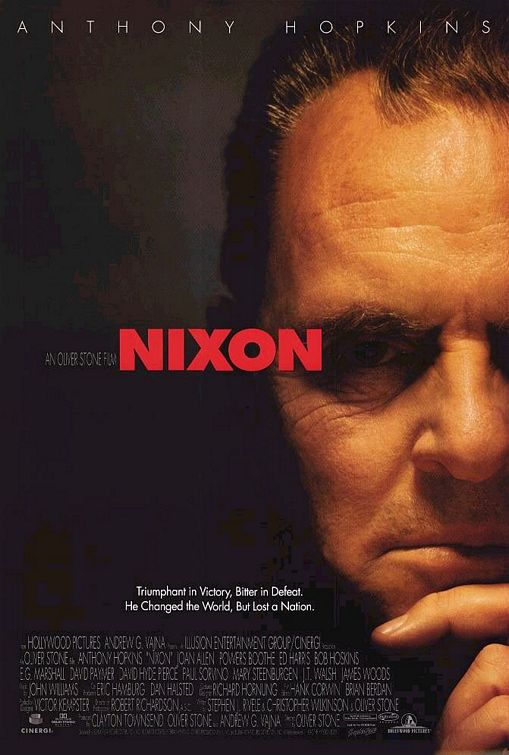
Year: 1995
Studios: Hollywood Pictures/Cinergi
Director: Oliver Stone
Producers: Clayton Townsend, Oliver Stone, Andrew G. Vajna
Co-Producers: Dan Halsted, Eric Hamburg
Writers: Stephen J. Rivele, Christopher Wilkinson, Oliver Stone
Main Cast: Anthony Hopkins, Joan Allen, Powers Boothe, Ed Harris, Bob Hoskins, E.G. Marshall, David Paymer, David Hyde Pierce, Paul Sorvino, Mary Steenburgen, J.T. Walsh, James Woods
Genre: Drama – History
For synopsis and full cast and crew credits, visit the IMDb page
Music Credits
Music Composed and Conducted by John Williams
Trumpet Solos: Tim Morrison
Music Editor: Kenneth Wannberg
Scoring Mixer: Shawn Murphy
Music Preparation: JoAnn Kane Music Service
Orchestra Contractor: Sandy DeCrescent
Orchestrator: John Neufeld
Assistant Music Editor: Kelly Mahan-Jaramillo
Assistant Engineer: Sue McLean
Technical Engineer: Bill Talbott
Stage Managers: Greg Dennen, Mark Eshelman
Recorded at Sony Pictures Scoring Stage, Culver City, California
Recording Dates: October 31, November 3, 6, 10, 13 and 16, 1995
Essential Discography
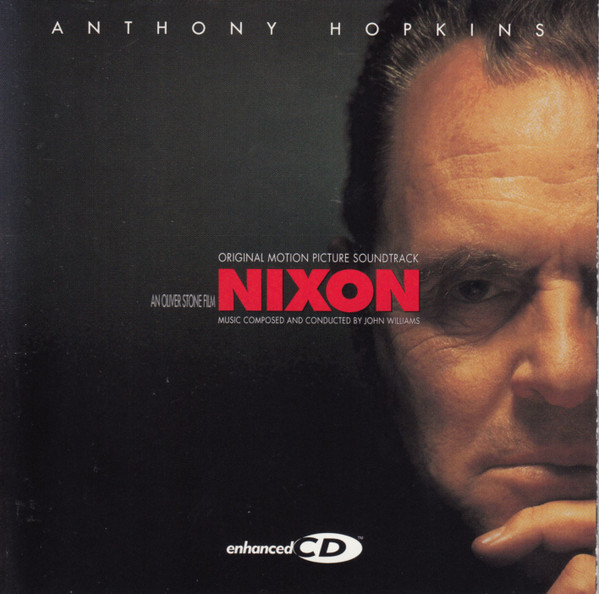
Original Motion Picture Soundtrack (1995) – CD
Illusion Records/Hollywood Records – 162 043-2
Album Produced by John Williams
Executive Producer: Budd Carr
Mastered by Patricia Sullivan Fourstar
Contains multimedia section featuring video interviews with John Williams and Oliver Stone
Awards and Nominations
68th Academy Awards
Nomination: Best Original Dramatic Score

In Williams’ Words
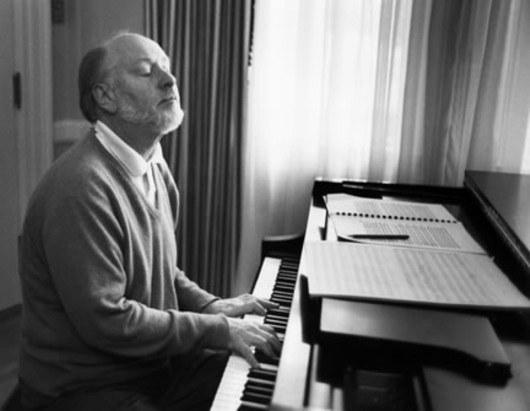
“Oliver Stone’s films are documentary in nature – at least the ones with which I have been associated with (JFK and Born on the Fourth of July). They are not so straightforwardly narrative…. There are flash-forwards and flash-backs in the middle of a scene and there may be some reference to meetings in China that took place years before or have haven’t even happened yet – right in the middle of a dialogue scene in the White House…. so we need to have music before, during and after these collages to sew everything together.
“[The score] is thematic, but in a more motivic kind of way… It’s full of contrast and difficulties. This side of the orchestra’s playing along in a sort of consonant sort of way, where you have this kind of Shaker/Quaker American roots solidity. And suddenly something else happens on the other side of the orchestra which diffuses that, a dissonant element that comes in.”
“Here in the film studio we regularly mix very advanced technological sound production sources with traditional acoustic instruments in a wonderful way. At the beginning of the film, as General Haig is approaching to have his meeting with Nixon in his private quarters, in an absolutely empty White House, you have orchestral music that accompanies that very sinister atmosphere in the music. But electronically, you also produce some explosions that are kind of low-end booms. This kind of thing where you almost don’t hear it but you feel it. Which is like a kind of napalm recollection of something in Cambodia that perhaps hadn’t even happened yet. It’s a kind of a pre-lap into the future and I think it can be very suggestive.” 1
Quotes and Commentary
“John Williams has really entered into the dark side of Nixon’s character but at the same time given him a grandeur which is important because, although Nixon could be mean and petty, he also had a grander theme to his life which John addresses in a classical score that is reminiscent, for me, of the feelings evoked by the music of Mahler – a composer that Nixon himself admired.” 2
“Richard Nixon’s character was present as a watermark in Born on the Fourth of July and JFK. So, when I decided to dedicate a biopic to him in 1995, John’s return was a must. The approach was more problematic, less obvious, firstly because Nixon’s character doesn’t have the poetry of Kennedy. Secondly, the film was heavilv dialogued and quite somber: manv interiors. many rainy night sequences. Like Howard Hunt of the CIA’S line, “Nixon is the darkness reaching out for the darkness.” I became aware of it during the editing, making John a paradoxical request, “Write me a dark music… but still, try to put a little light in it!” When it arrived, his score was like a character study, with blackness but also contradictions, or let’s say contradictory impulses. John explained to me that amidst a consonant orchestra, he was going to introduce a burst of dissonances, to translate the idea of being torn apart. He also adored the opening sequence: General Haig walks through an empty White House, at night, accompanied by an orchestra in which electronic instruments make rhythmic motifs like miniature explosions. As if there was an internal war within the White House… Nixon wasn’t a commercial success, but I would say it’s a critical one. I’m proud of it. But after ten ambitious full-length feature films in ten years, I was exhausted, as much by the hellish pace as by the violence of the critics towards me. Nixon thus marked the end of a cycle, in that, among other things, John and I have never worked together since.” 3
– Oliver Stone, writer and director

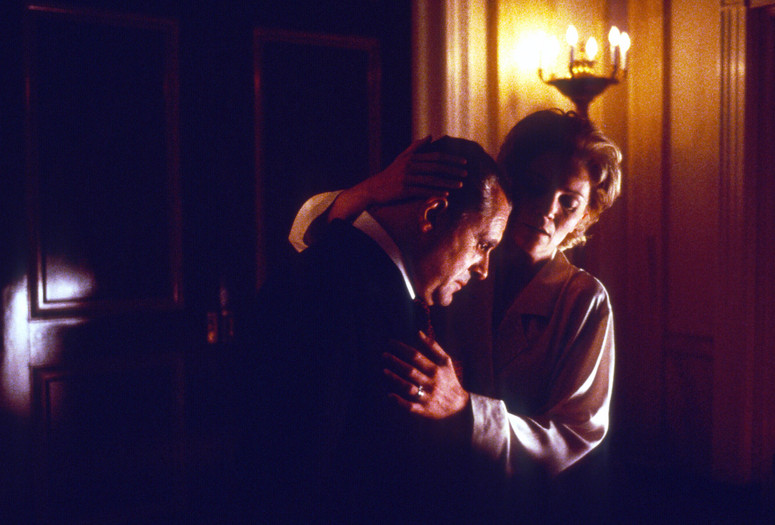
The balance of grim reality and hopeful idealization is reversed in Stone’s Nixon. During its even longer running time (221 minutes), the film achieves a feeling of buzzing overrepresentation for the title character, who hardly ever leaves the screen. Nixon’s score is far longer, more sustained in its musical arguments, and subject to more insightful motivic development. In tandem with Hopkins’s raw performance, music helps lay bare the thirty-seventh president’s personal demons and traumatic past. Yet the surfeit of characterization alludes to a lack deliberately structured into the very fabric of the film —a musical “hole” comparable to the one in JFK, but approached from the other direction, as surplus presence rather than absence. Overflow of personality contributes to the story’s tragic dimensions, the sense that the character is too big for the stage he is placed on. At the same time, it helps manufacture a broader narrative about the nature of historical representation. […] Williams’s musical characterization of Nixon is in line
with this combination of psychodramatic excess and refractive deconstruction. A glimpse at the inventory of recurrent musical materials of the score reveals a strikingly different pattern than for JFK. The president of this film garners no one single motto, but a spiraling collection of motifs and submotifs; his thematic identity is located at once everywhere and nowhere in the score. Much material originates from the thematic fount of the film’s trailer, which includes a specially composed overture that Williams later titled “1960s: The Turbulent Years” for the soundtrack album. With a large-scale ternary structure, “The Turbulent Years” inverts the film’s tripartite narrative structure. The film’s dramatic arc details Nixon’s struggles and failures in Acts I and III, and his rise to power in Act II. By contrast, the overture sandwiches its most tumultuous music between ookends of ambivalent aspiration. From “The Turbulent Years,” one may discern
the gestation of the aforementioned “napalm recollections”, along with a half dozen other motifs that range from cataclysmic to growling but noble to almost bucolic. In the film these particles attach to and develop alongside various details of Nixon’s career. Those motifs associated with “striving” are subjected to particularly elaborate development, their exaggerated rise/fall contours often set against ungainly chromatic harmonies. Yet, as with the “Prologue” from JFK, these musical ideas are not simply “themes for Nixon.” The fact that the source of the motifs refers to time period rather than the man himself illustrates the extent to which history, rather than just personality, is at stake in Williams’s score. 4
– Frank Lehman
Videos
The meeting with Mao Zedong | Nixon (1995) | Hollywood Pictures/Cinergi
Nixon Theatrical Trailer (featuring an original score by John Williams | 1995 | Hollywood Pictures/Cinergi
Interview with John Williams | Nixon – Original Motion Picture Soundtrack | Illusion/Hollywood Records | 1995
Brett Mitchell performs his original solo piano arrangement of ‘Growing Up in Whittier’ from Nixon
References
- “Interview with John Williams,” Nixon – Original Motion Picture Soundtrack, video segment, 1995 ↩︎
- “Interview with Oliver Stone,” Nixon – Original Motion Picture Soundtrack, video segment, 1995 ↩︎
- Liner notes for The Legend of John Williams boxset, Ecoutez le cinéma/Universal Music France, 2023 ↩︎
- Lehman, Frank – “Scoring The President: Myth and Politics in John
Williams’s JFK and Nixon,” Journal of the Society for American Music Volume 9, Number 4, 2015 ↩︎
Legacy of John Williams Additional Resources
. L.A. Studio Legends: Tim Morrison (podcast interview)
 The Legacy of John Williams