

Table Of Contents
- Film Details
- Music Credits
- Essential Discography
- Quotes and Commentary
- Videos
- Bibliography and References
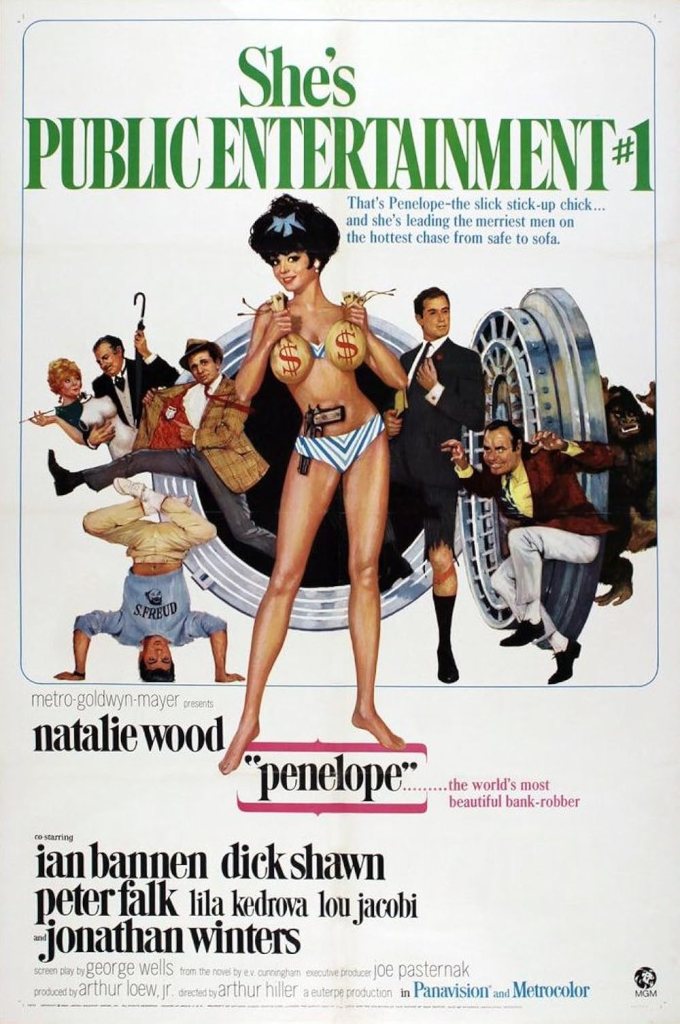
Film Details
Year: 1966
Studio: Metro-Goldwyn-Mayer
Director: Arthur Hiller
Producer: Arthur Loew, Jr.
Executive Producer: Joe Pasternak
Writer: George Wells, from the novel by E. V. Cunningham
Main Cast: Natalie Wood, Ian Bannen, Dick Shawn, Peter Falk, Lila Kedrova, Lou Jacobi, Jonathan Winters, Norma Crane
Genre: Comedy – Crime
For synopsis and full cast and crew credits, visit the IMDb page
Music Credits
Music Composed and Conducted by John Williams (credited as “Johnny Williams”)
“Penelope”
Music by Johnny Williams
Lyrics by Leslie Bricusse
Orchestra Manager: James C. Whelan
Librarian: Theodore E. Bergren
Orchestrators: Al Woodbury, James Bryant
Engineer: Thorne Noger
Recorded at M-G-M Scoring Stage, Culver City, California
Recording Dates: September 12, October 4 and 6, 1966

Essential Discography
Original Soundtrack Album and Expanded Reissues

Original Music From the MGM Film (1966) – LP
MGM Records – SE-4426 ST
Produced by Jesse Kaye
Re-recorded selections from the original score, arranged and expanded by the composer for album presentation
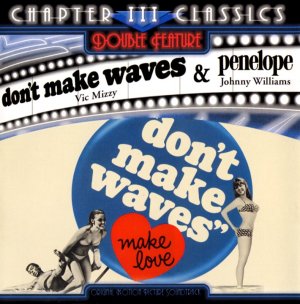
Chapter III Classics Double Feature (2000)
Chapter III Records CHA 1002-2
Reissue Producer: Amy Rosen
Executive Producer: Randy Gerston
First CD release of the 1966 OST album; also contains the soundtrack album reissue for Don’t Make Waves (1967) by Vic Mizzy

FSM Silver Age Classics (2004)
Film Score Monthly Vol. 7 No. 18
2-CD Limited Edition
Produced by Lukas Kendall
Music Score Remix by Michael McDonald
Digital Transfer by Doug Schwartz
Liner Notes: Jeff Eldridge
Premiere release of the complete film score recording + remastered 1966 OST album re-recording; also contains the soundtrack for the film Bachelor In Paradise (1961) by Henry Mancini
Quotes and Commentary
New York-born Johnny Williams got his first taste of musical life right in the family circle. (His dad was drummer in the Raymond Scott Quintet.)
By the time Williams was in his early twenties, he’d already earned his own spurs as pianist, composer and conductor.
Johnny has provided the musical savvy for many of the nation’s top pop singers. He’s made the TV scene with scores to such quality shows as “Checkmate,” “The Kraft Theatre” and “The Bob Hope—Chrysler Theatre.” Classical music buffs know him for his “Essay for Strings,” which has been performed by leading symphony orchestras.
But during the last few years, Williams has turned his attention primarily to Hollywood soundtracks. Among his numerous movie credits: “Diamond Head,” “John Goldfarb, Please Come Home,” “How to Steal a Million,” “Not With My Wife, You Don’t” and – of course – this delightful musical portrait of “Penelope.”1
– Biographic note on the 1966 soundtrack album
The slapstick romantic comedy Penelope stars Natalie Wood as a zany kleptomaniac who contesses her crimes to her psychiatrist. This wacky caper also stars an A-List of talent including Dick Shawn, Peter Falk, and Jonathan Winters.
Looking at the above original liner notes, what a kick to hear about Johnny Williams and his adventures in the swinging sixties. It’s even more mind-blowing to look at where he would go in later decades. Yes, Johnny Williams ultimately adopted the somewhat more refined moniker JOHN WILLIAMS – THE John Williams we know today as the composer of scores for some of the biggest movies of the twentieth century, including, all of the Star Wars films, Raiders of the Lost Ark, Close Encounters of the Third Kind, Superman, E.T., Jaws, Jurassic Park, and countless others.
He has been the recipient of numerous Academy Award nominations, with wins for Schindler’s List, Star Wars, and E.T. John Williams continues to inspire and awe his legion of fans into the new century and remains a major force in the film composing world.2
– Amy Rosen

The film’s principal weakness—its lack of a consistent tone—presented a dilemma for its composer: should he attempt to find a single musical approach that would work for the entire film, or “go with the flow” and supply music appropriate to each scene? John Williams opted for the latter course, supplying elegant source music for various parties and scenes in which Penelope Elcott models stylish Edith Head costumes, cartoonish action music for the slapstick, and heartfelt dramatic scoring for the occasional moments of genuine pathos.
For Penelope‘s title song, Williams re-teamed with Leslie Bricusse, with whom he had first worked on How to Steal a Million earlier the same year. Heard as a pop tune sung by male chorus over the main titles (and, briefly, over the end cast), Bricusse’s lyrics ask, “Who is Penelope?”—a question the characters in the film ask themselves with regularity, as they attempt to unravel the mysteries of the young woman’s psyche. Williams skillfully presents the title song in a variety of instrumental guises, most effectively as a love theme scored for oboe and strings.
Several other compositions in the score utilize the three-note motive associated with the name “Penelope” in the title song, lending the score a cohesiveness it might not otherwise possess.
Aside from the title song, the only other recurring melody in the film is one for salon proprietor and erstwhile blackmailer Madame Sadaba, a minor-mode tune with an Eastern European flavor. It is often scored for English horn to add an exotic tinge, with goofy electric piano interludes to underline the humor of the character.
Variety called Williams’s score “outstanding,” but The New York Times wrote that “Arthur Hiller’s shrill direction…is ripely emphasized by a cutie-pie rock ‘n’ roll musical score that all but leaps off the sound track.” 3
– Jeff Eldridge

Videos
Main Title sequence from Penelope | M-G-M | 1966
“To Bergdorf’s” scene from Penelope | M-G-M | 1966
Singers Stephan Van Dorn and Cassandra Nuss sight read John Williams’ title song for Penelope accompanied by pianist Mike Farrel | Video by Richard Kraft
Bibliography and References
. Audissino, Emilio – “Williams’ Early Years: Spotting the First Traces of Neoclassicism,” The Film Music of John Williams, University of Wisconsin Press, 2021
. Audissino, Emilio / Huvet, Chloé – “Irony, Comic, and Humor: The Comedic Side of John Williams,” The Palgrave Handbook of Music in Comedy Cinema, Palgrave-Macmillan, 2023
. Eldridge, Jeff – Penelope – Original Motion Picture Soundtrack liner notes, Film Score Monthly, 2004
Footnotes
 The Legacy of John Williams