

Table Of Contents
- Film Details
- Music Credits
- Essential Discography
- Awards and Nominations
- Quotes and Commentary
- Videos
- Bibliography and References
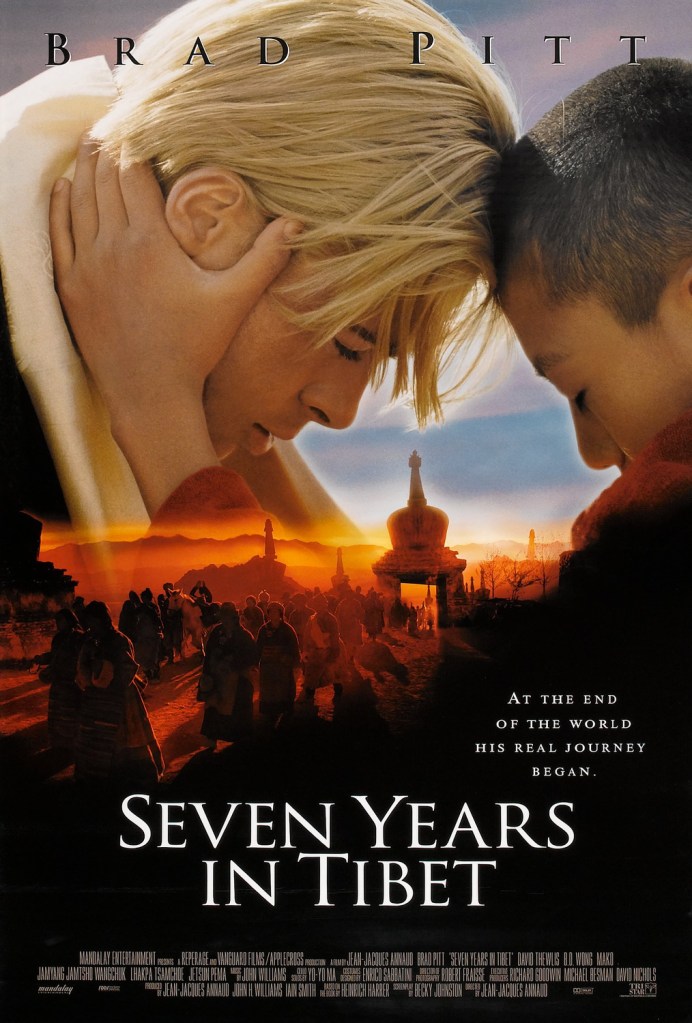
Film Details
Year: 1997
Studios: Tri-Star Pictures/Mandalay Entertainment
Director: Jean-Jacques Annaud
Producers: Jean-Jacques Annaud, John H. Williams, Iain Smith
Executive Producers: Richard Goodwin, Michael Besman, David Nichols
Writer: Becky Johnston, based on the book by Heinrich Harrer
Main Cast: Brad Pitt, David Thewlis, B.D. Wong, Mako, Jamyang Jamtsho Wangchuk, Ingeborga Dapkunaite, Lhakpa Tsamchoe, Jetsun Pema
Genre: Drama
For synopsis and full cast and crew credits, visit the IMDb page
Music Credits
Music Composed and Conducted by John Williams
Cello Solos by Yo-Yo Ma
Music Editor: Kenneth Wannberg
Scoring Mixer: Shawn Murphy
Assistant Engineers: Sue McLean, Greg Dennen
Scoring Recordist: Grant Schmitz
Technical Engineer: Patrick Weber
Music Preparation: JoAnn Kane Music Service
Orchestra Contractor: Sandy DeCrescent
Orchestrator: John Neufeld
Concertmaster: Bruce Dukov
Recorded at Sony Pictures Scoring Stage, Culver City, California
Recording Dates: July 25, 28, 29, 30, and 31, 1997

Essential Discography

Original Motion Picture Soundtrack (1998) – CD
Sony Music/Mandalay Records – SK 60271
Album Produced by John Williams
Mastered by Patricia Sullivan Fourstar
Executive Producer: Budd Carr

Original Motion Picture Soundtrack (2016) – Vinyl reissue
Music On Vinyl/At The Movies/Sony Classical – MOVATM086
2-LP limited edition of 1000 individually numbered copies on snow white vinyl
Selected Re-recordings

John Williams Reimagined (2024)
Warner Classics – 5054197942334
contains “Theme” From Seven Years in Tibet (Transcribed by Simone Pedroni for Cello and Piano)
Cécilia Tsan, cello
Simone Pedroni, piano

The Sound of Adventure (2025)
Prospero Classical – PROSP0039
contains “End Credits” From Seven Years in Tibet
Alexandre Castro-Balbi, cello
City Lights Symphony Orchestra conducted by Kevin Griffiths
Awards and Nominations
57th Golden Globes Awards
Nomination: Best Original Score – Motion Picture
40th Grammy Awards
Nomination: Best Instrumental Composition Written For a Motion Picture or Television (“Seven Years In Tibet”)

Quotes and Commentary
When I’m not making movies, I listen to music – mostly classical music.
The most enjoyable times in my life are therefore those occasions when I can blend both worlds in recording the music of my films.
I have a lot of admiration for people whose work lies at the crossroads of my two passions. If I believed in reincarnation, as the Tibetans do, my wish would be to come back as someone like John Williams, the composer and conductor, dividing my time between making music for films and music for its own sake.
I do not know whether the good fairies would endow me with the same versatility and talent, but we are allowed to dream. The fact is that for years I have dreamt of being able to place my images in the hands of John Williams. I rank him with Prokofiev and Nino Rota, for he is one of those rare people who has found the perfect marriage, the bloom of true reciprocity that develops between the orchestra and the screen.
During my childhood I spent ten years playing the violin. I practiced with great fervor in the hope that my bow would draw such perfect vibrations from my strings as to transport me into the intoxicating ecstasy of pure delight. Alas, the squawks and screeches always had the upper hand. After having shed many tears over my instrument, I am now moved to tears when i listen to the playing of those blessed with the grace.
I had a second dream: To meet Yo-Yo Ma…1

On several occasions, Peter Gelb, the head of Sony Classical, had whispered in my ear: “Yo-Yo Ma, the virtuoso cellist, adores your work. If the subject of one of your films were to lend itself, he’d be delighted to be a soloist on the soundtrack!” The idea went in one ear without going out of the other. The very same day the main theme was enshrined, I raised this possibility with John. He replied with a polite smile. “I’m not sure that a concertante solo cello, in front of the orchestra, is the best treatment for this theme…” I caught the ball on the fly. “Your score has to be a western take on Tibet. It has to tell us about Harrer’s feelings, or rather the way his feelings evolve. In this sense, the cello would be an ideal inner voice for Brad Pitt.” With infinite courtesy, he picked up on my obstinacy. “I take note of your idea. Let me check how it could work, technically.” A month and a half later, we were recording with Yo-Yo Ma.
For the first time, I deserted the London studios for the Sony Scoring Stage, one of the most beautiful recording studios in Hollywood, with Shawn Murphy behind the console. These few days spent observing John conducting the orchestra were a moment of grace, a magical interlude. My wife Laurence, a former violinist, sat just a yard away from Yo-Yo to better appreciate the depth of his low notes, his unique phrasing… Through his bow, Harrer’s soul was right there before us. At one point, John himself called his wife Samantha. “Something amazing is happening between Yo-Yo and this score. If you have time, come to the studio!” As the sessions went on, John’s music took shape, it swelled the image, carried it further, higher. It seemed as much inspired by the silent close-up gazes as by the vast snowy spaces…
The orchestra was the Tibetan landscapes; the cello Harrer’s inner self.
Through his writing, the maestro Williams produced a magical synthesis between the spectacular and the intimate. I had dreams of Asia; musically, John made them come true.2
– Jean-Jacques Annaud

No contemporary composer has done more to blur the barriers between absolute and film music than John Williams. With Jean-Jacques Annaud’s handsomely produced Seven Years in Tibet, the composer nearly destroys the distinction. The film stars Brad Pitt as Austrian mountaineer Heinrich Harrer, who fled to Tibet after being incarcerated in a prison camp during the Second World War, befriended the 11-year-old Dalai Lama and taught Western customs while receiving reciprocal instruction in Buddhism. Williams has adopted a classical-orientated approach for his score, assisted by the presence of fellow Sony recording artist Yo-Yo Ma (for whom Williams has composed a cello concerto). Obviously inspired by Arnaud’s visual storytelling style, the composer decided to be less narrative-specific than is customary in his scoring. This helps focus attention on Ma, whose spare, serious dialogues with the orchestra grace ten of the 14 tracks.
The principal thematic material is presented in the opening seven-minute suite. A composition destined to belong in the concert-hall repertoire, the structure of this piece is remarkable. The orchestra breaks into a sweeping introduction of the main theme, the tone reminding us that the film is at least partly informed by the epic spirit. Ma enters at 0’49”, performing the lyrical, minor-key main theme before presenting two secondary themes. After a brief return to the first theme, the orchestra and cellist introduce a major new theme at 3’42” (associated with Tibet and the Dalai Lama). A short hymn for brass and strings segues to a first theme conversation between piano and cello, before Ma offers several concluding remarks in a restrained cadenza.
One of Williams’s achievements in this score is his facility for employing modernisms while remaining melodic (the stark “Premonitions” is a notable exception). The brass section has been neglected for a change, but lovers of strings will not complain. Another atypical but welcome characteristic is an increased use of ethnic music (even including vocal quotations from the Gyuto Monks on two tracks). All told, Seven Years in Tibet is an excellent work and one which is likely to appear on the shortlist for this year’s Oscars. 3
– Gramophone Music Magazine
Videos
Seven Years In Tibet Music Featurette | Sony Classical | 1997
“Seven Years In Tibet” | Cécile Gruebler, cello | Sinfonieorchester Tifico conducted by Christof Brunner | 2017
“End Credits” from Seven Years In Tibet | Alexandre Castro-Balbi, cello | City Lights Symphony Orchestra conducted by Kevin Griffiths | 2021
References
- Jean-Jacques Annaud, Seven Years In Tibet – Original Motion Picture Soundtrack liner notes, Sony Music, 1997 ↩︎
- Jean-Jacques Annaud, The Legend of John Williams liner notes, Universal Music France, 2023 ↩︎
- Seven Years In Tibet soundtrack review, Gramophone Music Magazine, 1997 ↩︎
 The Legacy of John Williams