

La-La Land Records’ HOOK – The Ultimate Edition finally offers the definitive presentation of one of the most brilliant results of the artistic partnership between director Steven Spielberg and composer John Williams. In this essay, we’ll go deeper into what makes this score particularly special and unique in the Spielberg/Williams canon.
Another Awfully Big Adventure
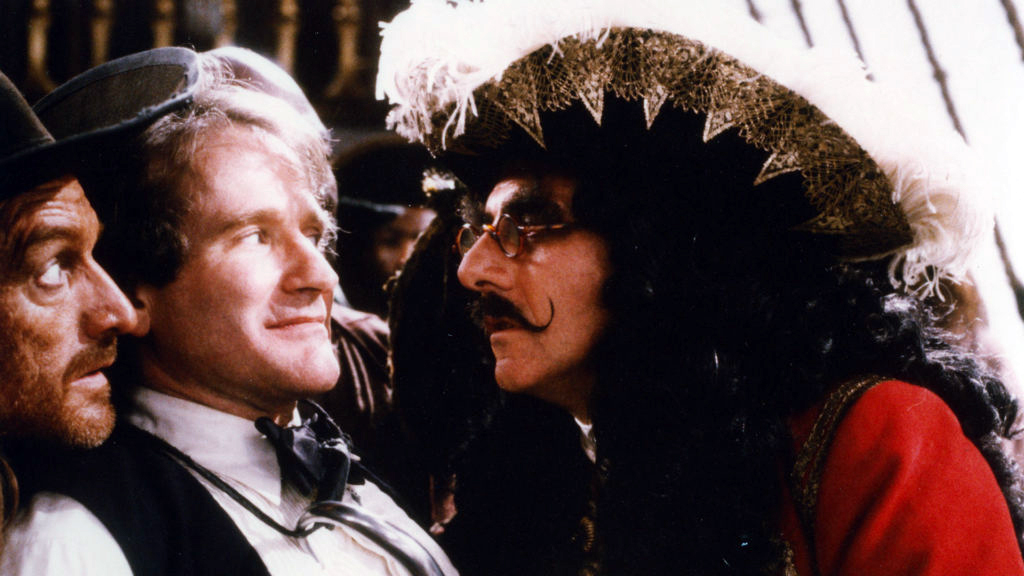
Based on characters and situations created by English writer James M. Barrie, Hook retells the myth of Peter Pan and his arch-nemesis Captain Hook as a sequel of sorts to the classic novel, imagining what might happen if Hook had survived his original fate in the mouth of the giant crocodile, and what if Peter Pan decided to leave Neverland and grow up as an adult. Working from a script by James V. Hart, director Steven Spielberg uses his own great deal of imagination and visual flair to bring to life the fantastical tale of Captain Hook kidnapping the children of Peter Pan and wanting a rematch with his opponent, now a middle-aged workaholic lawyer named Peter Banning who’s forgot Neverland and who now must regain his own imagination in order to save his kids.

Hook is a sort of center of the hourglass in Steven Spielberg’s filmography, coming after his first forays into more adult-oriented subjects (The Color Purple, Empire of the Sun, Always) and immediately before the blockbuster success of Jurassic Park and especially the critical acclaim of Schindler’s List, which would initiate a new phase of both his creative and personal life. The director was originally planning to make a film based on the novel by James Barrie in 1985, up to the point where a script was completed and pre-production officially launched, with a release date set for 1986 from Paramount Pictures. Spielberg pulled the plug on the project during production of The Color Purple, which also coincided with the birth of his first son, Max. Now a father himself, the director felt he was ready to leave worlds of fantasy and pursue more personal projects in which he would flex a different set of creative muscles. When the script of Hook landed on his desk in 1989, Spielberg saw recurring themes in the filigree of the story (which at its core deals with absent fathers, the responsibility of being a parent and what happens when childhood is forgotten and becomes just a distant memory) and settled to make it his next film after completing production on Always, thus finally fulfilling his long desire of making a Peter Pan movie.

The Never-Musical
Supported by a cast of A-list Hollywood stars (Robin Williams as Peter Pan, Dustin Hoffman as Captain Hook, Julia Roberts as Tinkerbell and Bob Hoskins as Hook’s sidekick Smee) and high-end production values (including British theater set designer John Napier working as visual consultant), Spielberg tried to fulfill another of his longtime wishes as a director, i.e. to make a full-blown movie musical, with an original score by his trusted collaborator John Williams (the 1986 Peter Pan project was also supposed to be a musical, but it never went beyond a very preliminary phase). When opportunity arose to insert a few musical numbers into the narrative of Hook, Spielberg asked John Williams to start writing songs for a handful of scenes. The composer turned to his friend and frequent collaborator Leslie Bricusse to pen lyrics to the songs: the duo had just finished working on songs for the Christmas comedy Home Alone (1990), which just turned into a phenomenal success and would receive two Academy Award nominations for Best Original Score and Best Original Song (“Somewhere In My Memory”).

Williams and Bricusse wrote three songs (“We Don’t Wanna Grow Up,” “Mothers,” and “Pick ‘Em Up”), but soon came the request to add more musical numbers throughout the film, which Spielberg saw as the ideal platform to indulge his love for complex choreographed dances and virtuosic camerawork, as he’d already shown with the “Jitterbug Contest” dance sequence of 1941 and the opening title number of Indiana Jones And The Temple Of Doom. Composer and lyricist wrote six more songs (“Childhood,” “Low Below,” “When You Are Alone,” “Believe,” “Stick With Me,” “The Never-Song,”) for which demos were made and pre-recordings planned, but at one point in the filming process (apparently after Spielberg and Williams reviewed footage of one of the filmed songs) the decision was made to cut most of the planned musical numbers, with only three songs surviving the final cut, albeit in reduced form. However, all work didn’t end up in a drawer: as the third disc of La-La Land Records’ Ultimate Edition finally reveals, a lot of the melodies of the songs found a new life in Williams’ final orchestral score, becoming part of its incredibly rich tapestry of themes and motifs. Perhaps mainly for this reason, Hook is one of the most tuneful and lyrical scores of John Williams’ long and very distinguished filmography, in addition to being one of the composer’s most orchestrally ambitious and expansive.
The Composer Who Grew Up
In 1991, John Williams was already the most sought-after and prestigious name working in the Hollywood film music scene, having written music for 6 of the 10 top-grossing movies of all time until then, including such cinematic touchstones as Jaws, Star Wars, Raiders of the Lost Ark and E.T. The Extra-Terrestrial. In addition to being a household name for movie-goers, the composer became a familiar face for television audiences across the US, appearing as the principal conductor of the Boston Pops Orchestra in the famous Evening At Pops tv program on PBS, often performing his own film music as part of the concert programs. During his stint as music director of the Boston Pops (1980-1993), John Williams brought film music to a new popularity among audiences, certainly helped by the global success of the films he was attached to, like his collaborations with Steven Spielberg and George Lucas, but nonetheless offering the audience a platform in which they could gain a stronger appreciation for the orchestral, symphonic sound that was at the core of many beloved film soundtracks. In addition to his own film pieces, Williams often showcased music composed by the previous generation of Hollywood’s maestros such as Erich Wolfgang Korngold, Alfred Newman, Max Steiner and Bernard Herrmann, thus acknowledging the legacy he inherited and that he brilliantly pushed to a new level of popularity and acceptance.

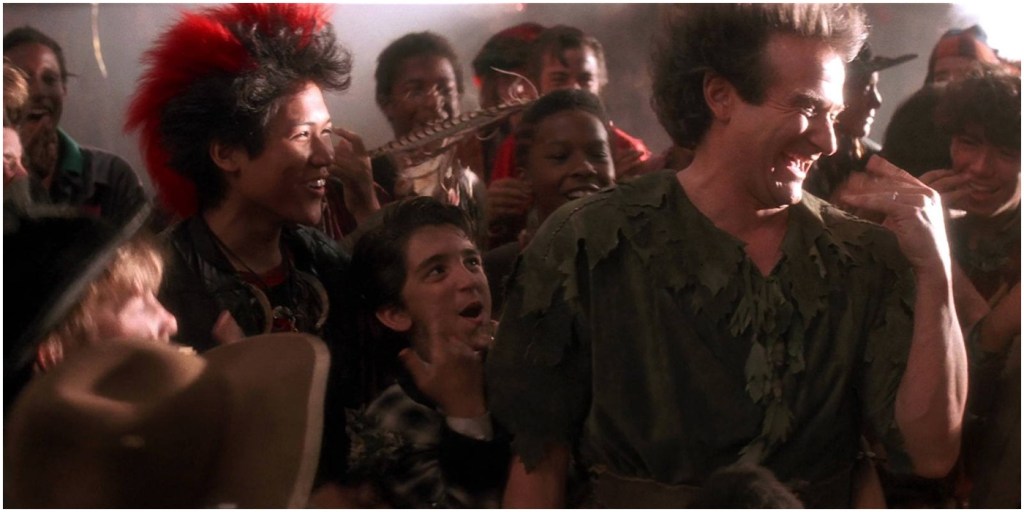
It’s in this scenario that John Williams wrote the score for Steven Spielberg’s Hook in 1991. As pointed out, once the idea of turning the film into a fully-fledged musical was discarded, the composer took part of the material originally written for the songs and reworked it into the components of the leitmotivic fabric of the score, perhaps one of Williams’ richest and most dense theme-wise, with a total count of 12 major themes and motifs appearing throughout the musical narrative. Some of the songs’ melodies like “Childhood,” “Stick With Me,” “Believe” and “Mothers” remained virtually intact in the orchestral score, with Williams adding more material, including themes for Peter Pan, Tinkerbell, the Lost Boys and a few more motifs attached to Captain Hook.

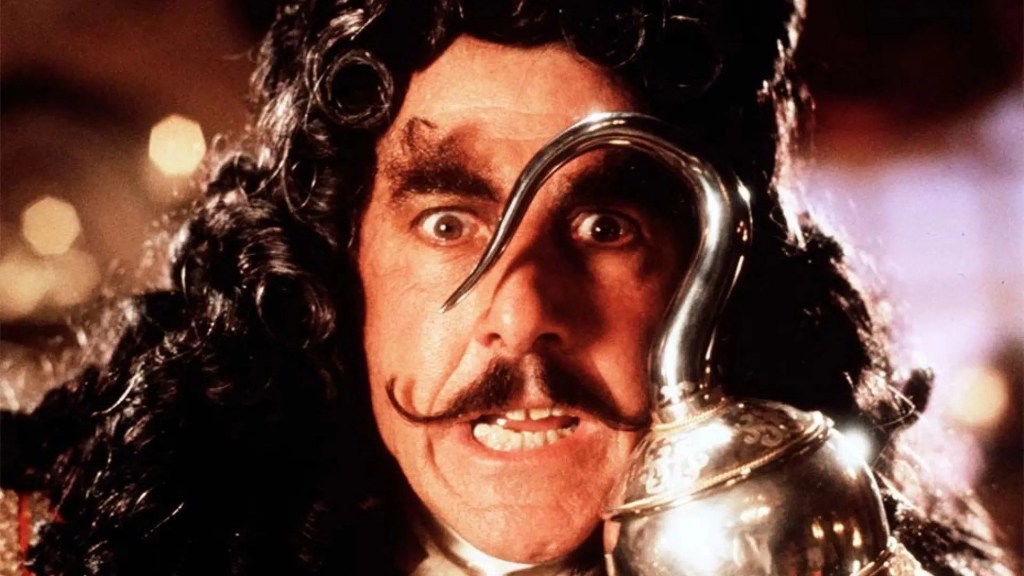
The audience got a first taste of the score in June 1991, when a teaser trailer for the film debuted in movie theaters attached to some of the most popular blockbusters of that summer, six months prior the film’s release. The 90-second promo features a tracking shot of a yellow-tinged treasure map upon which a magnifying glass reveals miniature drawings of pirate ships, mermaids, crocodiles and other visual elements evoking the world of Peter Pan; the glass then reveals the main cast of the film and Steven Spielberg’s directing credit. The light goes through the lens and the map burns, transitioning to a close-up of the magnifying glass now part of Captain Hook’s arm and then gets substituted with the eponymous weapon, after which the film’s title and the main credits appear.
The teaser trailer features no dialogue and virtually no other sound element other than John Williams’ gloriously swashbuckling music, which in a little more than a minute condenses all the adventure, excitement and wonder that the film itself promises to the audience. The piece would also turn as the curtain raiser of the original soundtrack album released on the Epic Soundtrax label in November 1991, a few weeks before the film’s premiere, becoming a true musical welcome to the world of Hook for fans and admirers of John Williams all across the globe.

Musical Happy Thoughts
If Williams’ music for the Hook teaser encapsulates the sense of wonder of the film in a perfectly shaped musical miniature, it’s throughout the actual 2-plus hour score that the composer offers a monumental showcase of his innate sense as a musical storyteller. With a masterful treatment of the various themes and motifs associated to characters and locations and impeccable command of orchestration, Williams’ score for Hook shines with lyricism, adventure and sheer symphonic brilliance, accompanying Spielberg’s film with a rich musical narrative that has few comparisons even in the composer’s long and distinguished filmography (John Takis’ brilliant liner notes for La-La Land’s Ultimate Edition brilliantly summarize the dense thematic vocabulary of the score). The progression of the story and the characters’ evolution are perfectly complemented by the development and variation of the thematic components, in this case incredibly rich and malleable, often referring to more than just a single character or idea, and also working as emotional guidelines to the story’s overall concepts. Williams balances flamboyant theatrical gestures (such as the introduction of Captain Hook after Peter arrives at Neverland, aka “Presenting the Hook”) with a more intimate, almost nostalgic character supporting the story’s more personal elements like loss of innocence (“The Face of Pan”) and the responsibility of adulthood. The various themes are masterfully interwoven in the musical tapestry, creating an enchanting storybook feeling especially during some of the film’s most inspired sequences (“Peter Remembers and The Flying Sequence”).
Another major aspect that gives the score its unique character is the balletic nature of many moments, especially scenes involving elaborate and densely choreographed action scenes. In these sequences (“The Arrival of Tink,” “The Lost Boy Chase,” “From Mermaids to Lost Boys,” and the whole non-stop action galore of the “Ultimate War” cues), Williams’ music is effervescent and busy, nodding with affection both to the tradition of the great Ballet Russes scores of Stravinsky and Prokofiev and the stirring swashbuckling scores by Korngold and Steiner for Errol Flynn adventure films like The Sea Hawk, Captain Blood and The Adventures of Don Juan (the latter already explicitly referenced in the 1985 Spielberg-produced kids adventure film The Goonies), but ultimately sounding 100% John Williams. All throughout the score, Williams displays his uncanny dexterity as a symphonic composer, showcased also through the talents of the many brilliant Los Angeles-based instrumentalists playing in the orchestra contracted by Sandy DeCrescent, including Louise Di Tullio, Geri Rotella and Jim Walker (flutes), Jim Thatcher (French Horn), Jim Self (tuba), Malcolm McNab (trumpet), Tom Boyd (oboe), Phil Ayling (cor anglais), Dom Fera (clarinet), Mike Lang (piano), to name just a few (the full musicians roster is included in the booklet of La-La Land’s release).
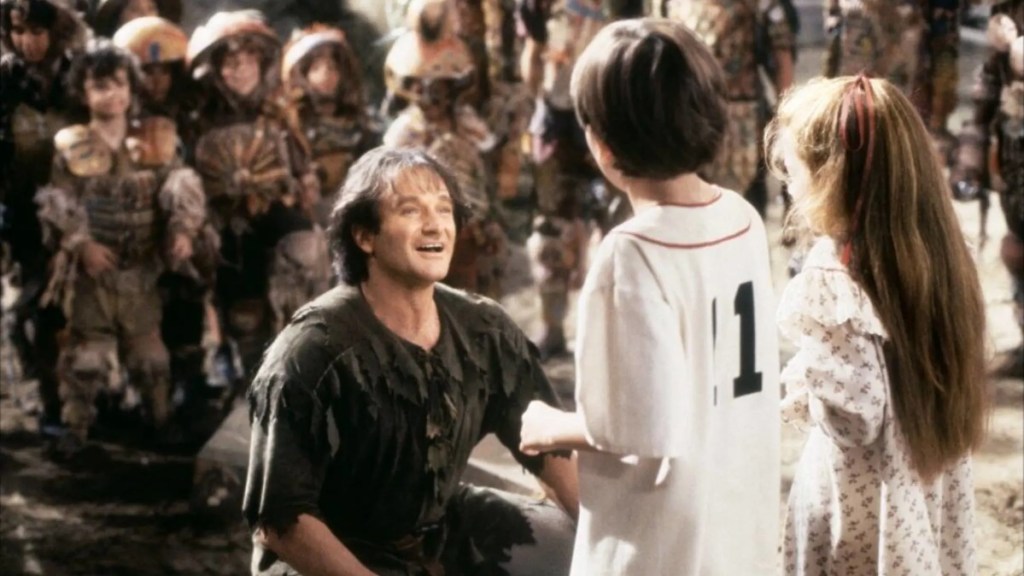
But where John Williams’ music for Hook ultimately finds its most profound sense of accomplishment is perhaps in the composer’s unrivaled ability to take the listener back to their fondest memories of childhood and to evoke a beautiful sense of magical innocence. Whenever writing music for films dealing with childhood and imagination (E.T., Home Alone, Harry Potter), Williams has always been able to reach the depth of human soul, i.e. our attachment to the joys that childhood hopefully has to offer and that we bring with ourselves into adult life, trying to remember what made everything special and even magical in our daily lives. John Williams effortlessly translates those feelings into music that, as in the case of Hook, continues to speak to listeners of all ages and will inspire more people in decades and even centuries to come to take care of their happy thoughts.
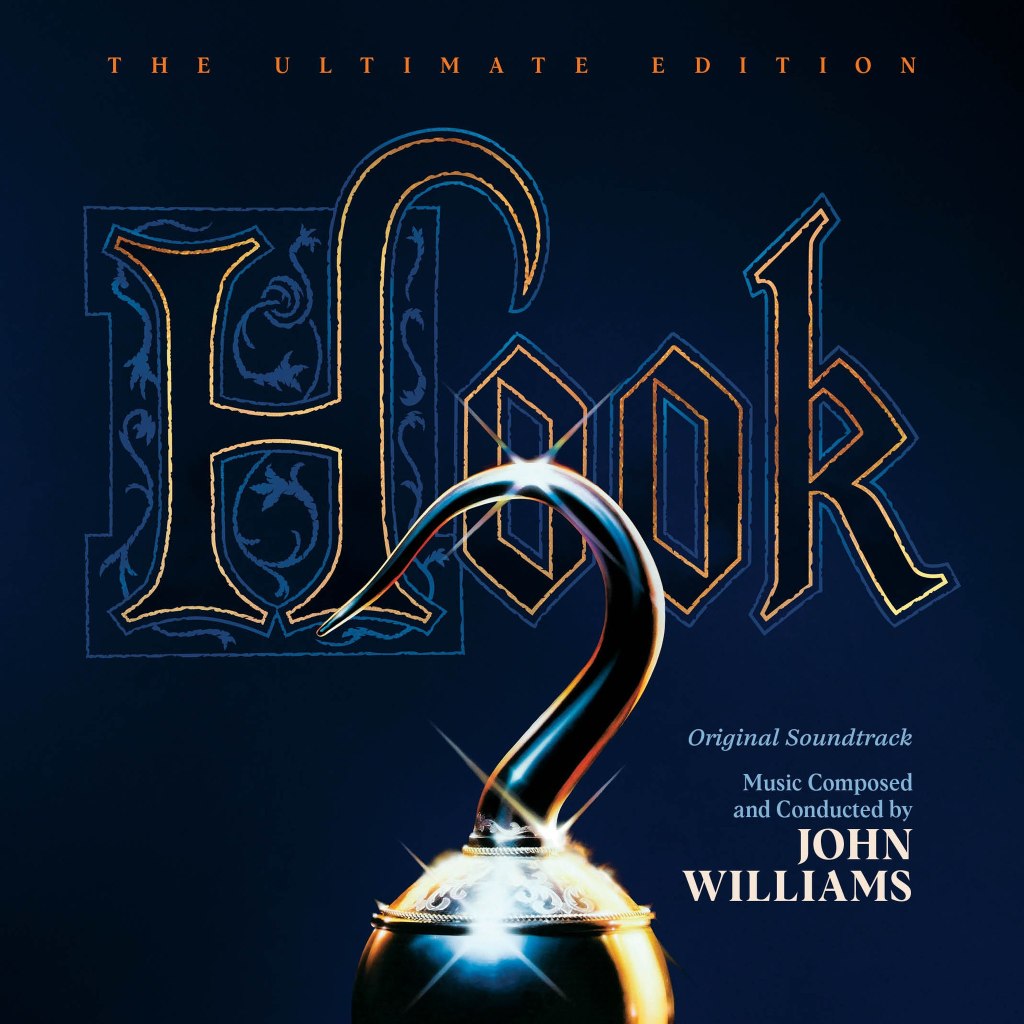
HOOK – THE ULTIMATE EDITION
Music Composed and Conducted by John Williams
Limited Edition of 5000 Units
Now Available at La-La Land Records
 The Legacy of John Williams