

The Berlin Philharmonic Plays John Williams
Stéphane Denève, conductor
June 5-7, 2025
35+ years ago, my teenage self was taking its first steps in discovering all the joys of loving music. And when I realized that I had been a John Williams fan for my whole (albeit still short) life, I found out that — even without knowing it — I was also being introduced to the music of all the great masters of the past and those amazing musicians keeping it alive.
Back in the late 1980s, there wasn’t a more respected conductor/orchestra combo than the late Herbert von Karajan and his mighty Berliner Philharmoniker. Even after his passing, the orchestra remained one of the finest in the world. Around that time, I developed this fantasy of the Berliner Philharmoniker playing John Williams’ music under a top conductor. By early 1992, after the release of Hook, this fantasy evolved into having a multi-movement suite from that score, with Claudio Abbado conducting—he was the then music director in Berlin after succeeding Karajan; he also had a very close relationship with the London Symphony Orchestra, having been its principal conductor during the mid-1980’s.

(Picture: Unitel / Berliner Philharmoniker)
Over the decades, we’ve been fortunate to witness the progressive recognition of John Williams’ relevance by the most important musical institutions all around the world. It included the acceptance of his music into the canon and its addition to the repertoire of the finest orchestras — including several occasions when some of his most famous themes were performed by the Berliner Philharmoniker. But not until 2021 did the orchestra give its full attention to Williams’ music when the composer made his Berlin debut. One may say that, at that point, the dream I had in my youth was surpassed with Williams himself conducting what may be considered the best orchestra in the world. As exhilarating as those three concerts in 2021 were, I was still longing for that experience when the best orchestra would have one of the world’s finest conductors in a concert of Williams’ music.
With that in mind, I was somehow able to come to terms with the unfortunate news that the greatly anticipated return of John Williams to Berlin had to be cancelled due to health issues. What helped me cope was knowing he’d be replaced by one of the finest conductors of his generation: Maestro Stéphane Denève. Most Williams’ fans will know him from the 2024 joint concerts with the Saito Kinen Orchestra in Japan, but Denève has been championing Williams’ music for much longer and they have regularly teamed up over a decade since they first met in 2007. One of the pieces the conductor has toured with is the composer’s first Violin Concerto (1974/76), with soloists Gil Shaham and James Ehnes (having recorded the piece with the latter). From the film repertoire, Denève has often performed the suite from The Book Thief (2013) along with other and lesser-known pieces. He is also a strong promoter of new music and music education, having held directorship of several orchestras in Europe and currently holding the music director position with the St. Louis Symphony and the New World Symphony Orchestra.
As much of a let-down as the absence of John Williams was, we were in for some artistry of the highest order in Berlin, with someone at the helm who clearly loves and respects the music of John Williams.
The program started to a rousing performance of one of Williams’ favourite curtain-raisers, the brilliant Sound The Bells!. Composed over Memorial Weekend 1993, it was first intended as a celebration of the Japanese Royal Wedding occurring during that summer’s Boston Pops Orchestra tour to Japan. Originally scored for brass and percussion alone, the composer revised it to its present form for full orchestra, making it the perfect piece to welcome audiences to such a fantastic music hall as the Berlin’s Philharmonie. Despite the ties to Japan, the music is distinctively Williams’ own, and in no way ethnically sounding – in fact, back in 1993, Williams mentioned how the ceremonies were filled with silence, so far removed from this festive little overture of sorts. Denève showed right from the moment he energetically entered the stage that we would be in for high adrenaline performances.
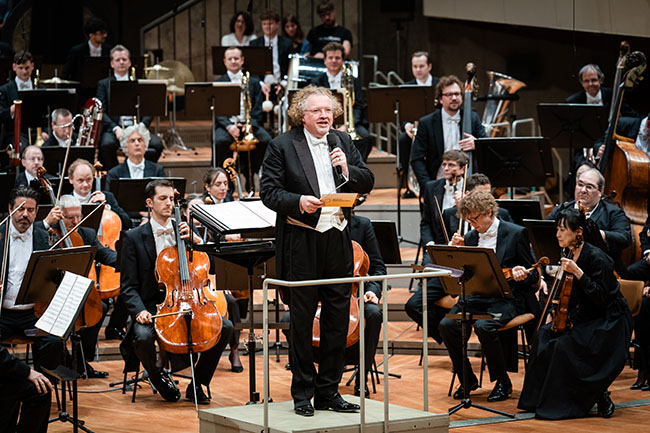
The bells did sound loud and clear and made the most beautiful and brilliant noise. As Sound the Bells! had its final resounding bang, and the ovation faded away, Denève quickly moved on to an energy-filled “March” from Superman (1978) that pulled all the stops without an apparent breathing pause for anyone present (musicians and audience alike).
(Picture: Stephan Rabold)
After this grand opening of the procedures, the guest conductor (making his Berlin debut) turned to the audience, addressing it in fluent German. Besides a couple of John Williams quotes during the evening that were in their original English, Denève always spoke in German. I should say I’m not a fan of presentations from the stage; I much prefer going through the notes in the program book. Often, I find those little speeches boring and they tend to drag for too long. (I once attended a performance of Mahler’s 4th Symphony, fortunately one of his shorter symphonies, in which the introduction took almost as long as the piece…). But Denève was always concise, directly to the point and light-hearted, with the adequate touches of good humour. Not only an excellent conductor, he is also the best of hosts. As he introduced the program, he read the audience a short message from John Williams:
Dear friends,
I want to thank each one of you for gathering here tonight to hear your great Berlin Philharmonic. As you probably know by now, a health issue prevents me from being with you at this time. I regret this more than I can tell you as I have looked forward to these concerts. In the meantime, I am very grateful to my friend Stéphane Denève for conducting this program in my absence. As you also know, the Berlin Philharmonic sets the standard for the entire world. Their wish to perform a program of my music brings with it the highest honor a composer can receive. In this spirit, I would like to wish all of you a joyous evening of music.
John Williams
It should be noted that, right from the start, it became apparent that the tempos chosen by Denève were somewhat faster than the composer’s own. This in no way detracted from the articulation or intonation. It is a clear tribute to the highest level of artistry of all those involved that these performances never sound rushed but perfectly articulated, without anyone playing over anyone else’s music. At the same time, the respectful and yet unique readings by Denève allowed for details usually buried under the symphonic texture to become more apparent, either on the orchestration lever or even in the phrasing.
That was the case of the following selection, the dark toned “Night Journeys” from Dracula (1979). A favourite of Williams’ very close friend, the late André Previn, the piece has been gradually getting more love from performers. In fact, Dracula isn’t a forgotten masterpiece: Williams conducted it live in the 1970’s in London, and John Mauceri did champion it during the 1990’s with the Hollywood Bowl Orchestra. More recently, both the “End Title” and “Night Journeys” (the later both on its concert setting and the reworked version for violin and orchestra) have been getting regular performances. Yet, due to the obscurity of the film, it remains a lesser-known gem in the Williams canon. Denève’s reading brought forward some details that have remained in the background under other conductors’ leadership, while keeping the adequate dark gothic overtones of the doomed romance. Prominent timpani by Wieland Welzel made the performance even more dramatic as it came to its close. These artistic liberties don’t make one reading superior to another, just different, enriching the catalogue of recorded performances. One will certainly remain indebted to the conductor for providing his own fresh vision of the work.
Another example of such a unique reading was the opening piece of the second half of the concert, another overture-like favourite of the composer, “The Flight to Neverland” from Hook (1991). While most of the time Denève went for a brisker tempo, this time he slowed it down – and that made the first section of the piece more stately and slightly more menacing, signalling the presence of the nefarious Captain James Hook, or more exhilarating with Peter Pan’s flying music. On the other hand, the second half sounded like a song without words, to such an extent that I could actually hear the lyrics the late Leslie Bricusse originally wrote, something I had never experienced before while listening to this beautiful melody so reminiscent of the dreams of youth.

(Picture: Stephan Rabold)
These two selections were certainly highlights of the evening, but going back to the grand finale of the first half, the audience was presented with an absolutely rousing performance of the suite from E.T. The Extra-Terrestrial (1982). The score has been represented in concert often by the “Flying theme” or by “Adventures on Earth,” the concert distillation of the finale. Not until 2009 did Williams prepare the E.T. and Eliott harp music for concert, naming it “Stargazers,” and only in 2011 was the present suite with the three-movement structure introduced. “Stargazers” has been widely performed on its own, and the revised “Three Million Light Years from Home” (i.e. the music accompanying the opening of the film) has had a few performances too. But the actual suite has only returned in 2023, for the Japan concerts (though in abridged fashion), replacing the final movement, “Adventures on Earth,” by “Flying,” making it, in this writer’s opinion, a less pleasing presentation. Back then, it fell on Denève to bring the suite to life with the Saito Kinen Orchestra, but this time, with the mighty Berlin Philharmonic, the original 2011 concept for the suite was fully realized. The orchestra played with gusto and the opening was made even more suspenseful and magical with the presence of the organ (as we were sitting near it, one could feel the surroundings vibrate to its sound … simply amazing). From the mysterious and menacing opening, the orchestra moved to the delicate “Stargazers” with a superb performance on the harp by Marie-Pierre Langlamet, accompanied with emotion and understanding especially by the woodwinds and horns, and ended with the beautiful duet of harp and flute over a soft orchestral backup. This is music that makes time stand still, just like a Satie miniature, and Denève was able to convey that to the extent that no sound could be heard from the audience and, as the piece ended, a reverential silence followed. Denève’s conducting style enabled the audience to fully understand when to clap, allowing them to enjoy everything to the last note as it softly faded away inside the Großer Saal of the Berliner Philharmonie. The finale “Adventures on Earth” started in a glorious fashion, and just as gloriously it went through a faultless and emotional performance that was bound to leave tears in many an eye. When it concluded with a thunderous coda that brought the house down, the astounding brass section of the orchestra delivered the most vigorous reading of the final fanfare, again with strong punctuation by the timpani, delicately balanced by the piccolo. With this the first half of the concert ended, earning the performers the first of several (and very well deserved) standing ovations.
As mentioned above, the second half started with “Flight to Neverland,” the first piece of what would be a succession of highlights. During a humorous introduction by the conductor, the basses and low brass assisted him by playing those menacing notes that describe the shark from Jaws (1975). Denève then proceeded to “Out to Sea and The Shark Cage Fugue.” Again a fast-paced but always crisp reading with lots of detail, and the musicians offered an amazing exercise in counterpoint, always retaining the nautical flair to it.
For the two Harry Potter selections, Stéphane Denève again got a bit of help when introducing the pieces, this time from celesta player Sarah Tysman. After that he turned to the orchestra for renditions of “Fawkes the Phoenix” and “Harry’s Wondrous World”, doing (magical) justice to what the conductor called an ’official hymn to the wizarding world’.

(Picture: Stephan Rabold)
In the 2021 concerts, with John Williams conducting, one of the absolute highlights of the evenings was Bruno Delepelaire performing the solo part of the emotional Elegy for Cello and Orchestra (1997). As Denève told the audience, the composer was so profoundly moved by the principal cellist’s playing that, when returning to Berlin, he wanted to gift him with something new to play. This surprise came in the form of a brand-new revision of “Sayuri’s Theme” from Memoirs of a Geisha (2005), the multi award winning score that is very close to Williams’ heart and that, just like the Elegy, had the solo parts originally written for superstar cellist Yo-Yo Ma. This new version showcases the soloist even more – while the original focused on the thematic material associated with Sayuri, this new one cuts halfway through into more cello-oriented material, quoting passages from “Chiyo’s Prayer” and “A Dream Discarded.” To sum it up, the new version not only brings the soloist front and centre, it also becomes more intimate, more of a chamber piece than one for large symphony orchestra. Delepelaire’s playing was exquisite, breathing sensuality and sensitivity, with the proper sorrow that inhabits the soul of the character in both novel and film. (As a side note: This is more true for the novel, as in the film we are treated with a sort of happy ending.) A moment of reverential silence was followed by thunderous applause and a well-deserved standing ovation for this breathtaking performance.
There is no anthology concert of John Williams that can miss Star Wars. This is his magnum opus, his own Ring Cycle, that — just like Wagner’s Ring — took decades to complete. (Even though, unlike Wagner, Williams had no idea he would put his final notes on the paper more than four decades after the Star Wars saga had started). The three chosen selections represented the old and the new in the saga, starting with “March of the Resistance” from The Force Awakens (2015), followed by “Luke and Leia” from Return of the Jedi (1983) and concluding with the majestic “Main Title” from A New Hope (1977). Even though the orchestra always showed its commitment and excitement towards the music it played, the players reached their peak with these selections. The excitement could be felt like electricity in the air, and understandably so: Despite this writer being there mainly for the music, the cross-cultural impact of Star Wars is omnipresent. Most of the people in the Philharmonie, either on stage or in the audience, belonged to a generation that grew up with Star Wars. And dare I say it, what contributed most to the enduring success of the trilogies has always been John Williams’ music. As for the performances themselves, they ranged from the athletic and breathtaking to the beautiful and delicate — mainly in the gorgeous horn and flute solos as was duly pointed out by maestro Denève during the ensuing standing ovation. As the conductor simply put it when he introduced these three pieces: “The Force is with them!” Enough said.

(Picture: Stephan Rabold)
Had the concert ended right there, this would have been a stellar presentation of Williams’ music and a stellar debut of Denève at the podium of one the most venerable orchestras in the world. But we still had three encores. Concertmaster Noah Bendix-Balgley took the stage as Stéphane Denève returned to the podium for a heartfelt performance of the theme from Schindler’s List (1993). One of Williams’ most famous and most often performed pieces, it could easily be dismissed as just another run-through, but it certainly wasn’t. For my taste, I like it to hear it at a more deliberate tempo yet the whole performance was tremendously powerful with great intonation from the soloist. (I wonder how many dry eyes were there in the hall after the performance, and yes, another standing ovation). A joyous, youthful “Raiders March” (1981) followed, and the final encore was the now mandatory “Imperial March” from The Empire Strikes Back (1980). After the Vienna concert in January 2020, I haven’t been able to listen to this powerhouse of a march the same way. Since then, no other performance seems, at least to the ears of this writer, to have achieved the same level of energy, but if any orchestra can contend, it certainly is the Berliner Philharmoniker. So Darth Vader’s March closed the most wonderful evening of music in an amazing performance.
Earlier, I used the word ‘faultless’ quite freely, but there is of course no faultless performance, let alone a live one. There were little things here and there. But these were the inevitable slips that happen even to the best of the best. The orchestra performed with the most amazing vibrancy and belief in the music, and all of that showed in their body language and excitement and their obvious commitment to the performance at the highest level. As did Stéphane Denève, a champion of Williams’ music. We might be used to seeing the Berliner Philharmoniker perform the core symphonic repertoire with both gusto and respect (and some not so core but at least accepted by the stricter critical circles). However, they approached the music on this delightful June evening in the exact same way. There were no flashy lights, no video projections of any sort, no funny costumes and no comedian playing the host. Instead, we had the music alone, performed at the highest level of artistry and with absolute respect. Denève, as we all know, is highly appreciative of Williams’ music, and that always shone through. Especially when he lovingly held the score to his chest, thus diverting all the applause to the music itself.

(Picture: Stephan Rabold)
As we left Berlin, the uniquely combined sound of the Berliner Philharmoniker and its amazing hall remained in my ears and in my heart. As I write down this recollection, the video of the concert is already available at the Digital Concert Hall for all to enjoy, but for now I’ll hold to the actual experience of what was indeed, as predicted by the absent composer with typical modesty, a joyous evening of music.
Special Thanks to the Berlin Philharmonic Press Office for their kindness and precious collaboration.
The Berlin Philharmonic Plays The Music of John Williams
Stéphane Denève, conductor
Bruno Delepelaire, violoncello
PROGRAM
- Sound the Bells
- “March” from Superman
- “Night Journeys” from Dracula
- Symphonic Suite from E.T. the Extra-Terrestrial
I. Three Million Light Years from Home
II. Stargazers
III. Adventures on Earth
– Intermission – - “The Flight to Neverland” from Hook
- “Out to Sea/The Shark Cage Fugue” from Jaws
- “Fawkes the Phoenix” from Harry Potter and the Chamber of Secrets:
- “Harry’s Wondrous World” from Harry Potter and the Philosopher’s Stone:
- Sayuri’s Theme from Memoirs of a Geisha
Bruno Delepelaire, violoncello - “March of the Resistance” from Star Wars: The Force Awakens
- “Luke and Leia” from Star Wars – Return of the Jedi
- “Main Title” from Star Wars, Suite for Orchestra
ENCORES - “Theme” from Schindler’s List
Noax Bendix-Bagley, violin - “The Raiders March” from Raiders of the Lost Ark
- “The Imperial March (Darth Vader’s Theme)” from Star Wars: The Empire Strikes Back
 The Legacy of John Williams