The following is a brief excerpt from my forthcoming biography, John Williams: A Composer’s Life (out on September 2 from Oxford University Press, but available for preorder now and already out in ebook form).
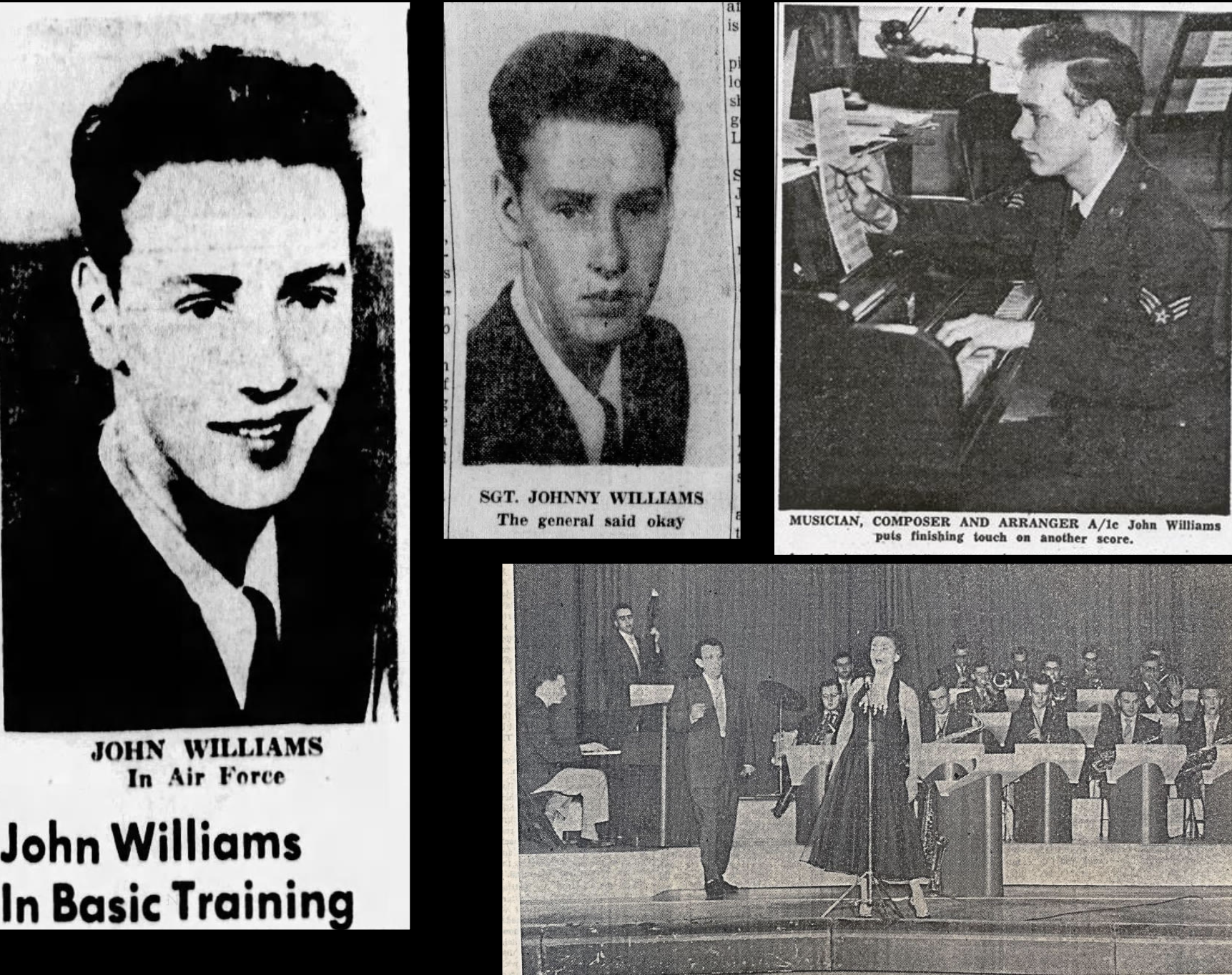
In December 1950, John Williams abruptly interrupted his college education and enlisted in the United States Air Force—a decision that would have profound ramifications in his life and musical career. It meant, for one thing, that he would never actually attain a college degree. But he would argue that his time in the bands and barracks of the USAF bases in Arizona, Newfoundland, and California gave him a greater education in arranging music as well as understanding brass and wind instruments (particularly) than any conservatory. These four years also crystallized his strong sense of old-fashioned patriotism, his personal discipline, and his penchant for marches and musical pageantry.
(This excerpt comes from Chapter 3 in my book, “Leaving Home: 1951–1956.”)
***
John was assigned to Davis-Monthan Air Force Base in Tucson, Arizona, where he joined the 775th Air Force Band, along with several of his friends from back home—like John Bambridge, Jr., who was a year older and a graduate of Van Nuys High. Bambridge was an “absolute class A woodwind player,” John said, and his father was a classical tuba player who played in the Warner Brothers orchestra; John Bambridge, Sr., actually produced a few recordings of his son’s trio—which included John—at Radio Recorders in Hollywood, not for commercial release but just for fun. Bambridge, Jr., was studying at Juilliard when he, too, enlisted in January 1951—and he proved an invaluable young teacher on John’s journey toward composing.
The Air Force encouraged cadets to take classes at the University of Arizona, which John did throughout the year he was there. He discovered that Arthur Olaf Andersen, a composer from Rhode Island who wrote what John regarded as the definitive book on harmony, was head of the music theory department. So John took composition lessons with Andersen, showing him the piano sonata and a few other pieces. “What I got from him was some encouragement,” John said. “That’s pretty much all.” In March, Leonard Bernstein came through town on a tour with the Israel Philharmonic, and John saw the great American conductor for the first time in a concert at the university auditorium.
John was still playing trombone, but “he had ruined his chops over-practicing, and he’d crack a lot of notes,” said Bill Peterson, a trumpeter and graduate of San Bernardino High who arrived at Davis-Monthan at the same time. “He never practiced the thing except in the band rehearsals. We went out every day to take the flag down: the band marched, they took the flag down, we came back—we were done for the day.” John, Peterson, Bambridge, and Mel Pollen all palled around in the barracks when they weren’t playing music for parades or dances for enlisted men or officers—and in their free time, jazz. Peterson and John saw An American in Paris when it came to town, then went back to the barracks where John played George Gershwin’s dreamy “Love Is Here to Stay” from the film.
Music continued to dominate John’s life. “He was attuned to everything that was going on,” said Peterson. “I remember practicing one day, something out of a book, and it was a note that was tied to another note. He heard me play that as he walked by my room, and he came back and said, ‘You’re late getting off that first note.’” There was an open-air band shell and amphitheater on base that had a stage with a spinet piano, and John was given a key. While his friends went to play tennis or swim, John would go over to the open-air auditorium—with temperatures often in the 100s—wearing his formal fatigues. Peterson would gather him at lunchtime: “I’d knock on the door, and it would open . . . and by this time he was down to his skivvies.” Walking back from the amphitheater to the chow hall one day, Peterson asked John what he was working on all those hours, and John simply pumped his ring finger up and down: “That.”
The L.A. friend group would often pile into a car and drive home on weekends, where John would take a lesson with [Robert] Van Eps and come back to the base with a composition assignment, something eccentric like “a piece for six clarinets.” John had so many good players at his disposal that the only limit was his imagination. “He just wanted to soak it all up,” said Peterson, “now.” John later lamented how the Korean War would soon be eclipsed in America’s cultural memory by the war in Vietnam, its many sacrifices too easily forgotten, but one of its unique qualities was the influx of highly skilled musicians. “All these conservatory kids came running out,” said John, avoiding combat by opting into the band program like he did, “and we had in my barracks all these kids that were all future symphony orchestra players. I would ask someone, ‘How do you play that trill on a flute?’ and he would show me. So I perhaps had a better school than I would have had if I had been able to go to Juilliard.”
John was specifically learning orchestration for band—only woodwinds, brass, and percussion—and in that, the most influential teacher he had was his friend, John Bambridge, Jr. “He would write wind stems all the way down,” John said, drawing a vertical line with his finger, “if they were in sync with the brass stems. Which you wouldn’t normally do—I mean, it’s something that a kid would do. But it gave me a visual concept of these divided sections. [Bambridge] and I were practically roommates in the Air Force, and I learned so much about voicing and harmonization from him. I think he taught me more about band arranging than anybody.”
Bambridge’s father took a shine to John, and—with some kind of prophetic sight—recognized his writing potential. He gifted John a copy of Frank Skinner’s 1950 book Underscore, the composer’s technical guide to film scoring. For some reason the old man gave it, not to his son, “who was more advanced than I,” but to John Williams. “And it’s with me forever, and my debt to him is great, because I studied it.”
***

You can order John Williams: A Composer’s Life from Oxford University Press or most other major booksellers. It’s also available to order as an audiobook.