Audio-only version:
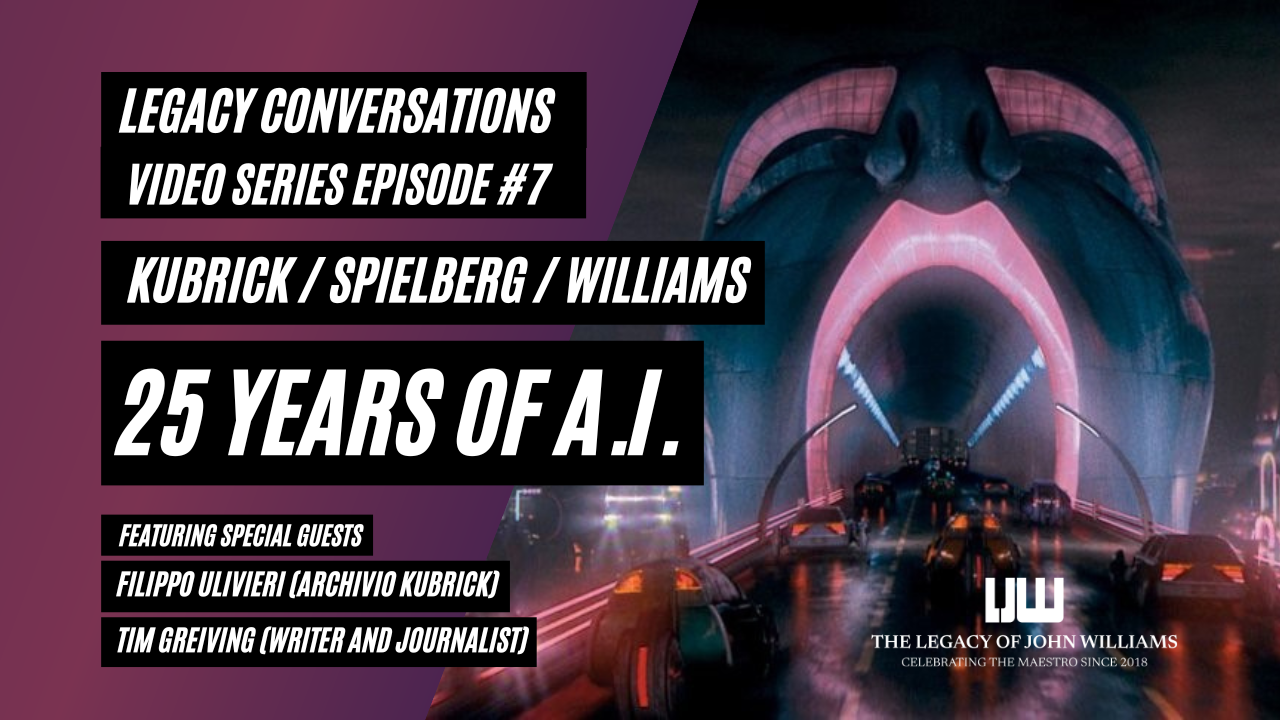
The Legacy of John Williams presents a new installment of its “Legacy Conversations” series, this time also available in video format: a look back to Steven Spielberg’s sci-fi epic A.I. Artificial Intelligence, the project long-gestated for decades by genius director Stanley Kubrick and that was meant to be a collaboration between the two legendary filmmakers.

In 2026, A.I. Artificial Intelligence celebrates its 25th anniversary since the release in theaters and it’s time for a proper re-evaluation. The film always had ardent fans and defenders, but when the film was released in June 2001, the overall consensus was to consider it, if not a failure, at least a missed opportunity, a sentiment that was shared by a good portion of both from film critics and the general audience. A.I. was indeed a mild box office success and received a lot of mixed reviews. Many commented on the impossible marriage between the aesthetics and the philosophies of two very different directors, who were considered at the opposite spectrum of each other. The fact Spielberg inherited the project immediately after Kubrick’s death propelled a sense of sacrilege from film purists and fueled the prejudices that Spielberg trivialized Kubrick’s original dark and pessimistic vision with his own penchant for sentimentalism.

Yet Kubrick and Spielberg actively collaborated on the project for almost two decades, almost immediately after Kubrick acquired the rights of the short sci-fi story on which the film is based (Supertoys Last All Summer Long by Brian Aldiss). Kubrick was fascinated and deeply interested in the themes at the core of Aldiss’ short story (the advancement of robotics and the idea that sentient machines would be undistinguishable from human beings) and used it as the starting point on which he wanted to build a much more ambitious and sprawling science-fiction epic tale, not unlike the way he did with Arthur C. Clarke’s The Sentinel, which inspired his sci-fi groundbreaking opus 2001: A Space Odyssey. As he continued to develop the screenplay, in the mid-1980’s Kubrick inquired Spielberg – whom he met during the filming of The Shining in 1980 – to get his own ideas and feedback, feeling that he was more in touch with some of the story’s themes and ideas, which started to include also fairy-tale elements to the point where Kubrick considered to turn it into a sci-fi version of Carlo Collodi’s Pinocchio.

The two filmmakers started a long collaboration mainly through endless phone conversations and exchange of notes via fax, bouncing story ideas and visual concepts to each other. At one point, Kubrick felt Spielberg was better suited to direct the film and offered him the director’s chair while he would’ve acted as the film’s producer. Spielberg bounced back saying Kubrick should’ve been the director while he would have been the producer, as he felt that Kubrick was so deeply entangled with the development of the film that no other director could have made justice to his own vision. The two directors kept on collaborating on the project throughout most of the 1990’s, with Kubrick still trying to crack the right screenplay together with several different writers (Ian Watson, Sara Maitland, Bob Shaw) while working with concept illustrator Chris Baker a.k.a. Fangorn to develop the film’s visual style. In the late 1990’s, Kubrick hit pause on work for ArtificiaI Intelligence to start pre-production on another decades-long obsession: the adaptation of Arhur Schnitzler’s 1926 short novel Traumnovelle, which would’ve become Eyes Wide Shut. The plan was to direct and produce Eyes Wide Shut (his first film in 12 years) and then follow up with A.I. Artificial Intelligence immediately after, but Kubrick’s untimely death on March 7th, 1999 let the project once again in an unfinished state after almost two decades of development, joining the list of other unrealized Kubrick’s projects such as Napoleon and Aryan Papers.

A few months after the passing, Kubrick’s family offered A.I. Artificial Intelligence to Spielberg, asking him to finally bring it to life as close as Stanley would’ve wanted. Spielberg accepted the daunting challenge, inheriting tons of preparatory material—hundreds and hundreds of pages that included scripts at various different stage of development, notebooks, concept drawings and illustrations and set off to make A.I. as his own next film. The director wrote the screenplay himself – his first film script since 1977’s Close Encounters of the Third Kind – using mostly the story material as developed by writer Ian Watson, who worked for years with Kubrick, and figuring out the structure of the film as close as Kubrick was envisioning it. The film was fast-tracked into production in 2000, with Spielberg assembling his usual team of trusted key collaborators (including composer John Williams), with a release date set by Warner Bros. for the summer of 2001, the year of Kubrick’s timeless masterpiece. Casting then-child star Haley Joel Osment as the main character David was another Spielbergian touch, as the director was notorious to have a unique penchant for working with very young actors and get outstanding performances from them. The film ended up being a unique confluence of two directors who are perhaps at the polar opposite, but found an ideal match on the ground of this fascinating, complex, ambiguous and even problematic project. While there are many aspects on which Spielberg and Kubrick differ deeply, they always shared the same level of commitment and almost faith to the art of film-making, therefore A.I. became something more than a collaboration, but a sort of impossible synthesis, or hybrid, of both directors’ personal obsessions and ideas at the core of their work.

As the world received it in June 2001 just a few months before the tragic events of September 11th, A.I. Artificial Intelligence became immediately a topic of endless and often polarizing conversations among film buffs and fans of both directors. While some rejected it vehemently – often with spikes of animosity toward Spielberg, accused of over-sentimentalizing the subject – others were instead spellbound by the film’s personality and style. As the years went by, some of the initial critics mellowed their feelings toward the film and some even completely reassessed it—the most notorious 180° came from popular UK film critic Mark Kermode.

A.I. found a second life on home entertainment release, regular TV showings and streaming platforms, building a cult status among Spielberg aficionados. The film’s themes – from artificial intelligence itself to climate change, environmental concerns and a hyper-technologized society fully dependant on machines – started to become more and more relevant as the years went by and a new audience connected to it perhaps more personally and directly than it happened in 2001. Spielberg kept talking fondly on the overall experience and about his friendship with Stanley Kubrick whenever asked about this film throughout the years (even as recently as during the promotion of Disclosure Day), saying that the film is first and foremost an homage and a tribute to his friend, defending some of the film’s more divisive aspect such as the third act of the film and taking full responsability about the overall final outcome.

John Williams’ score is certainly one of the elements that was more unanimously praised in the first place and continues to remain among the all-time favorites of many of his admirers. Williams composed a fascinating and diverse work that accompanies the film with glacial introspection and subdued colours during the first act, using eerie electronic textures, space-cold string adagios and lonely piano fragments, but then becomes more varied and colorful as it follows the odyssey of little mecha David (Haley Joel Osment), adding elements of minimalist-inspired writing that perfectly marries the film’s overall aesthetics, but also a profound, heart-wrenching lyricism which enhances David’s yearning to become a real boy until the final fulfillment of his destiny. Williams also pays homage to some of the Kubrick-ian music aesthetics throughout the film, nodding to some of the director’s musical choices as heard in 2001: A Space Odyssey such as Khachaturian and Ligeti, but also interpolating a brief quote from the waltz of Der Rosenkavalier by Richard Strauss, which was mentioned in some of the drafts of the screenplay by Kubrick and his writers. Williams collected a nod to the Academy Award for A.I. as Best Original Score (he was also nominated for Harry Potter and the Sorcerer’s Stone), but ended up losing to Howard Shore’s fiery score for The Fellowship of the Ring.

In this in-depth conversation hosted by editor Maurizio Caschetto, film historian Filippo Ulivieri (manager and curator of ArchivioKubrick.it) and writer/journalist Tim Greiving (author of John Williams – A Composer’s Life) delve into the film’s incredibly complex genesis and development, while assessing the final film’s own merits and the key role of John Williams’ score. Both Ulivieri and Greiving are scholars on the subject and dived deep down the immense amount of material housed at the Stanley Kubrick Archives in London in order to recreate the most accurate chronology of the overall creative process by Kubrick and Spielberg and research deeply a project that brought together two masters of modern cinema.
Many thanks to Filippo Ulivieri and Tim Greiving for their time and generosity.
Visit Archivio Kubrick – The Definitive Online Archive On Stanley Kubrick
Website: https://www.archiviokubrick.it/english/index.html
YouTube Channel: https://www.youtube.com/@filippoulivieri
Visit Tim Greiving’s website to remain updated on his writings, book signing events and upcoming appearances:
https://timgreiving.com/